Chapter 2 — Closer to Reality
Core Thesis
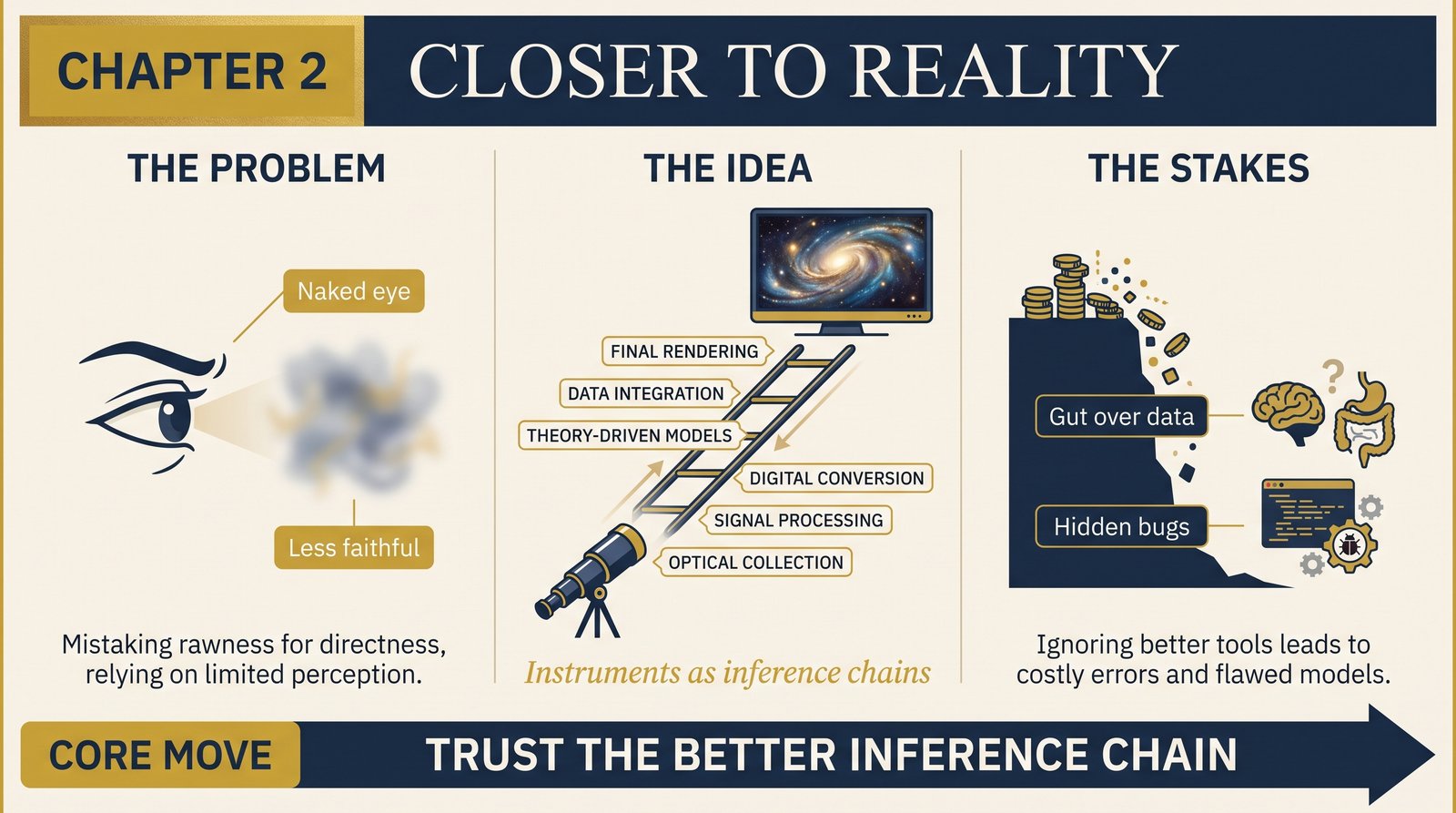
Telescopes, interferometers, and computer-processed data do not distance us from reality — they bring us closer to it than unaided senses ever could. Perception itself is theory-laden inference from raw signals; instruments are simply better inference chains, built from better theories. Seeing a galaxy in processed false-color imagery is more direct, not less, than seeing a smudge by eye.
The Problem It Solves
The intuition that "directly observed" means "more real" — and its corollary, that science's reliance on instruments and interpretation makes its objects suspect. Deutsch inverts it: all observation is indirect. The brain constructs the visual field from nerve impulses using inborn and learned theories; a camera-plus-software chain differs in quality, not kind. Once that's accepted, the laboratory's exotic entities have the same claim to reality as tables.
Key Episode
Deutsch's night at the Texas McDonald Observatory: "looking" at a galaxy through an instrument chain — mirror, sensors, processing, screen. Every photon his retina received was manufactured by the display; not one came from the galaxy. Yet the observation was more faithful — corrected for atmosphere, amplified beyond retinal sensitivity — than any unaided look could be. The self is always in a "virtual-reality chamber" built by the brain; science swaps in better renderers.
The Shift
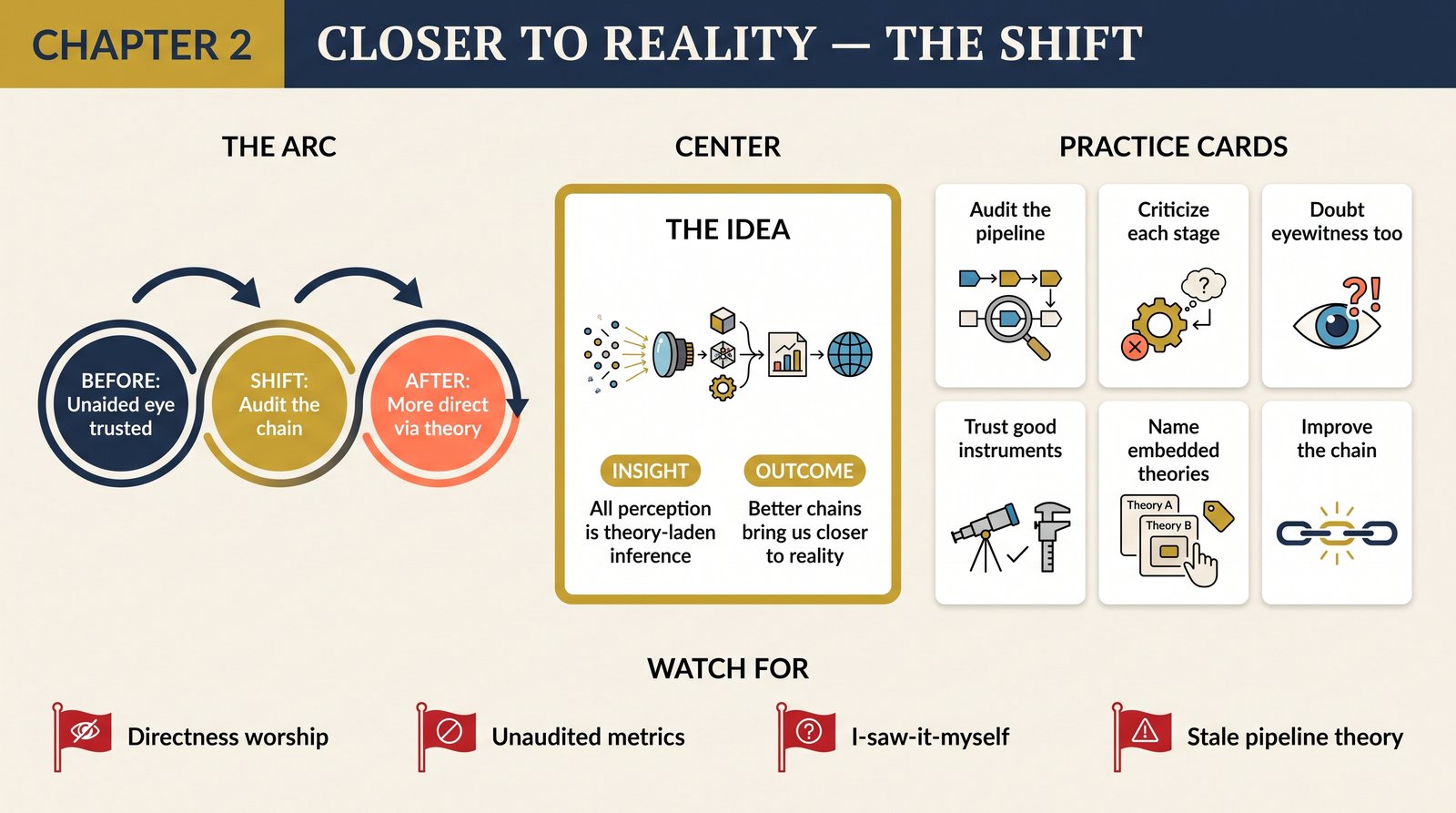
From authenticity-of-the-unaided-eye to fidelity-of-the-explanation-chain. What makes an observation good is not proximity but the quality of the theories in the chain from reality to awareness. This dissolves the "observable/unobservable" boundary that instrumentalists lean on — quarks and quasars differ from chairs only in chain length.
Critiques & Rivals
Constructivists take theory-ladenness the other way: if perception is constructed, reality-talk is naive. Deutsch's reply: construction from reality's signals via criticizable theories is precisely what contact with reality is — fallible, improvable, real. Van Fraassen's empiricism (believe only the observable) founders on the arbitrariness of where "observable" ends.
Modern Application
Trust dashboards over gut walks — if the pipeline's theories are good. The lesson cuts both ways: instrumented perception (metrics, monitors, models) can be more direct than intuition, but only as good as the inference chain, so audit the chain: what theories does each stage embed, and when were they last criticized? "I saw it myself" deserves the same audit — the brain's pipeline has known bugs (bias, salience, memory rewrite).
Key Terms
- Theory-laden observation — all perception is inference via theories
- Virtual-reality chamber — the brain's rendered model of the world
- Inference chain — the theory-bearing path from reality to awareness
Key Quotes
"We never perceive anything directly. All our external experience is virtual reality... generated by our own brains."
"Telescopes... are rungs on a ladder of theoretical interpretation which reaches down to the true, unseen reality."
Reflection Questions
- Which "direct" impression of yours deserves the same skepticism you give to dashboards?
- What theories are embedded in your key metrics pipeline — and who criticizes them?
- Where do you privilege eyewitness over instrument out of mere intuition?