Chapter 10 — Revolutions as Changes of World View
Core Thesis
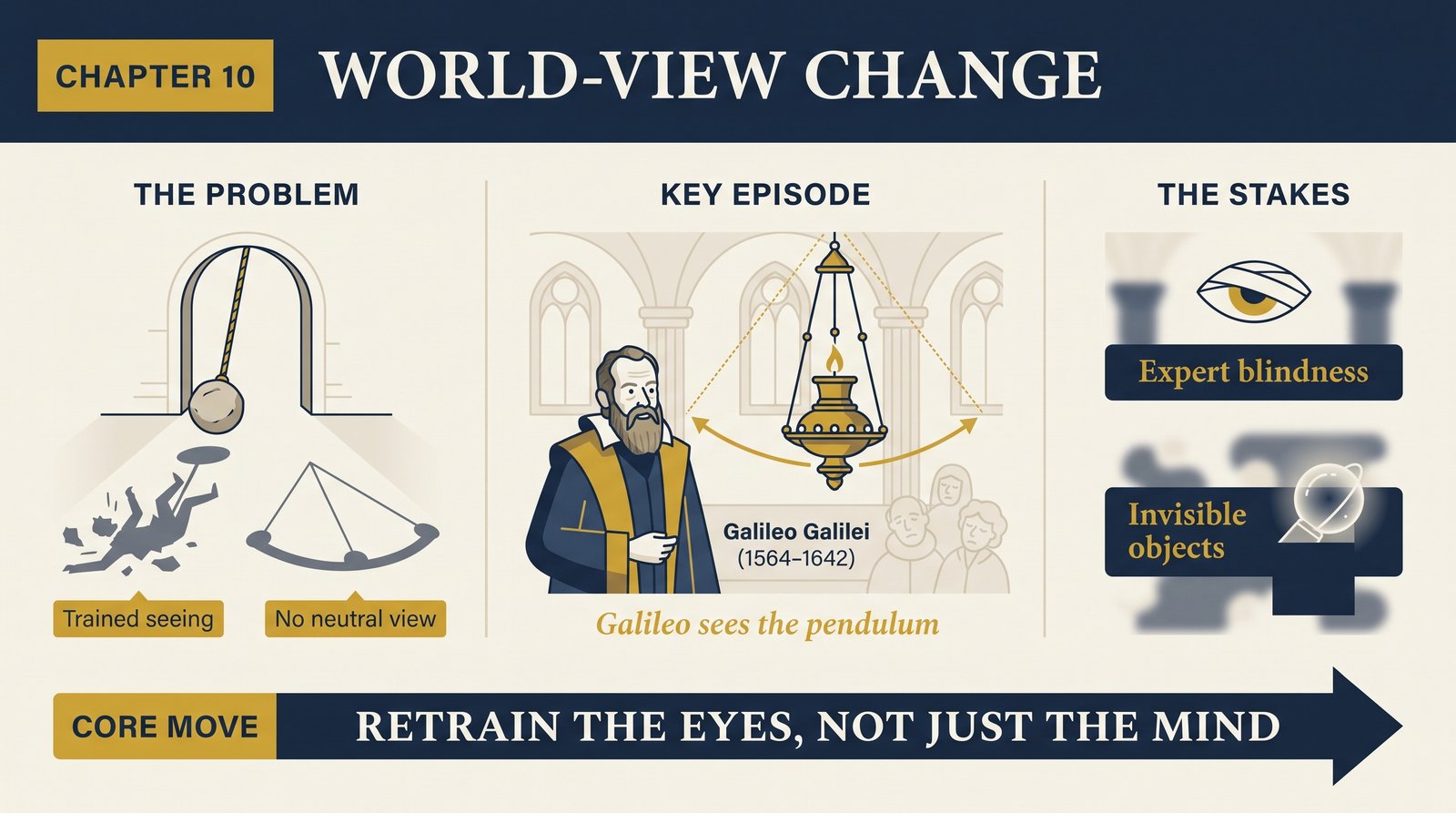
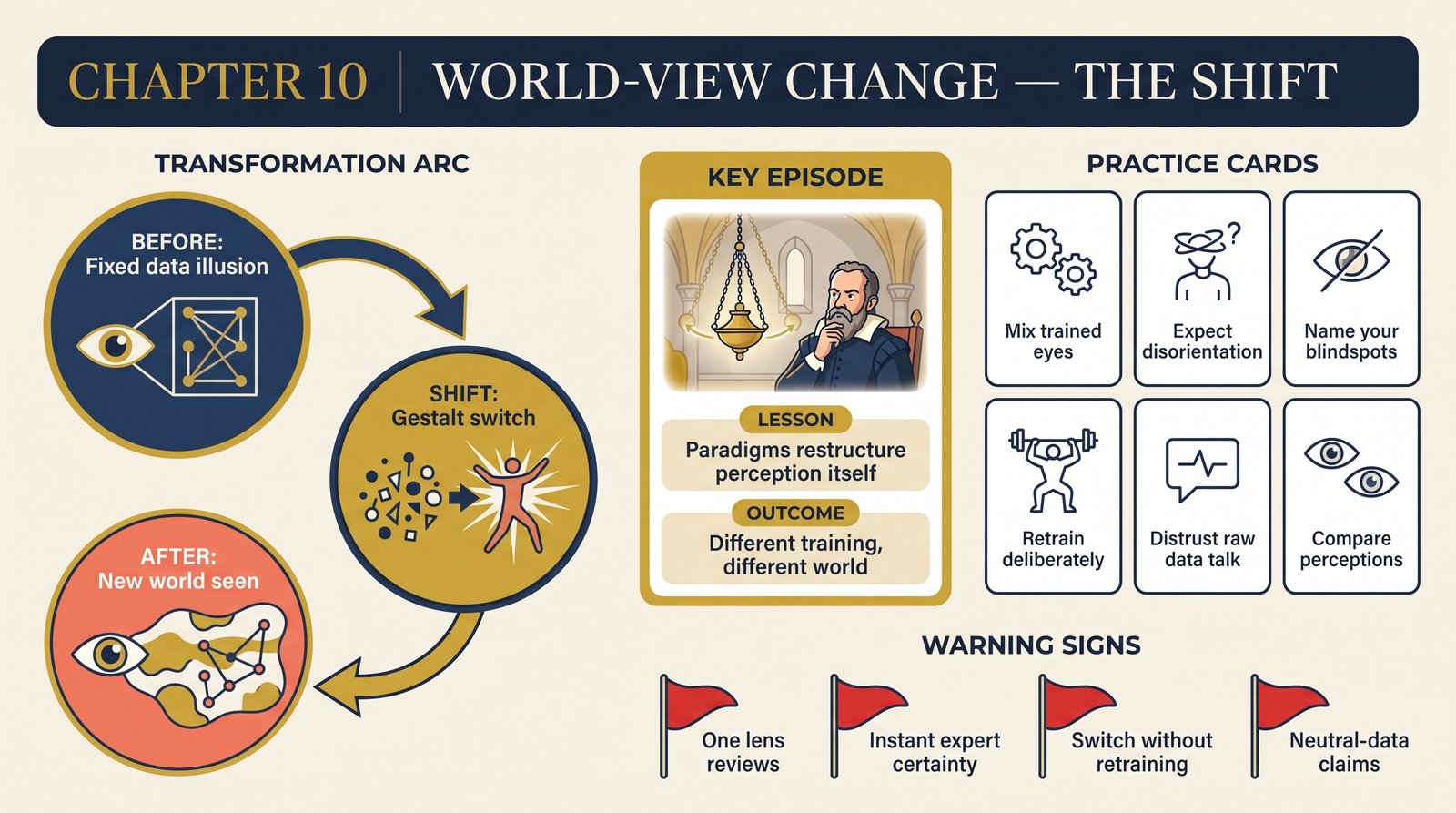
After a revolution, scientists work in a different world. Paradigm change is like a gestalt switch — the duck becomes a rabbit — except there is no going back and, crucially, no neutral description underneath. Perception itself is paradigm-laden: what a scientist sees depends on what the paradigm has trained them to see.
The Problem It Solves
The myth of neutral observation. If theory choice were judged against paradigm-free data, revolutions would be resolvable by looking harder. Kuhn argues there is no such data: the very categories of observation (a pendulum vs. constrained fall, a planet vs. a wandering star) are supplied by the paradigm. Scientists don't reinterpret fixed data; the data themselves change.
Key Episode
Where Aristotle saw constrained fall — a heavy body struggling toward its natural place — Galileo saw a pendulum: near-frictionless periodic motion. Same swinging stone, different phenomenon, different measurable quantities, different science. Likewise post-Copernican astronomers promptly "saw" new things in an unchanged sky (sunspots, a changing heavens), and chemists after Dalton saw fixed proportions where predecessors had seen continuous solutions.
The Shift
From observation-then-interpretation to trained perception all the way down. Kuhn leans on the Bruner–Postman anomalous cards and gestalt psychology, but with a sharpened point: the scientist, unlike the psychology subject, has no access to a stimulus-level description to fall back on. The world of the practitioner is the phenomenal world the paradigm builds.
Critiques & Rivals
The most philosophically contested chapter. Realists object: the stimuli don't change, so "different world" is metaphor at best, idealism at worst. Kuhn himself later reformulated the claim linguistically (change in taxonomic categories) rather than perceptually. Cognitive science, meanwhile, confirmed the underlying mechanism: expert perception is genuinely restructured by training — chess masters literally see boards differently.
Modern Application
Expertise is trained seeing — and so is expert blindness. A security engineer sees attack surfaces where a designer sees flow; neither sees "the interface as it is." Two practical rules: staff reviews with differently-trained eyes, because they perceive different objects, not just different opinions; and when you switch frameworks, expect a disorienting period where you literally cannot see what you used to — that's the retraining, not incompetence.
Key Terms
- Gestalt switch — sudden perceptual reorganization (duck–rabbit)
- Theory-laden observation — perception shaped by conceptual training
- World change — the practitioner's phenomenal world differs across paradigms
Key Quotes
"What were ducks in the scientist's world before the revolution are rabbits afterwards."
"The scientist who embraces a new paradigm is like the man wearing inverting lenses... he must learn to see a new gestalt."
Reflection Questions
- What does your training make you see instantly — and what does it therefore hide?
- Recall your last framework switch: what became visible, and what did you lose sight of?
- Whose differently-trained eyes should review your next major decision?
Connections
- Builds the perceptual base for incommensurability's resolution
- The anomalous-cards mechanism appeared in Anomaly