Chapter 6 — Anomaly and the Emergence of Scientific Discoveries
Core Thesis
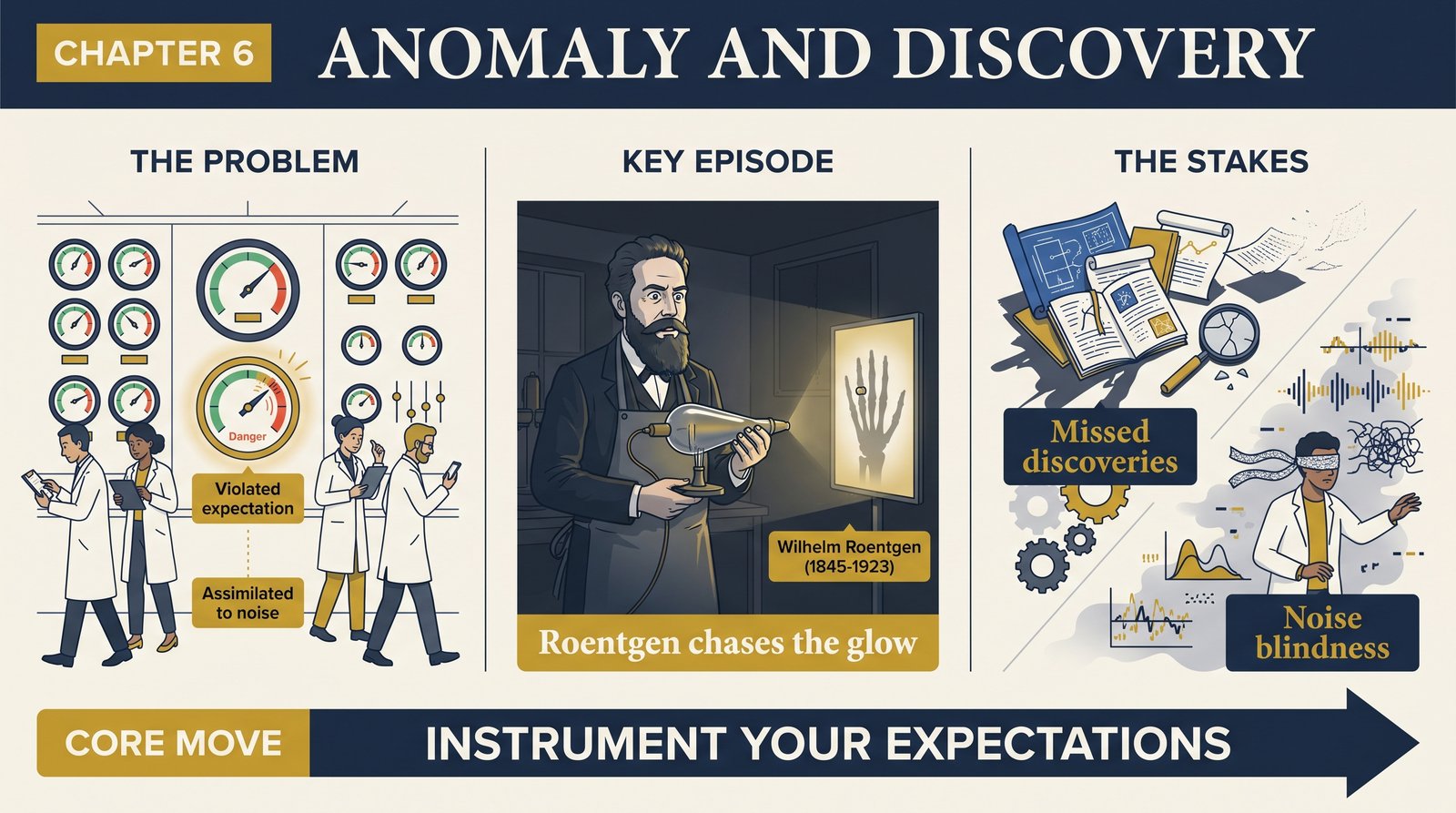
Discovery is not an event but a structured process: it begins with the awareness of anomaly — nature violating paradigm-induced expectations — and ends only when the paradigm has been adjusted so the anomalous becomes the expected. Paradoxically, the paradigm's rigidity is what makes anomalies visible: you can only be surprised if you had precise expectations.
The Problem It Solves
The myth of the discovery moment. "Who discovered oxygen, and when?" has no clean answer — because seeing something and seeing it as something new are different achievements, often spread across people and years. Kuhn replaces "eureka" with a process: anomaly → extended exploration → conceptual adjustment.
Key Episode
Oxygen. Priestley collected the gas but categorized it within phlogiston chemistry ("dephlogisticated air"). Lavoisier, primed by growing anomalies in weight-gain experiments, saw a new kind of substance — and rebuilt chemistry around it. Also X-rays: Roentgen noticed a glowing screen that "shouldn't" glow, and weeks of investigation turned a lab accident into a new class of phenomena. The cathode-ray paradigm made the glow anomalous; that's why it was noticed at all.
The Shift
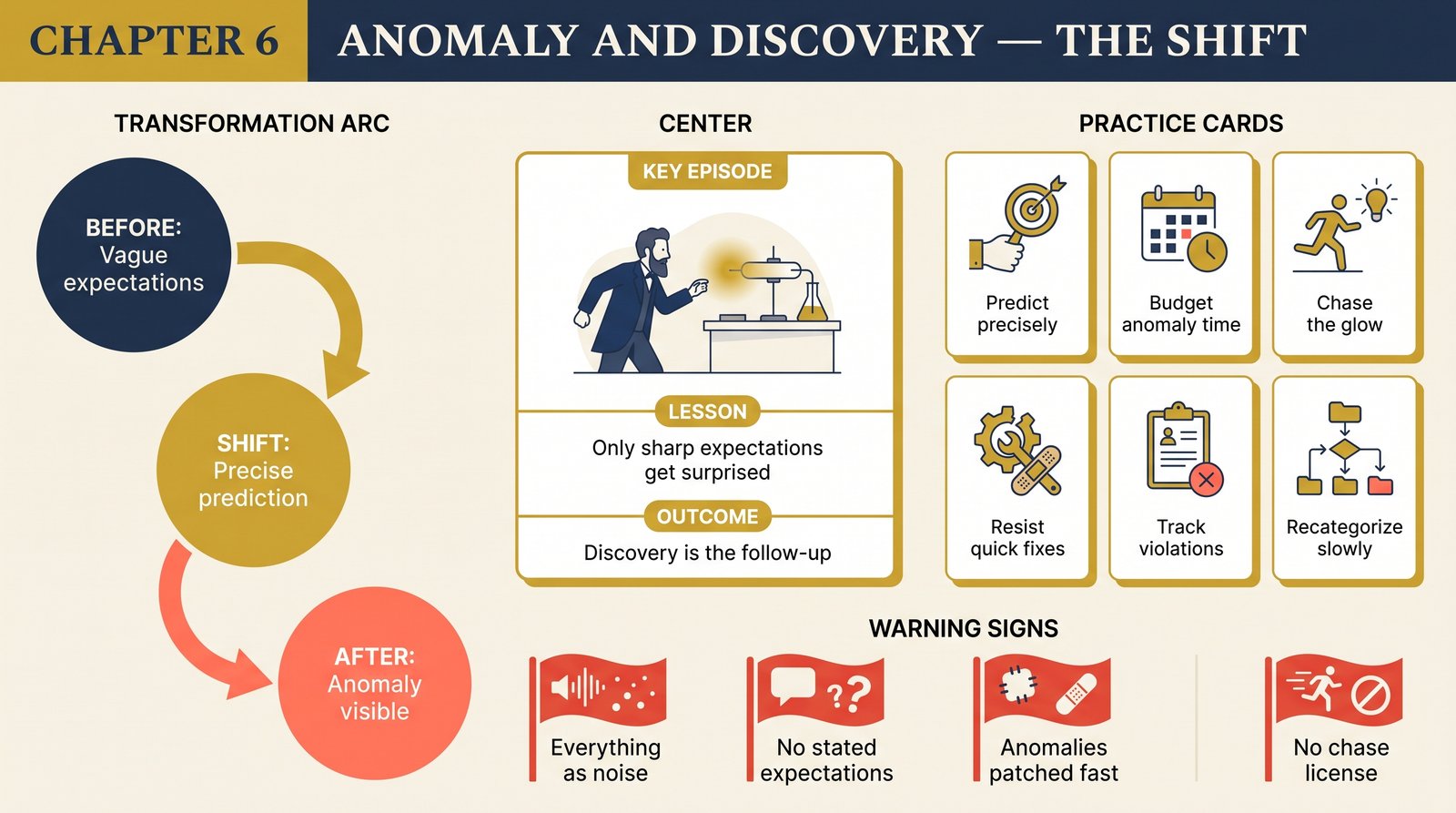
From discovery-as-moment to discovery-as-process, and from novelty-seeking to novelty-against-expectation. Kuhn adds the psychology: like the anomalous playing cards in the Bruner–Postman experiment (a red six of spades), scientists first assimilate anomalies to existing categories, and only with repeated exposure — often with resistance and discomfort — does the new category emerge.
Critiques & Rivals
Philosophers questioned whether "paradigm-induced expectation" is needed — wouldn't any background theory do? Others note discoveries in weakly-paradigmatic fields. But the core claim — that precision of expectation is the anomaly-detector — survives and now underwrites ideas like "measure everything so surprises can register."
Modern Application
Instrument your expectations. A team that predicts precisely (forecasts, error budgets, dashboards with expected ranges) will detect the market shift or the system fault early; a team with vague expectations sees nothing but noise. And when an anomaly appears, budget real time for it — the discovery is in the follow-up, not the first glimpse.
Key Terms
- Anomaly — a violation of paradigm-induced expectation
- Discovery-as-process — noticing, exploring, and conceptually assimilating novelty
- Perceptual assimilation — forcing the new into old categories (the anomalous cards)
Key Quotes
"Discovery commences with the awareness of anomaly, i.e., with the recognition that nature has somehow violated the paradigm-induced expectations that govern normal science."
"Novelty ordinarily emerges only for the man who, knowing with precision what he should expect, is able to recognize that something has gone wrong."
Reflection Questions
- What are your precise expectations this quarter — precise enough that a violation would register?
- What anomaly are you currently explaining away as measurement error?
- Who in your organization has permission to chase a glowing screen for three weeks?
Connections
- When anomalies accumulate and resist: Crisis
- The perceptual mechanics return in Revolutions as Changes of World View