Chapter 3 — The Nature of Normal Science
Core Thesis
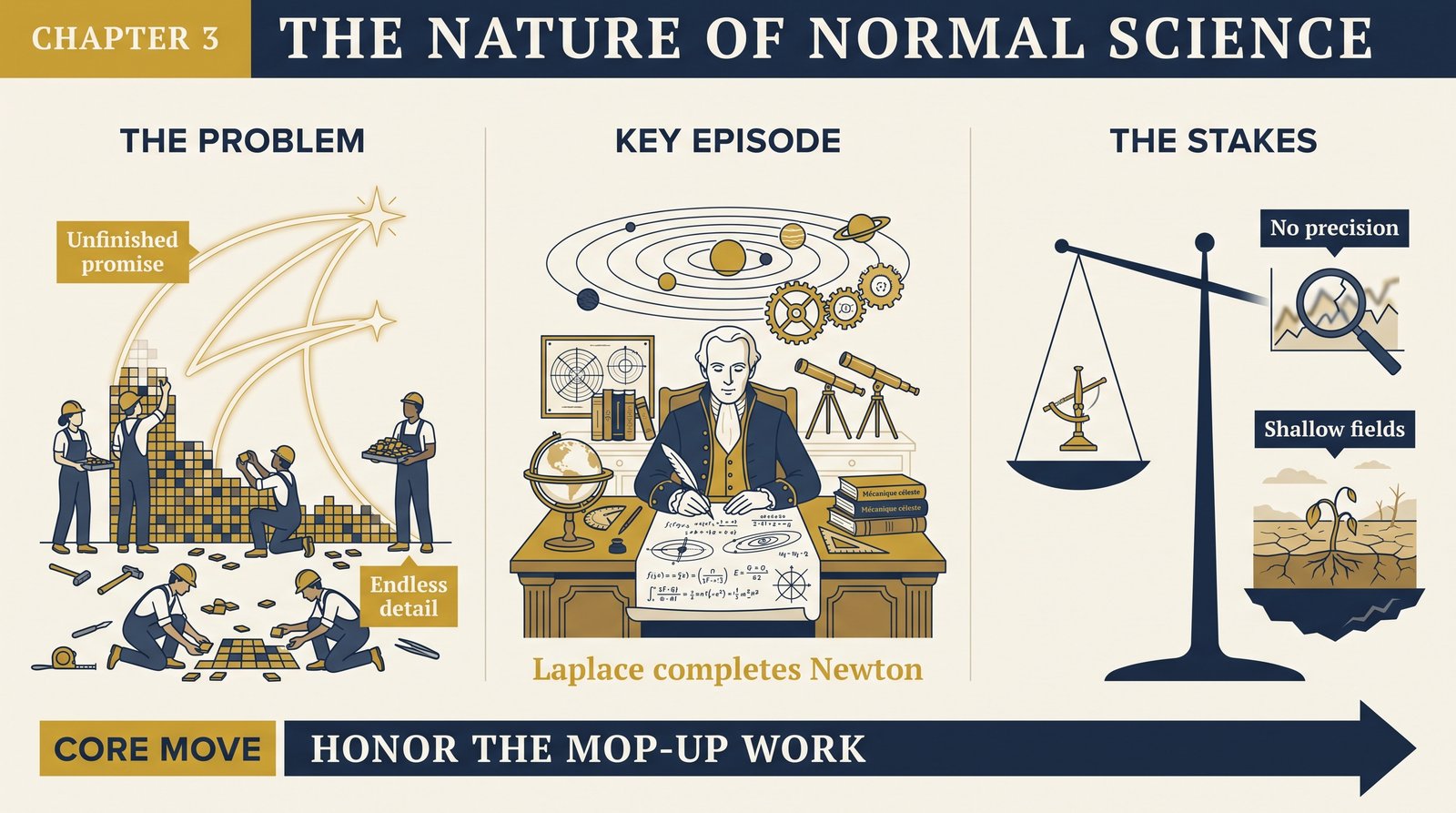
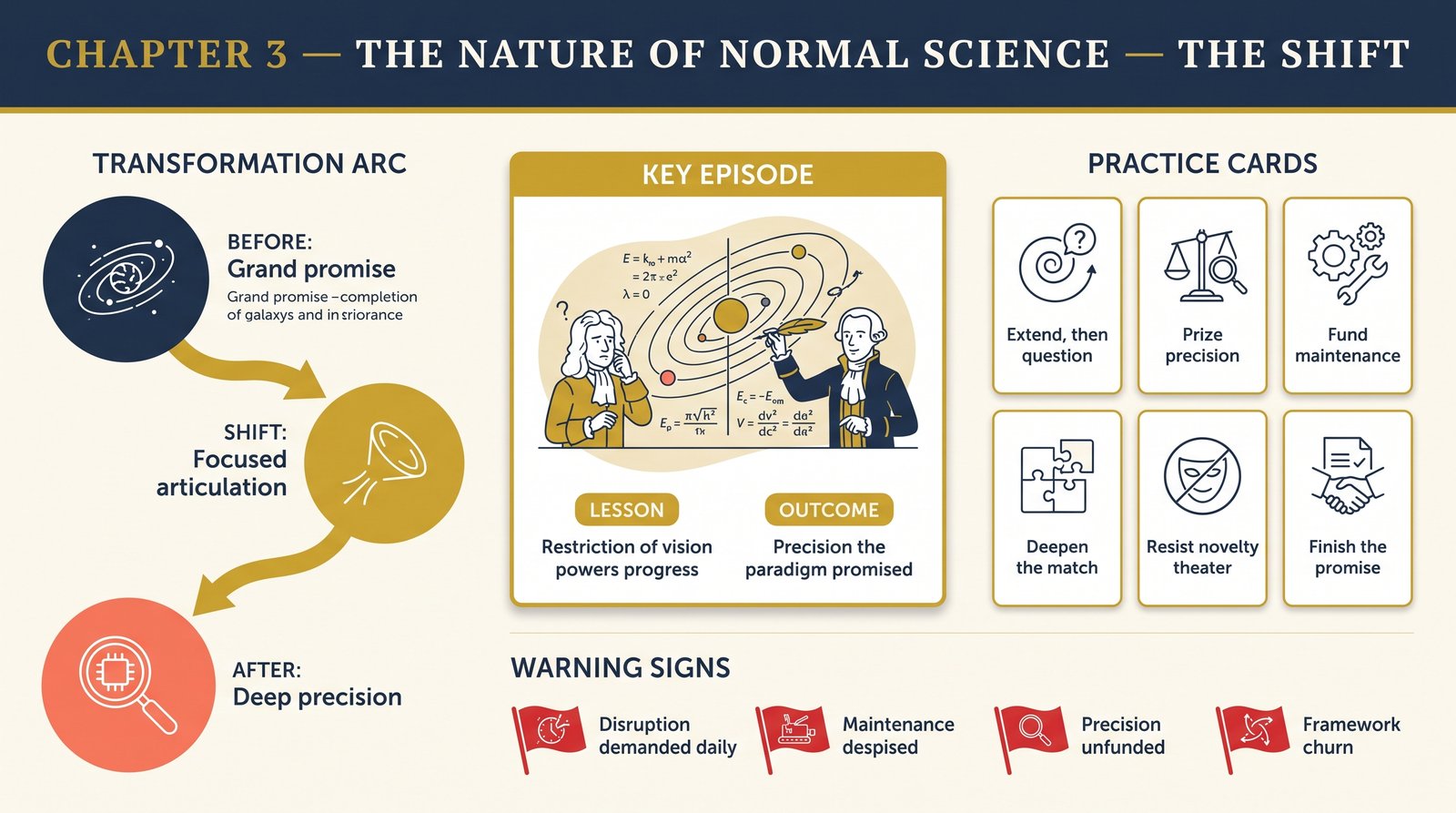
Normal science is mop-up work — and Kuhn means that as high praise. Once a paradigm wins, scientists don't test it; they extend it. The paradigm is a promise, and normal science is the actualization of that promise: increasing the precision of facts the paradigm marks as important, improving the match between facts and theory, and articulating the theory itself.
The Problem It Solves
Why is mature science so productive? Because the paradigm lets a community stop debating what to look at and start looking, intensely and in depth, at a narrow range of esoteric problems. Restriction of vision is the engine of progress. Nobody could build a precision instrument or run a decades-long measurement program in a field still fighting over foundations.
Key Episode
Post-Newtonian astronomy and physics. The Principia promised that all celestial motion follows universal gravitation, but Newton left the actual calculations for the Moon's orbit and planetary perturbations crude. A century of Europe's best mathematicians — Euler, Lagrange, Laplace — spent careers making nature match the promise. None of them was testing Newton. All of them were completing him.
The Shift
From imagining scientists as bold falsifiers to seeing most science as skilled, committed puzzle-completion. The three classes of normal problems: determination of significant fact, matching facts with theory, and articulation of theory. What normal science does not aim at: novelty. Surprises are, at first, failures.
Critiques & Rivals
Popper's image of science — bold conjectures, ruthless refutation — is the direct rival. Popperians called normal science "the danger": dogmatic, uncritical. Kuhn's reply: without committed consensus, science never develops the precision that makes deep anomalies visible at all. Feyerabend went the other way — even Kuhn's revolutions were too orderly for him.
Modern Application
Most valuable work in any mature practice is normal science: refactoring within an architecture, optimizing within a business model, replicating within a lab. The manager's error is demanding "disruption" from every quarter. The practitioner's error is despising maintenance work. Precision and depth come only from people not questioning the framework daily.
Key Terms
- Normal science — paradigm-based research; actualizing the paradigm's promise
- Mop-up work — extending precision and scope within accepted foundations
- Articulation — refining the paradigm's constants, laws, and applications
Key Quotes
"Mopping-up operations are what engage most scientists throughout their careers."
"Normal science does not aim at novelties of fact or theory and, when successful, finds none."
Reflection Questions
- What fraction of your work extends a framework versus questions one — and is the ratio right?
- Which "mop-up" project in your field quietly enabled a later breakthrough?
- Where are you demanding novelty when what's needed is precision?
Connections
- Why this work is psychologically compelling: puzzle-solving
- How the same precision manufactures crises: Anomaly