Concept 1 — The Problem: Rescuing Rationality
Core Thesis
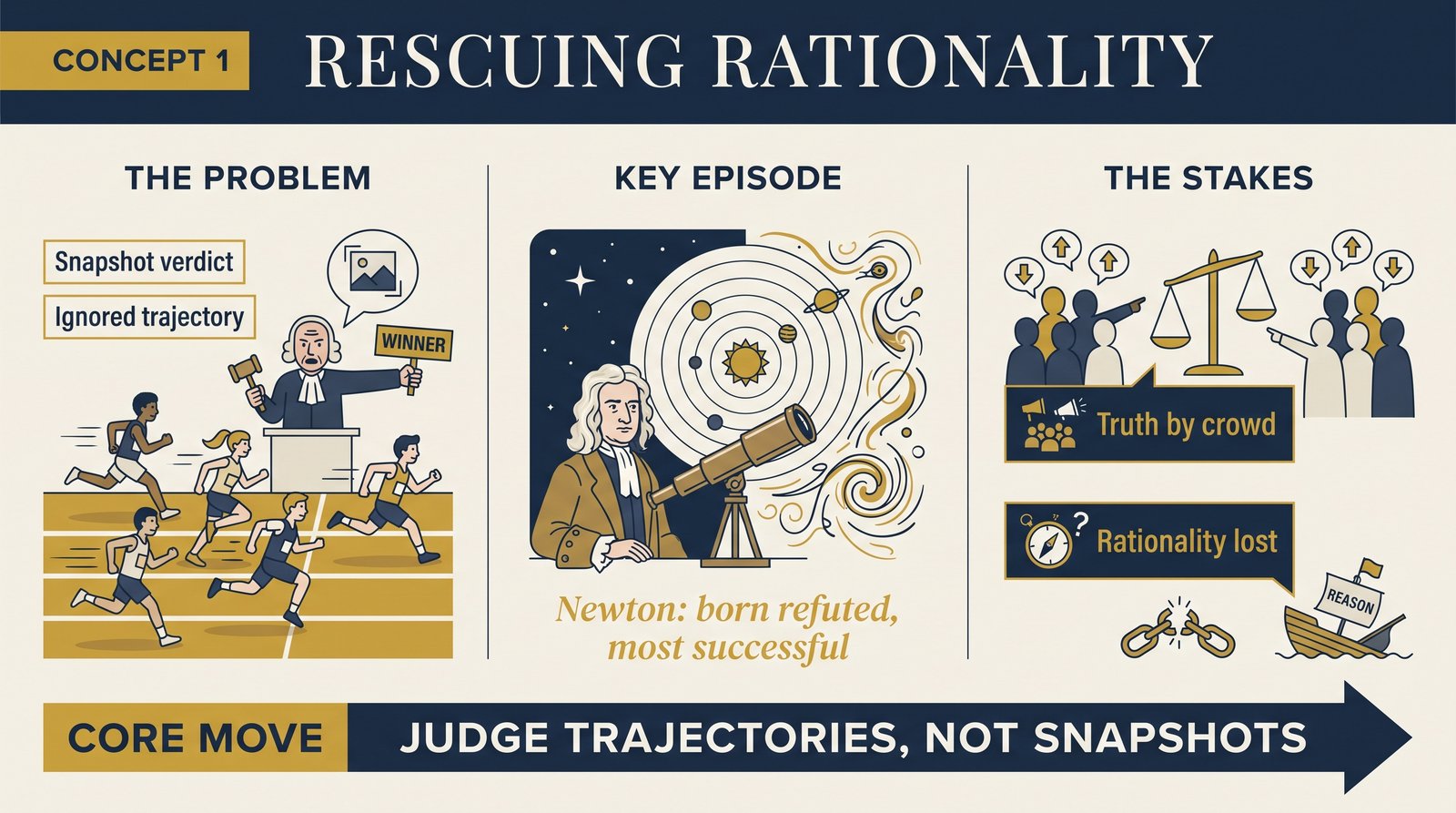
Lakatos writes in the crossfire of the century's great demarcation battle. Popper says science is rational because it refutes; Kuhn says history shows scientists ignoring refutations for decades, making theory change look like conversion — "mob psychology," in Lakatos's barbed phrase. Both, Lakatos argues, are half right: Popper's logic can't survive history, and Kuhn's history seems to abandon logic. His project: a methodology that keeps science rational while fitting what scientists actually did.
The Problem It Solves
If Popper is right, most of the best science was bad science — Newtonians dodged refutations for two hundred years. If Kuhn is right, there's no rational difference between physics and astrology, only different communities with different exemplars. The stakes Lakatos saw were not academic: demarcation determines what gets taught, funded, and believed. A theory of scientific rationality has to survive contact with real history — or admit that truth is decided by crowds.
Key Episode
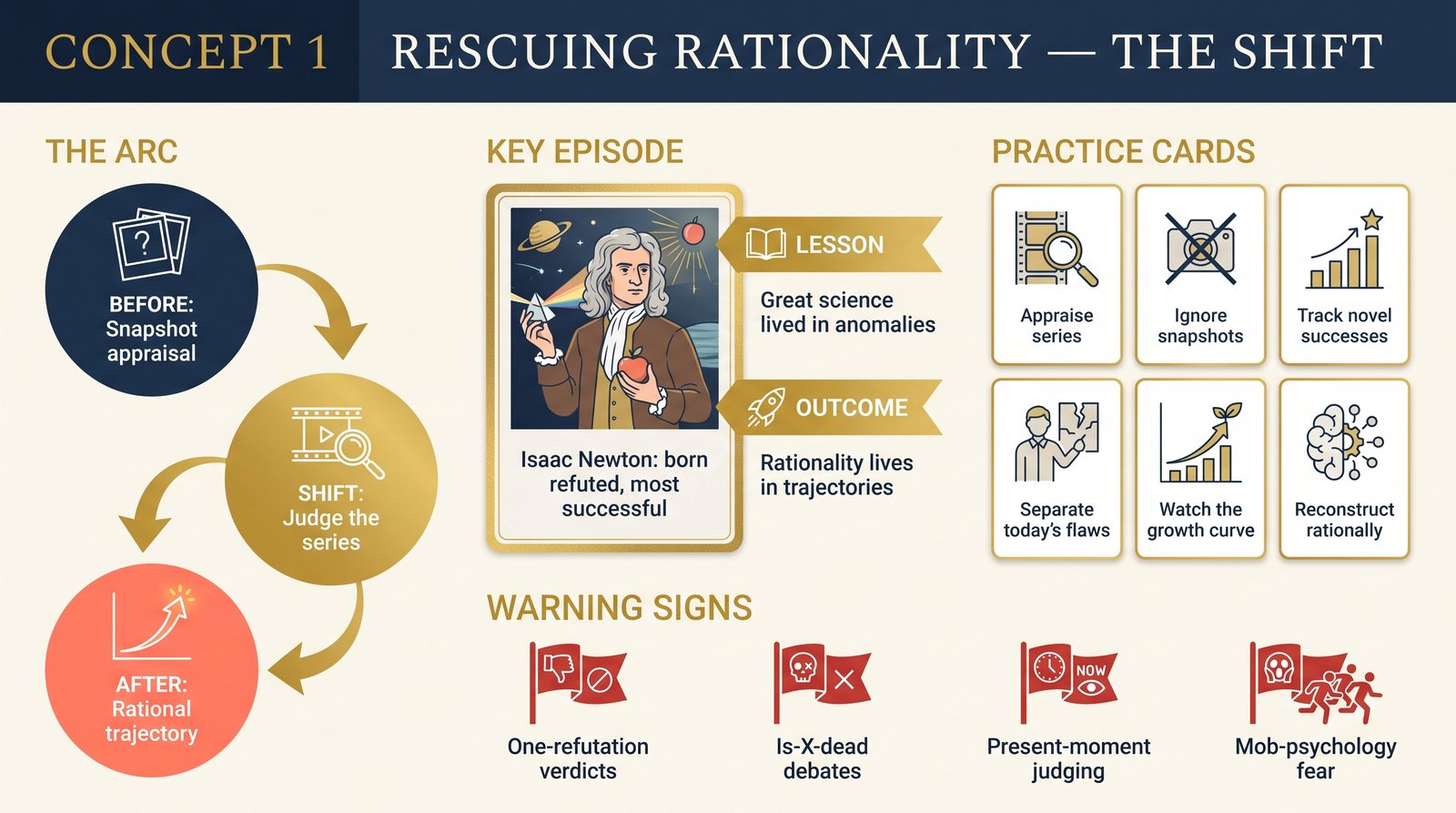
Newton's gravitational theory, "the most successful research programme ever," was born refuted and lived refuted — the Moon's motion misbehaved for decades, mercury's perihelion never did fit. On naive falsificationist rules, Newton should have been abandoned at birth. Instead the anomalies became the programme's fuel. Any methodology that condemns the Principia condemns itself.
The Shift
From appraising single theories at single moments to appraising series of theories over time. The question is never "is this theory falsified?" (everything is, always) but "is this sequence of theories growing?" Rationality lives in trajectories, not snapshots.
Critiques & Rivals
Popper accused Lakatos of abandoning falsificationism's teeth; Kuhn thought the "rational reconstruction" prettified real history. Feyerabend, Lakatos's friendly enemy, argued the methodology either gives advice (and then is refuted by history) or doesn't (and then is empty) — a dilemma Lakatos answered by separating appraisal from advice.
Modern Application
Every "is X dying?" debate — a technology, a strategy, a field — is asked snapshot-style and should be asked trajectory-style. Any framework has embarrassments today; the rational question is whether its sequence of versions keeps producing novel successes or only excuses. Judge series, not moments.
Key Terms
- Demarcation problem — separating science from pseudoscience
- Naive falsificationism — one refutation kills a theory
- Rational reconstruction — history rewritten to expose its rational skeleton
Key Quotes
"The history of science has been and should be a history of competing research programmes."
"If we look at history of science, we find that... some of the most important research programmes progressed on inconsistent foundations, in an ocean of anomalies."
Reflection Questions
- Which framework are you judging by snapshot that deserves trajectory judgment?
- Where does your field's "obviously refuted" verdict ignore a growing sequence?
- What would count as rational persistence — versus stubbornness — in your current biggest bet?
Connections
- The unit of trajectory judgment: the research programme
- The refined falsificationism this replaces: next concept