Chapter 12 — The Resolution of Revolutions
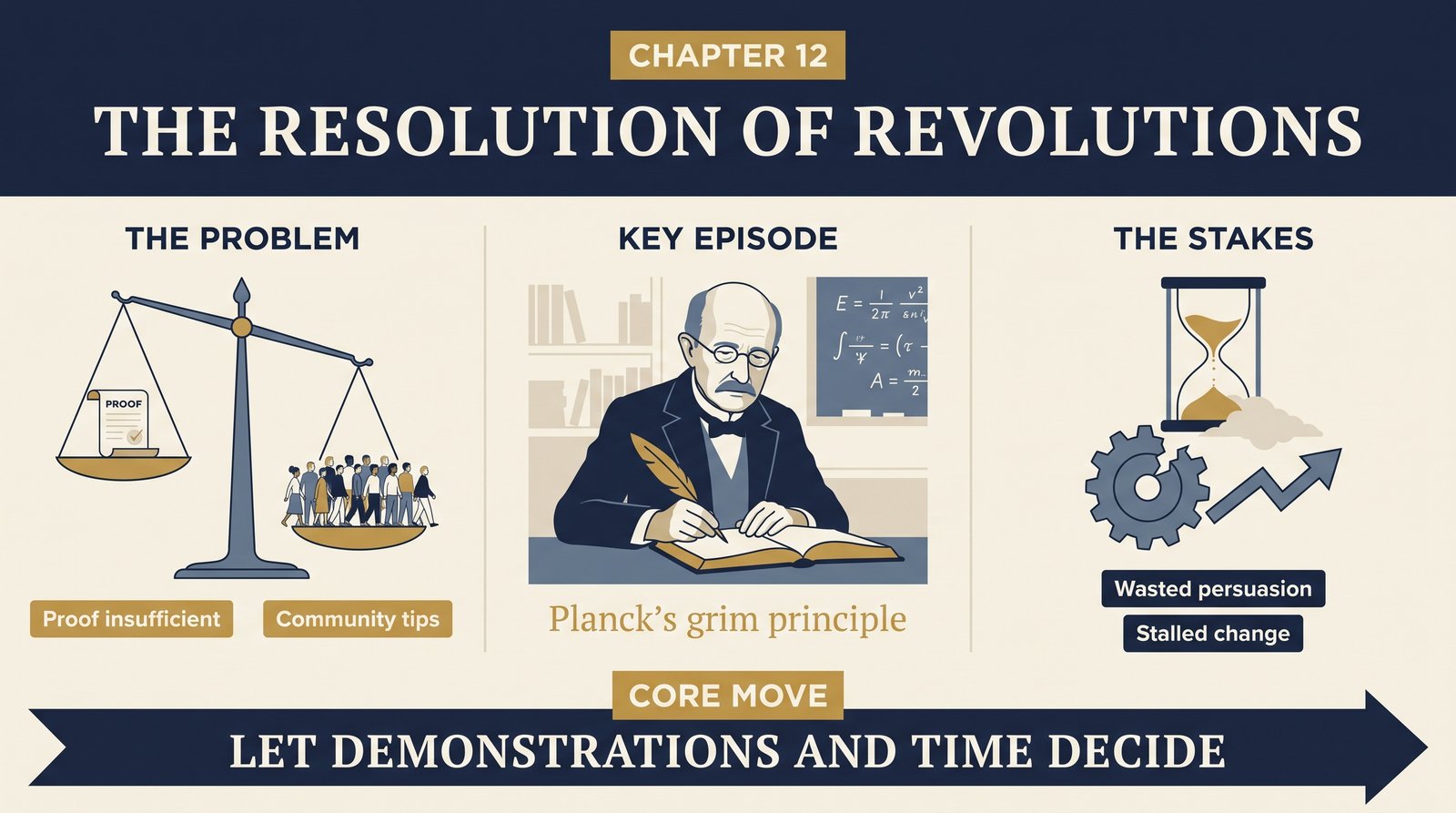
Core Thesis
Paradigm debates end not by proof but by conversion and community shift. Because the contest is incommensurable, arguments are circular and no algorithm of theory choice exists. What decides: the new paradigm's ability to solve the crisis problems, displays of quantitative precision, aesthetic appeal ("neater," "simpler"), and — bluntly — generational turnover, as the old guard's resistance is outlived rather than out-argued.
The Problem It Solves
How can science be rational if revolutions aren't settled by logic and experiment alone? Kuhn's answer: rationality lives in good reasons (problem-solving power, accuracy, fruitfulness) rather than compelling rules. Individual conversions are decisions made on promise and faith — early adopters commit before the evidence is decisive, and must, or the new paradigm would never get developed enough to win.
Key Episode
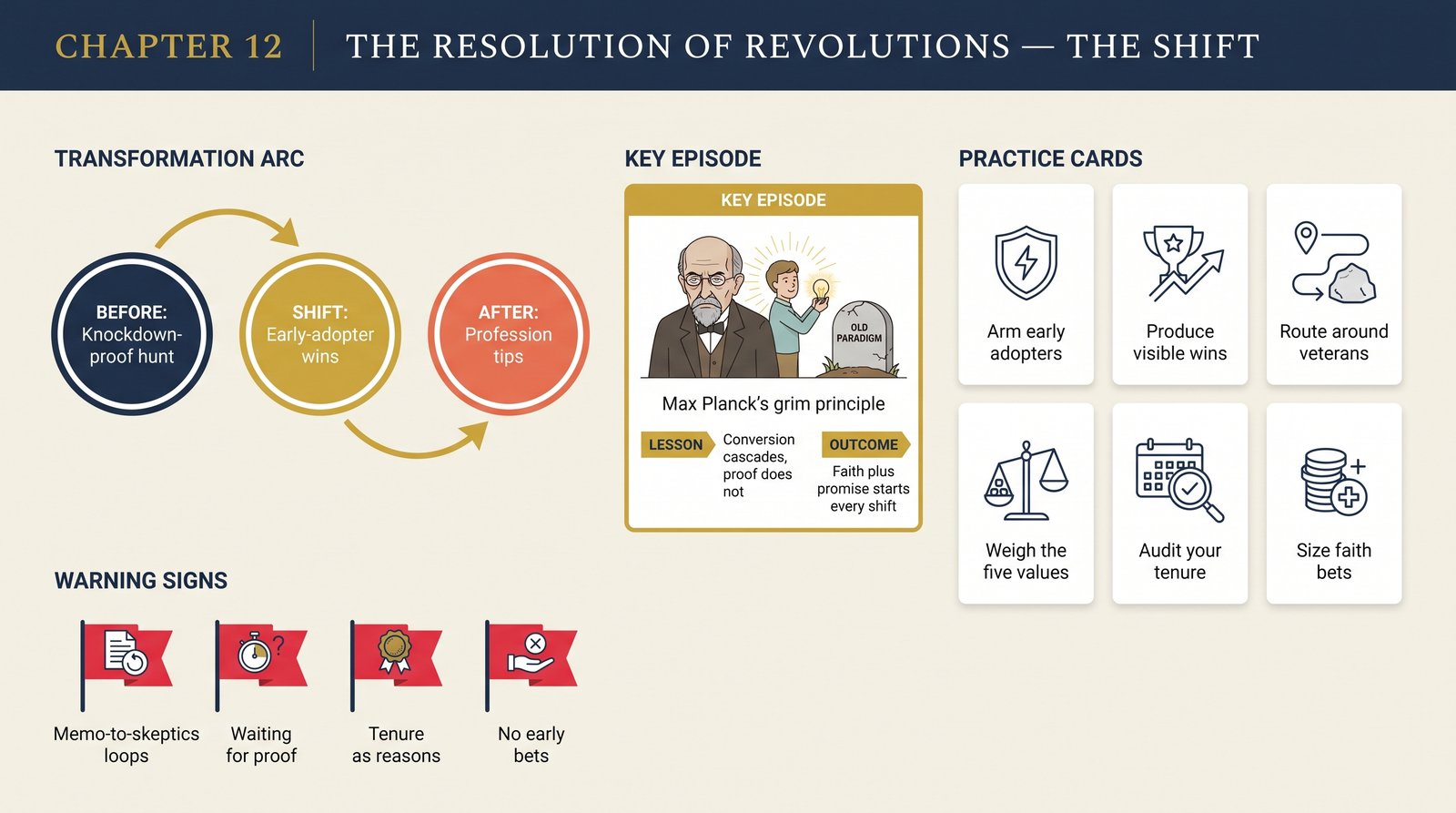
Max Planck's grim testimony, quoted by Kuhn: "a new scientific truth does not triumph by convincing its opponents and making them see the light, but rather because its opponents eventually die, and a new generation grows up that is familiar with it." Also Priestley, who never accepted oxygen chemistry to his death — not irrational, Kuhn insists, but no longer a chemist by the field's evolving definition. And the early Copernicans, converted by the theory's mathematical harmony years before Galileo's telescope supplied arguments.
The Shift
From verification/falsification to conversion dynamics: first a few, for varied and often aesthetic reasons; their work makes the paradigm concrete and fruitful; arguments multiply; the profession tips; holdouts dwindle into irrelevance. Theory choice is a social cascade with rational inputs — not a court verdict.
Critiques & Rivals
"Mob psychology!" (Lakatos's phrase). Kuhn's later "Objectivity, Value Judgment, and Theory Choice" answered with the five shared values — accuracy, consistency, scope, simplicity, fruitfulness — which constrain choice without dictating it; scientists weigh them differently, and that variance is functional: it distributes the community's bets. Bayesians model the same process as gradual updating; sociologists of science took the chapter as license Kuhn never intended.
Modern Application
Driving change: recruit early adopters on promise, arm them to produce visible wins, and let results argue. Don't waste cycles converting the most invested skeptics — route around them and let time do its work. Assess your own resistance honestly: are your objections reasons, or tenure? And when betting early on a framework, know that you're betting on faith plus promise — that's how it always works, so size the bet accordingly.
Key Terms
- Conversion — paradigm change as gestalt-like commitment, not stepwise proof
- Five values — accuracy, consistency, scope, simplicity, fruitfulness (Kuhn's later formulation)
- Generational resolution — Planck's principle: fields tip as cohorts replace each other
Key Quotes
"The transfer of allegiance from paradigm to paradigm is a conversion experience that cannot be forced."
"The man who embraces a new paradigm at an early stage must often do so in defiance of the evidence provided by problem-solving... a decision of that kind can only be made on faith."
Reflection Questions
- Which change are you trying to win by memo that can only be won by demonstration and time?
- What early-stage bet are you refusing because the evidence isn't decisive — when it can't yet be?
- Honestly: which of your professional positions are reasons, and which are tenure?
Connections
- Resolves the circularity established in Chapter 9
- Sets up the final question: is this still progress? Chapter 13