Concept 4 — The Hard Core
Core Thesis
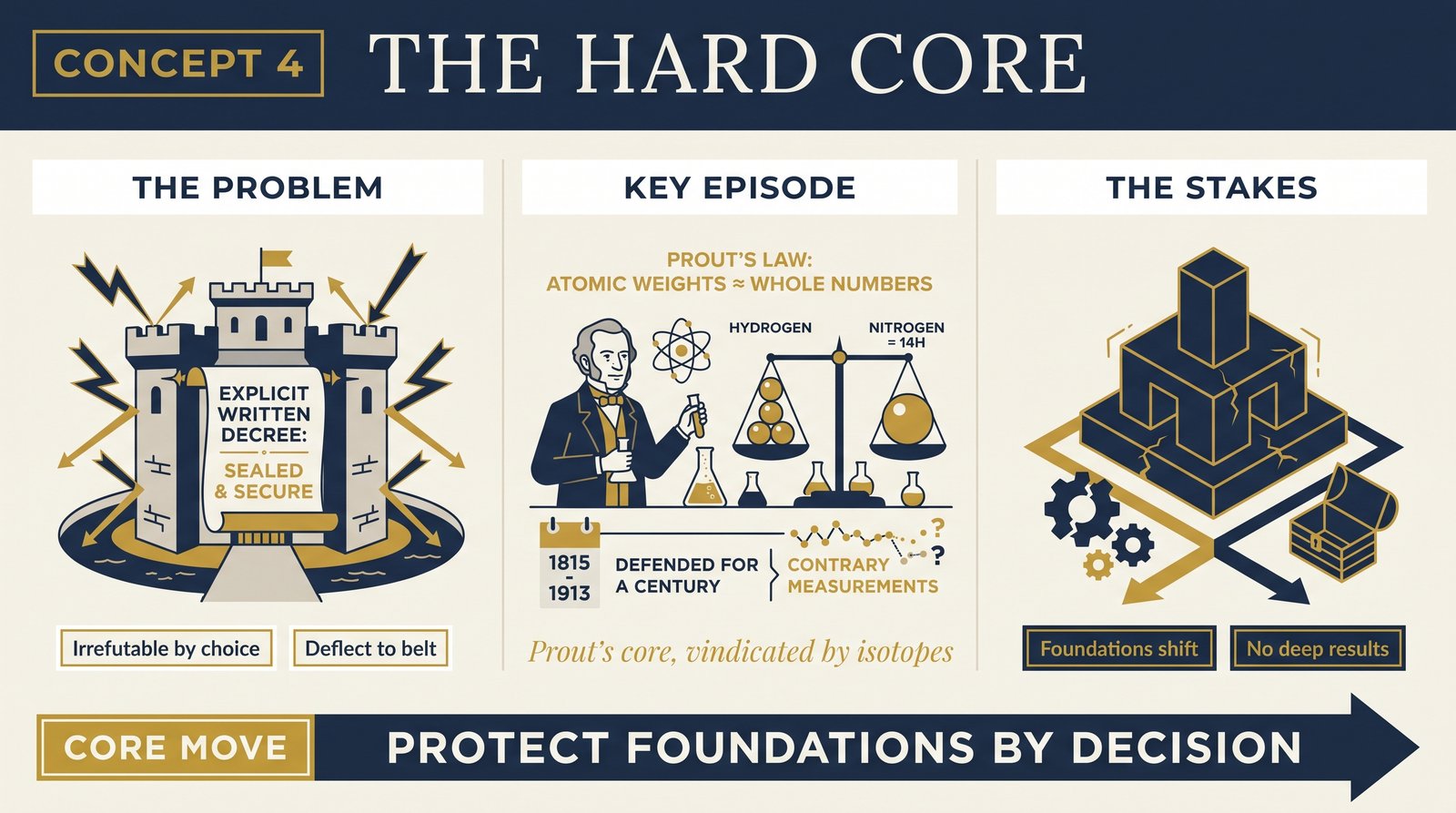
Every research programme has a hard core: the central commitments its adherents decide, methodologically, to treat as irrefutable. The negative heuristic forbids directing refutations at it — anomalies must be deflected into the auxiliary belt. This "dogmatism" is not a vice; it is what gives a programme identity and staying power. Abandon the core and you haven't revised the programme; you've left it.
The Problem It Solves
Why tenacity is rational. If practitioners renegotiated foundations at every anomaly, no deep consequences would ever be derived — the programme would die of doubt before its power showed. The hard core is a division of intellectual labor across time: fix the foundations by decision, and spend the community's energy where adjustment actually pays.
Key Episode
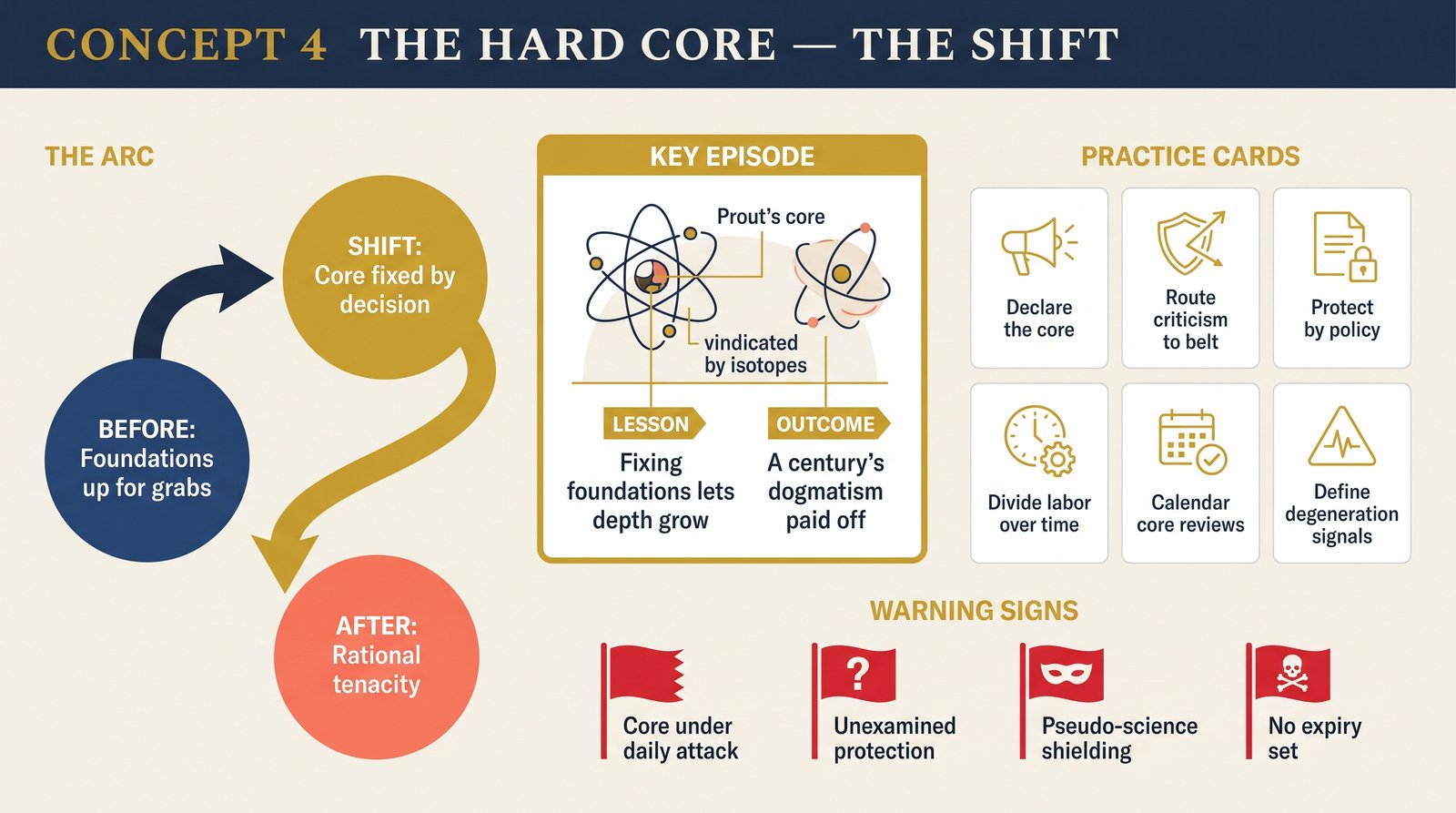
Prout's programme in chemistry (1815): hard core — all atomic weights are whole-number multiples of hydrogen's. Measured weights disagreed constantly (chlorine: 35.5). Proutians didn't touch the core; they attacked the belt — purification techniques, measurement theory — for a century. Vindication came absurdly late: isotopes explained the anomalies, and the core stood essentially right. A century of "dogmatism" paid off.
The Shift
From beliefs-held-because-true to commitments-held-by-decision. The core's irrefutability is conventional — chosen, not proven. That single move dissolves Kuhn's mystery of dogmatic normal science into strategy: protecting foundations is a policy with a rationale, revisable at the level of programme choice.
Critiques & Rivals
The obvious danger: the same structure shields astrology and pseudo-science — their cores also deflect refutation. Lakatos's answer is that protection is licensed only while the programme progresses (predicts novel facts); degenerating programmes protect cores too, but irrationally. Critics reply that this only relocates the problem — and note real cores do erode historically, piece by piece.
Modern Application
Name your hard core explicitly — the two or three commitments your team will not renegotiate this year — and route all criticism to the belt around them. Teams without a declared core relitigate identity in every retro; teams with one convert criticism into adjustment energy. But calendar the core review: protection is a policy, and policies expire on evidence of degeneration.
Key Terms
- Hard core — the programme's conventionally irrefutable center
- Negative heuristic — the rule deflecting refutation from the core
- Methodological decision — irrefutability by choice, not proof
Key Quotes
"The negative heuristic of the programme forbids us to direct the modus tollens at this 'hard core'."
"We must use our ingenuity to articulate or even invent 'auxiliary hypotheses', which form a protective belt around this core."
Reflection Questions
- What is your programme's hard core — and is its protection a conscious decision or an unexamined habit?
- Which anomaly are you wrongly aiming at someone's core, guaranteeing defensive war?
- When is your next scheduled core review — and what evidence would trigger revision?
Connections
- Where deflected anomalies land: protective belt
- The license's expiry condition: degeneration