Law 14: The Law of Conformity
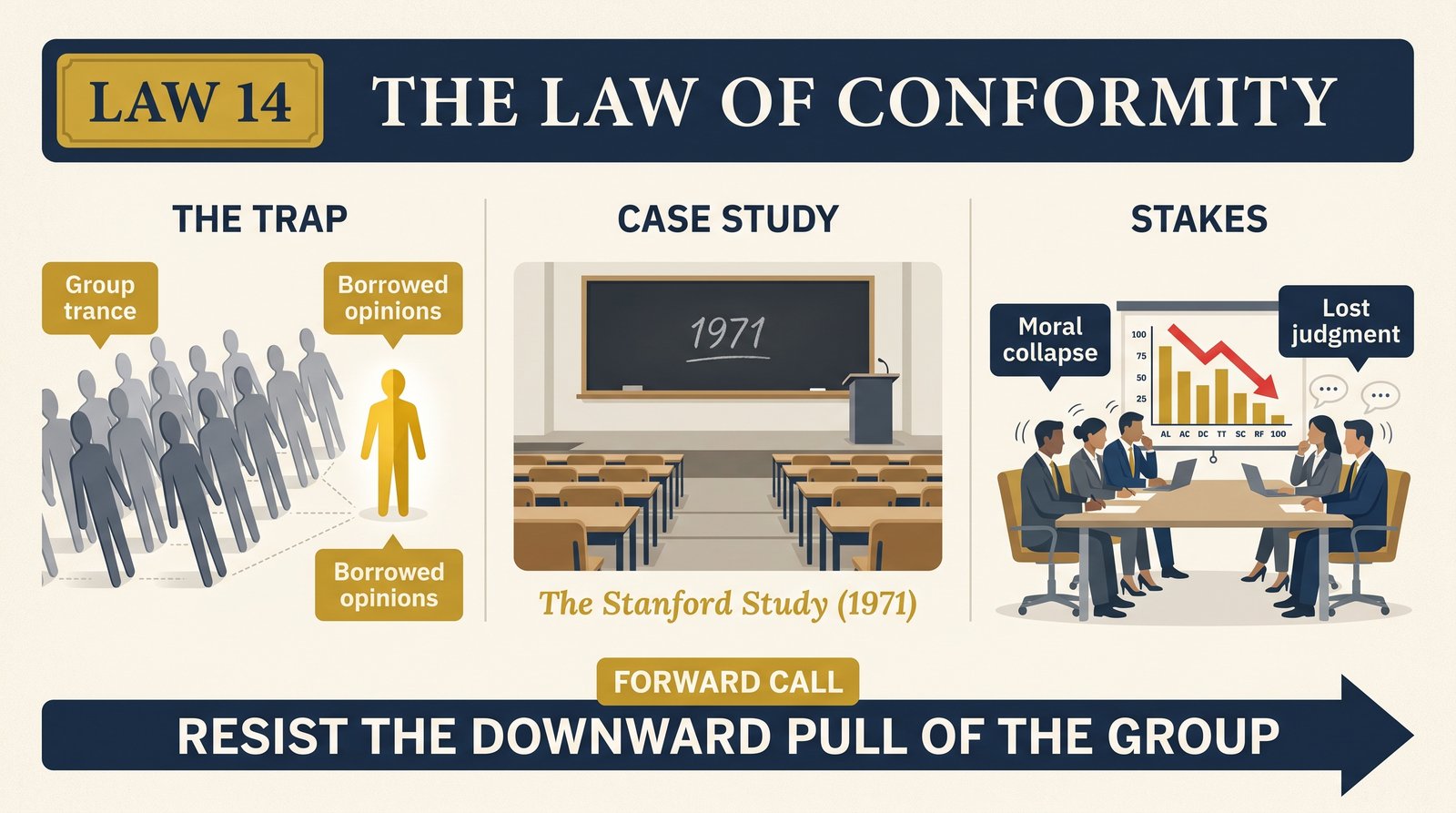
Directive: "Resist the Downward Pull of the Group"
Core Concept
Human beings are intensely social animals, and this social wiring served our ancestors well: group cohesion was the difference between survival and extinction on the African savanna. But those same ancient mechanisms — the deep compulsion to conform, to take our cues from the emotional state of those around us, to subordinate individual judgment to group consensus — operate today in corporate boardrooms, military units, political movements, and online communities with consequences that range from the merely foolish to the catastrophic. Greene's central claim in Law 14 is not that groups are bad but that they are reliably transformative: being in a group changes what you think, what you feel, and what you are capable of doing, almost always in the direction of less rationality and less individual moral responsibility.
The mechanics of this transformation are specific and predictable. First, there is what psychologists call "diffusion of responsibility": in a group, any given individual feels less personally accountable for collective outcomes. When everyone is responsible, no one is. This effect is compounding — the larger the group, the more attenuated individual responsibility becomes. Second, there is deindividuation: the partial dissolution of individual identity in a group context. People become "members" rather than persons; they think and feel in terms of the group's interests, threat narratives, and emotional state rather than their own considered judgment. Third, there is emotional contagion: moods, fears, and enthusiasms spread through groups with viral speed, bypassing rational deliberation. A single anxious or enraged member can shift the emotional temperature of an entire room within minutes.
Groups are also engines of social pressure in a particular direction: toward the mean, toward the already-existing consensus, toward what everyone else seems to believe. Dissenting from a group's emerging consensus triggers powerful social punishment — exclusion, ridicule, accusations of disloyalty — and the human aversion to this punishment is ancient and powerful. It takes unusual psychological strength to maintain an independent position when every social signal is pushing in the opposite direction. Most people, most of the time, do not have that strength — not because they are weak-willed in general, but because the social punishment for nonconformity triggers genuinely primal anxieties about belonging and acceptance.
What makes this law especially dangerous is that the transformative power of group dynamics operates largely below the level of conscious awareness. People do not experience themselves as losing their independent judgment; they experience themselves as arriving at clearer, more certain conclusions. The person swept up in a group's emotional current genuinely believes they are thinking clearly. This is why even intelligent, morally serious individuals can participate in terrible things when group dynamics are at their most intense — they do not recognize what is happening to them.
The Human Weakness
The core weakness is our desperate need for social belonging, which is not a character flaw but a biological inheritance. Exclusion from the group was, for most of human history, a death sentence — no individual could survive alone in a hostile environment without the protection and resource-sharing of a community. This history is inscribed in our nervous systems: social rejection activates the same neural pathways as physical pain. The fear of being cast out of the group is not rational in the modern sense; it is older and more powerful than rationality, which is why it consistently overrides individual judgment when the two come into conflict.
This biological vulnerability is compounded by a cognitive one: we are extraordinarily poor at recognizing when we are in the grip of group dynamics. The experience of conforming feels, from the inside, like consensus, clarity, or righteous conviction. The person who goes along with a bad group decision does not think "I am conforming out of fear of exclusion"; they think "everyone around me agrees, which must mean they're right — who am I to dissent?" This is especially acute in groups with strong shared identities (political, religious, national) where dissent feels not just socially threatening but morally wrong — a betrayal of something sacred.
A third weakness is the tendency to underestimate how differently we behave in groups versus alone. Most people believe their values and judgment are stable across contexts — that they would behave the same way in a mob as in private reflection. The evidence is overwhelming that this is false. The Stanford Prison Experiment, Milgram's obedience studies, and hundreds of historical examples demonstrate that ordinary people's behavior is extraordinarily sensitive to situational pressures, including group dynamics. The refusal to accept this about ourselves makes us more vulnerable, not less, because we don't take the protective measures that the reality of our situation demands.
Historical Figure: Lt. William Calley and the My Lai Massacre (Vietnam, 1968)
Greene uses the My Lai Massacre as his central historical case study because it illustrates, in an extreme and undeniable form, the transformation that groups perform on individuals. On March 16, 1968, American soldiers of Charlie Company, under the command of Lieutenant William Calley, killed between 347 and 504 unarmed South Vietnamese civilians — men, women, children, elderly — in the village of My Lai. The soldiers were not psychopaths or sadists. Post-war psychological assessments and accounts from the soldiers themselves consistently describe people who had been ordinary civilians before the war — young men with families and friends, people who would have been horrified if they had watched a film of what they were about to do.
What Greene traces is the step-by-step process by which ordinary soldiers became capable of this act. It began with dehumanization: months of training and combat experience in which Vietnamese civilians were routinely referred to as "gooks," in which distinguishing combatants from civilians had become nearly impossible, in which the death of fellow soldiers at the hands of an invisible enemy had generated both genuine grief and generalized rage. By the morning of My Lai, Charlie Company had lost multiple members to booby traps and snipers in the preceding weeks, and they had been told to expect heavy enemy resistance in the village. They arrived primed for violence.
The execution of the massacre itself then proceeded through a series of group-dynamic mechanisms. Authority pressure: Calley gave orders, and the military hierarchy made disobedience feel illegitimate. Diffusion of responsibility: with dozens of soldiers participating, no individual felt singularly accountable. Deindividuation: people were operating as "members of Charlie Company" rather than as individuals with personal moral codes. Normalization: once a few soldiers began firing, the behavior became the new baseline — not firing began to feel like the deviant act. The few soldiers who refused or objected, including helicopter pilot Hugh Thompson who physically intervened to protect survivors, were isolated and subsequently treated as traitors by their peers.
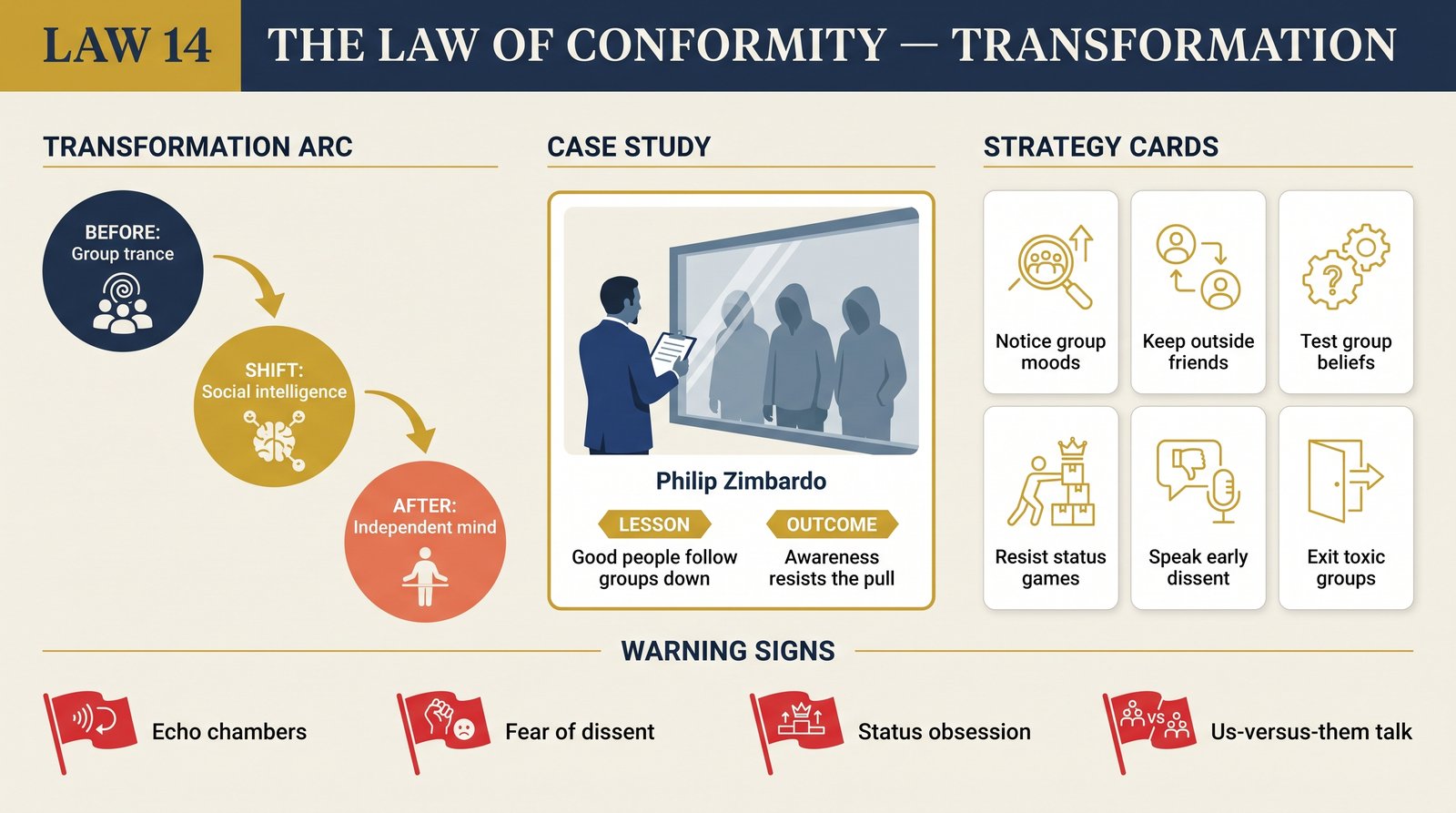
Greene also draws on Philip Zimbardo's Stanford Prison Experiment (1971) as a controlled demonstration of the same mechanisms. When ordinary Stanford undergraduates were randomly assigned to roles as "guards" and "prisoners" in a simulated prison, they rapidly internalized those roles in ways that produced genuine cruelty from the guards and genuine psychological breakdown in the prisoners — within six days, not six months. Zimbardo himself, as the experiment's supervisor, was so absorbed into the institutional role of "prison superintendent" that he allowed the experiment to continue far past the point when he should have stopped it. No one was immune.
The Transformation
The core of Greene's prescription is the development of what he calls a "Court of Opinion in Your Mind" — a practice of mentally consulting a diverse panel of wise, independent thinkers when group pressure is most intense. You populate this imaginary court with figures — historical, literary, or personal — whose independence of judgment you admire and whose perspectives span different frameworks and values. When you feel the pull of group consensus, you pause and ask: what would these advisors say? This is not an escape into fantasy; it is a technique for temporarily stepping outside the group's emotional field and accessing a more independent vantage point. The very act of consulting an imaginary alternative audience weakens the hold of the actual group's pressure.
The second element of the transformation is what Greene calls "cultivating independence in small things." Resisting conformity under extreme pressure requires a muscle that must be built in ordinary circumstances. Practice taking positions that diverge from group consensus in low-stakes situations — disagree with a popular opinion at dinner, maintain an unpopular view in a meeting when you genuinely hold it, notice when you are about to change your stated position simply because others disagree and choose not to. These small acts of independence accumulate into a stronger general capacity for maintaining your own judgment when the stakes are high.
The third element is the development of what Greene calls "group awareness" — the ability to recognize when you are in a high-susceptibility environment. Certain conditions dramatically increase conformity risk: emotional intensity, strong shared identity, isolation from outside perspectives, authority figures pushing a particular direction, time pressure, and recent shared trauma. When you can identify these conditions as they emerge, you can deliberately slow down, increase your critical distance, seek outside input, and suspend major decisions until you are in a lower-pressure context. This is not cynicism about groups — it is realistic awareness of how they work.
Practical Guide
- Name the dynamic when you feel it. When you notice yourself in a group situation where consensus is forming rapidly and dissent feels uncomfortable, silently label what is happening: "This is group pressure, not evidence." The act of naming it activates critical distance.
- Delay decisions made in group contexts. Major commitments, significant agreements, and consequential actions should not be finalized while you are still inside the group's emotional field. Create a rule: sleep on any important group-influenced decision before acting on it.
- Build your internal court. Identify 4-6 figures — historical, literary, or personal — whose independent judgment you respect. When facing group pressure, spend five minutes genuinely asking what each would say. Write it down if possible. This is a practiced skill, not an occasional fancy.
- Monitor your "rhetoric thermostat." Groups generate heightened language — "us vs. them," "now or never," "they are evil / we are righteous." When the rhetoric in a group context is this elevated, treat it as a warning sign that emotional contagion is operating at high intensity, regardless of the group's actual merit.
- Practice being the dissenter in low-stakes situations. Deliberately maintain a minority position when you genuinely hold it, even in casual social contexts. Build the social muscle for nonconformity in circumstances where the cost is low, so the capacity exists when the cost is high.
- Identify the group's "emotional temperature" before participation. Before entering an important group context — a meeting, a protest, a family gathering with known conflict — assess the likely emotional intensity. High-temperature environments require more deliberate self-management.
- Seek out the group's dissenters privately. If you are uncertain about a group's direction, find the members most likely to hold reservations and speak with them one-on-one. People who will not dissent in the group's presence will often speak more honestly in private.
Modern Application
The corporate groupthink scenario: A product team at a technology company is deciding whether to launch a product that several engineers privately believe is not ready. The CEO is visibly excited, the marketing team has already begun external communications, and the meeting dynamic strongly rewards enthusiasm over caution. Individually, several engineers would strongly oppose the launch; in the meeting, they raise mild concerns that are smoothly acknowledged and dismissed, and the decision carries unanimously. Law 14 describes exactly this dynamic: authority pressure, sunk cost creating momentum, the social cost of being the person who "kills the excitement." The prescription is for dissenters to document their concerns in writing before the meeting, to speak to decision-makers one-on-one, and to use formal mechanisms (a written risk assessment) that preserve dissent without requiring real-time social confrontation.
The online mob dynamic: Social media platforms create a specific form of group dynamic — rapid emotional contagion, anonymity-fueled deindividuation, and the dopamine rewards of collective outrage — that produces behaviors in individuals who would not engage in them in face-to-face contexts. The person who tweets vicious condemnation of a stranger is often genuinely shocked, afterward, at what they participated in. Law 14 prescribes a specific rule: never post about a person or situation when you are in a state of high emotional arousal generated by online collective outrage. The 24-hour rule applies with special force here.
The political/ideological community: Someone deeply invested in a political or social movement finds that their independent thinking is progressively narrowing as they spend more time in movement spaces. They notice they are reading only movement-approved sources, dismissing evidence that complicates the movement's narrative, and experiencing genuine hostility toward people who hold even partially different views. This is deindividuation operating at the level of identity rather than action. The prescription is deliberate exposure to intelligent people who hold different views, maintenance of relationships outside the movement, and periodic private evaluation of the evidence for the movement's core claims rather than relying on the movement's own self-assessment.
The family system: Family dynamics are among the most powerful group contexts because membership is not voluntary and the stakes (belonging, love, approval) are the deepest possible. Adult children who cannot disagree with their parents on important matters, who find themselves reverting to childhood patterns of thought and behavior at family gatherings, are experiencing the group conformity effect in its most ancient form. Law 14's prescription here is not rebellion but the development of the internal resources — the "court of opinion" — that allows the person to remain psychologically distinct while still being relationally present.
Warning Signs
- You find that your opinions shift dramatically when you enter certain group contexts, and you rationalize this shift as "seeing more clearly" rather than recognizing it as social influence.
- You experience strong aversion to being the dissenter in group discussions — not because you genuinely agree, but because the social cost of disagreement feels intolerable.
- The groups you belong to have progressively narrowed your information diet — you find yourself reading, watching, and discussing only sources that confirm the group's existing views.
- You use "we" language about your group's beliefs and feelings in ways that blur the distinction between your independent view and the group's consensus position.
- You notice that your moral standards for behavior are significantly lower when "everyone else is doing it" — that actions you would judge harshly in isolation feel acceptable when the group endorses them.
- After emotionally intense group experiences — rallies, heated meetings, collective confrontations — your thinking about the relevant issues becomes more extreme rather than more nuanced.
Key Quotes
"The group is a powerful solvent of individual identity. It does not merely change what you do; it changes what you think you think and who you believe you are."
"The soldiers at My Lai were not monsters. They were ordinary young men who had been processed by a set of group dynamics that are, once understood, entirely recognizable and entirely predictable. This is the most frightening thing about them."
"Your first task is to recognize the phenomenon for what it is — not a sign of collective wisdom or moral clarity, but a predictable social-psychological process that operates on everyone, regardless of intelligence or virtue."
Reflection Questions
- Think of a time you went along with a group decision or position that you privately disagreed with. What specifically made dissent feel impossible or too costly? What would you need in order to behave differently in a similar situation?
- What are the strongest group identities in your life — political, professional, familial, religious — and how have they shaped what evidence you take seriously? What would a genuinely independent assessment of those groups' core claims reveal?
- Who are the figures — historical or contemporary — whose independent judgment you most admire? What made them capable of maintaining independent positions under social pressure? Can you more deliberately cultivate those capacities in yourself?
- When you look back on decisions you've made in group contexts, which ones do you feel most uncomfortable about in retrospect? What were the group dynamics at play, and what would it have taken to act differently in the moment?
- What are the emotional temperatures and conditions under which your independent judgment is most vulnerable — what kinds of groups, topics, or situations reliably compromise your ability to think for yourself?
Connected Laws
- Law 1: The Law of Irrationality — The mechanisms of group conformity are fundamentally irrational processes — emotional contagion and diffusion of responsibility operate by bypassing the rational faculties that Law 1 prescribes developing. The emotional self-mastery cultivated in Law 1 is the foundation for the group-resistance cultivated in Law 14; without it, group dynamics overwhelm individual judgment automatically.
- Law 15: The Law of Fickleness — Where Law 14 examines how groups transform members, Law 15 examines how leaders interact with group dynamics. The authority a genuine leader builds — through consistency, competence, and care — is partly the ability to channel group energy rather than being swept away by it. Understanding both laws together gives a complete picture of group psychology from both the member's and the leader's perspective.
- Law 16: The Law of Aggression — Group contexts are particularly fertile ground for aggression, because deindividuation removes the social inhibitions that normally moderate individual hostile impulses. The violence at My Lai, the toxicity of online mobs, the viciousness of collective persecution — all represent the intersection of conformity and aggression. Understanding both laws is essential for recognizing when you are in a group context that is becoming weaponized.