Concept 7 — Progressive vs Degenerating Programmes
Core Thesis
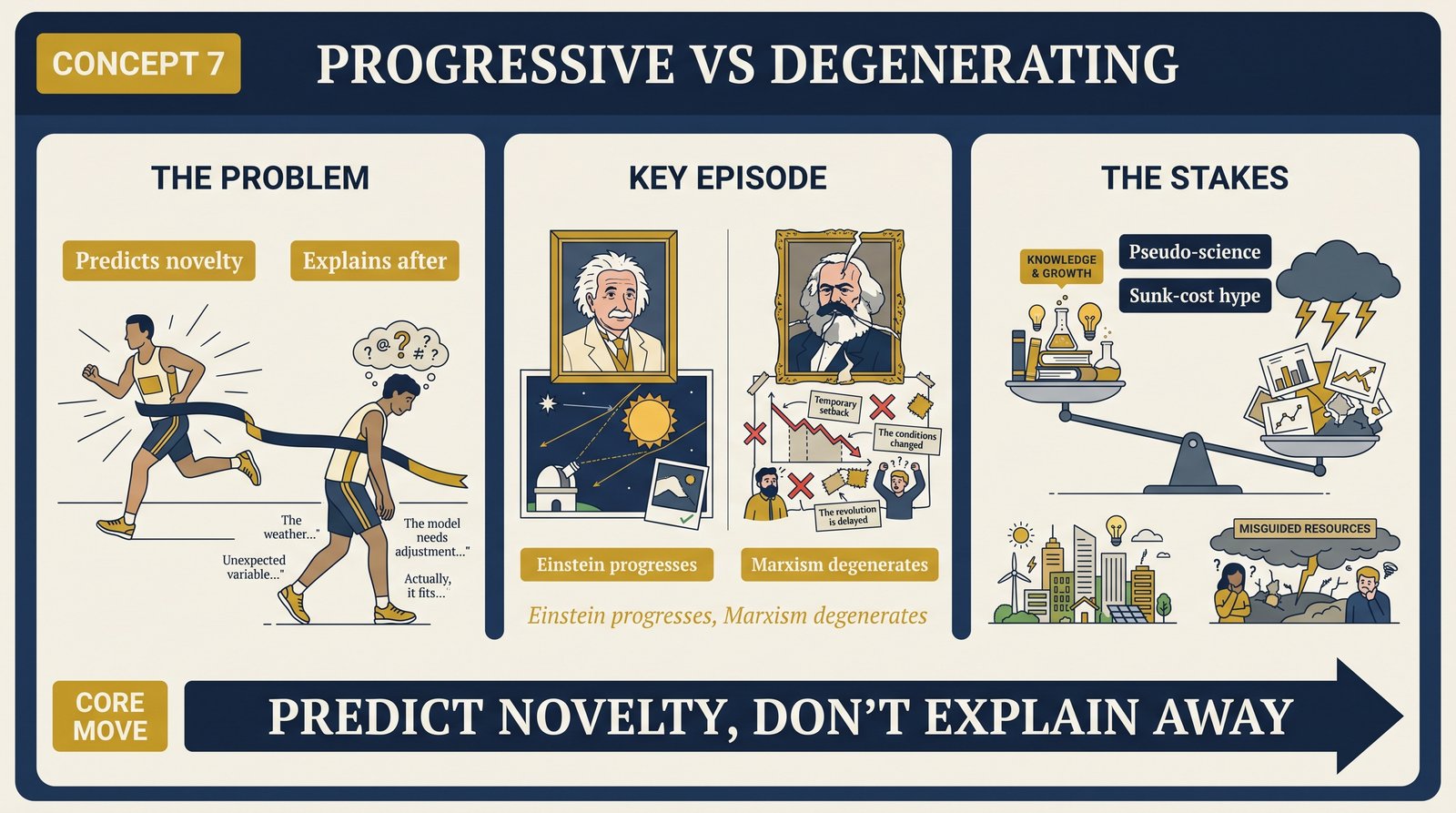
The heart of the methodology — the demarcation criterion itself. A programme is theoretically progressive if each new version predicts novel, unexpected facts; empirically progressive if some of those predictions are corroborated; degenerating if its adjustments only accommodate facts after the fact, explaining yesterday while predicting nothing. Science versus pseudoscience is not a property of content but of trajectory: is the programme running ahead of the facts, or panting behind them?
The Problem It Solves
Demarcation, at last, with history intact. Marxism and Freudianism aren't unscientific because they're false or untestable — they're degenerating because every adjustment has been retrospective patchwork ("the workers' rising living standard? false consciousness!"). Meanwhile Newton lived in an ocean of anomalies yet stayed gloriously scientific: each Newtonian repair predicted something new. The criterion judges programmes the way markets judge companies — on the growth curve, not the balance-sheet snapshot.
Key Episode
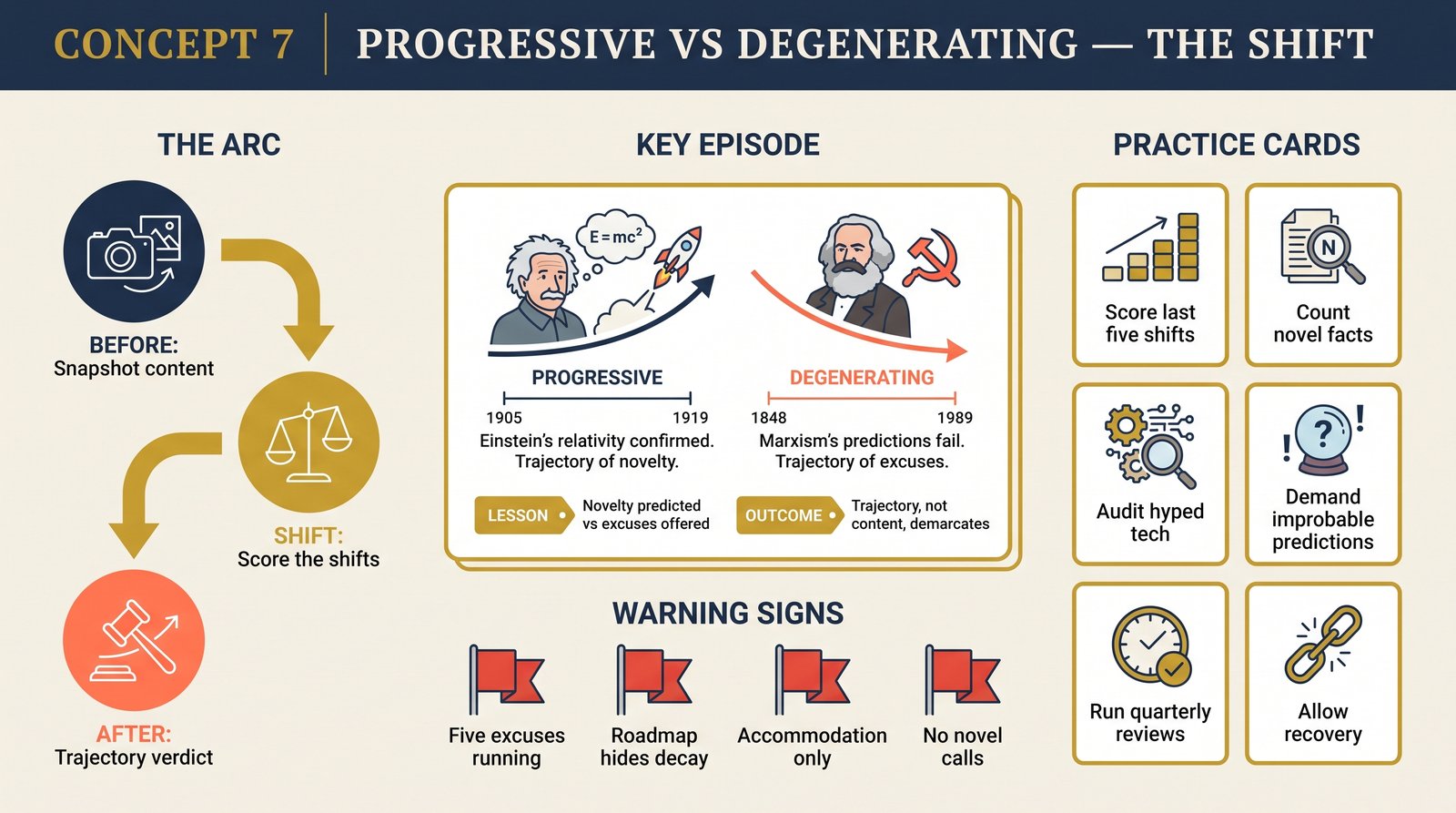
Lakatos's twin exhibits. Einstein's programme: predicted light bending before Eddington measured it — stunning novel content, empirically progressive. Marxism, in Lakatos's harsh audit: did it ever predict a novel fact successfully? Its famous predictions failed (workers' immiseration, revolution in the most industrial nations), and each failure was met by belt-patches predicting nothing further. The structure — hard core, belt, heuristic — is identical in both. The trajectory is opposite.
The Shift
From "is it falsifiable?" to "is it fertile?" — the demarcation question becomes dynamic. And crucially: degenerating is not dead. A programme behind the facts can recover (Prout's did). The verdict is always provisional, always dated, always revisable — which is exactly why no algorithm ever tells you the moment to abandon ship.
Critiques & Rivals
Feyerabend pounced: if degeneration doesn't dictate abandonment, the methodology gives no advice, so anything goes. "Novel fact" itself proved slippery — must it be temporally new, or merely not-used-in-construction? (The debate refined it toward the latter: use-novelty.) And measuring progress requires deciding what the programme's adjustments were for — historians can contest every scoring.
Modern Application
Audit your frameworks quarterly like a Lakatosian: list the last five adjustments (to strategy, model, product thesis). For each — did it predict something new that came true, or did it explain away a miss? Five explanations in a row = degeneration, whatever the sunk investment says. The same audit exposes hype: a technology whose every iteration merely re-explains its unmet promises is a degenerating programme wearing a roadmap.
Key Terms
- Progressive problemshift — adjustments with corroborated novel content
- Degenerating problemshift — retrospective accommodation only
- Novel fact — improbable, unexpected, not built into the theory
Key Quotes
"A research programme is said to be progressing as long as its theoretical growth anticipates its empirical growth... it is stagnating if its theoretical growth lags behind its empirical growth."
"What really count are dramatic, unexpected, stunning predictions: a few of them are enough to tilt the balance."
Reflection Questions
- Score your main framework's last five adjustments: predictions or excuses?
- Which celebrated project in your orbit is degenerating behind a confident roadmap?
- What novel fact — improbable in advance — has your current strategy actually called?
Connections
- Why degeneration doesn't command exit: no instant rationality
- The structure being scored: research programme