Chapter 5 — The Reality of Abstractions
Core Thesis
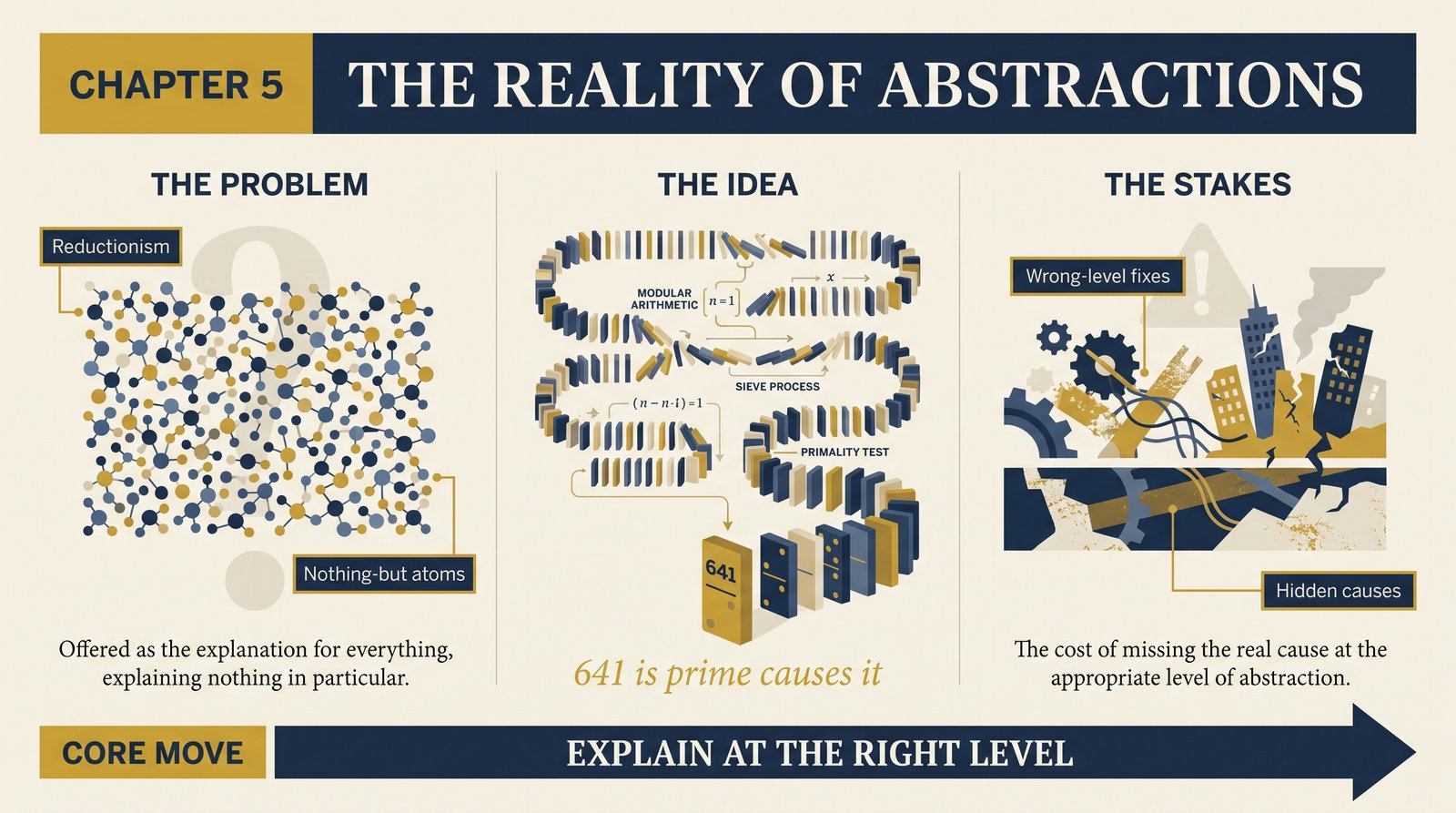
Abstractions — numbers, ideas, knowledge, moral principles — are real: they figure indispensably in causal explanations. Reductionism (only microphysics really causes anything) is false as methodology and as metaphysics. The criterion of reality is explanatory: if the best explanation of a phenomenon requires an entity, that entity is real — whatever level it lives on.
The Problem It Solves
The queasy modern habit of calling higher-level things "mere" — mere emergence, mere convention, "nothing but" atoms. If that were right, explanations citing ideas or programs would be dispensable shorthand. They aren't: no atom-level account of why a peg won't fit, or why Faraday's ideas spread, exists or could exist usefully. Explanation has autonomous levels, and causation runs through them.
Key Episode
Deutsch's domino computer: a vast array of dominoes wired to compute whether 641 is prime. One domino at the "output" never falls. Why? The microphysical story (this domino stood because that one stood because...) is true and explains nothing. The real explanation: 641 is prime — a fact of number theory, an abstraction, doing ineliminable causal work in the best explanation of a physical event. Hence: primality is real.
The Shift
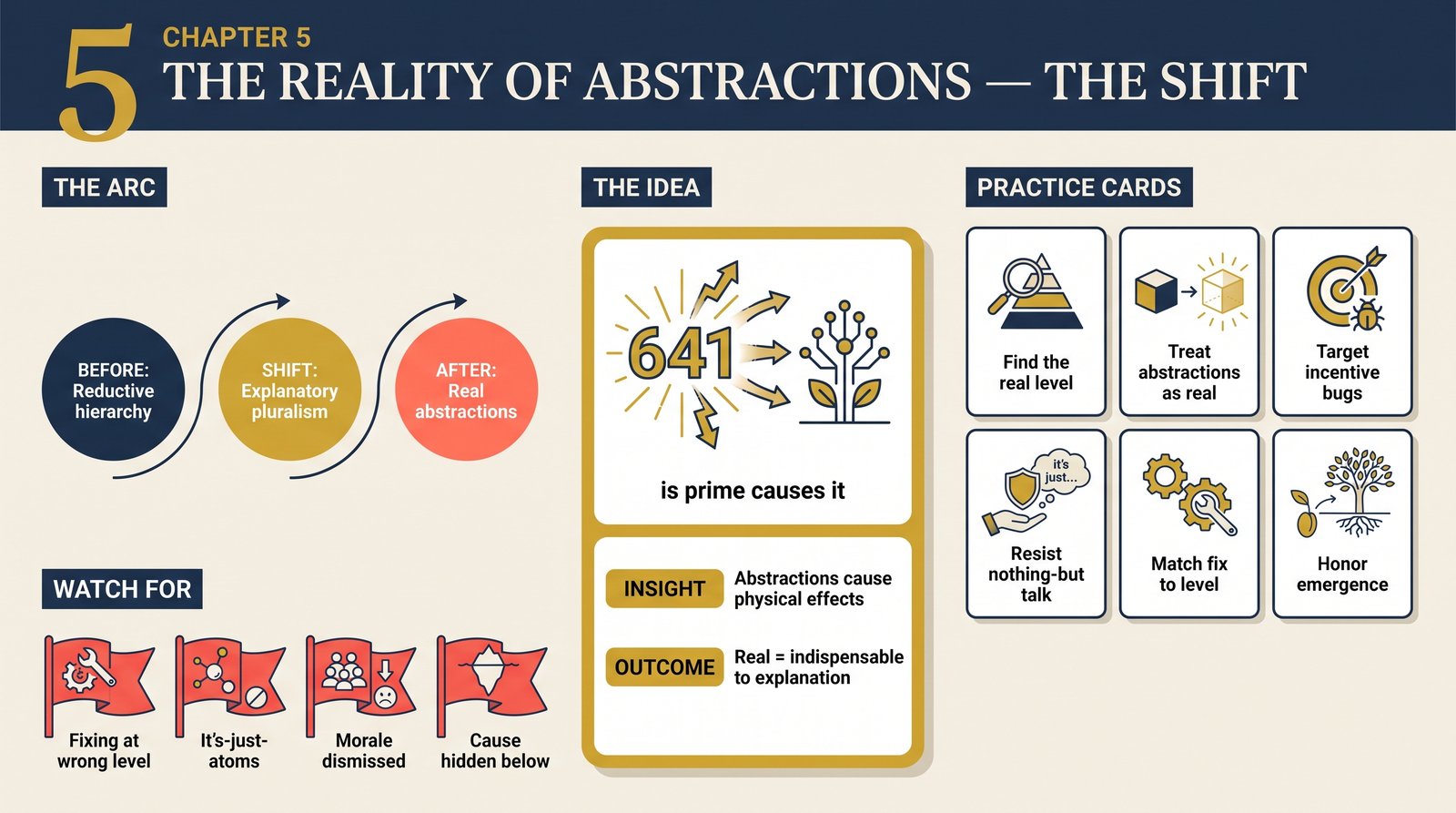
From the reductive hierarchy ("physics fundamental, the rest approximation") to explanatory pluralism: levels of emergence are quasi-autonomous, and fundamentality belongs to whatever the best explanations can't do without. This is also where persons re-enter physics: knowledge and ideas are abstractions with growing causal reach over matter — soon, per Chapter 3, over cosmology.
Critiques & Rivals
Physicalists accept "useful levels" but deny higher-level causation (exclusion problem: microphysics already fixes everything). Deutsch's reply is explanatory: causal talk lives inside explanations, and the microphysical "explanation" of the domino isn't one. Platonists welcome real abstractions but balk at tying reality to explanation; nominalists reject the whole menagerie. The debate is live in philosophy of mind (mental causation) and of mathematics.
Modern Application
Respect the level where the explanation lives. Debugging culture: some incidents are hardware-level, some code-level, some incentive-level — fixing an incentive bug at the code level is exactly the domino mistake. Same for organizations: "it's all just individuals" is reductionism; team dynamics, institutional knowledge, and morale are abstractions with causal teeth, and interventions must target the real level.
Key Terms
- Emergence — higher-level phenomena with autonomous explanations
- Explanatory criterion of reality — real = indispensable to the best explanation
- Reductionism — the false doctrine that lower levels explain everything
Key Quotes
"The behaviour of that domino is caused by the primality of 641... an abstraction can cause physical effects."
"There is no inconsistency in having multiple explanations of the same phenomenon, at different levels of emergence."
Reflection Questions
- Which recurring problem are you fixing at the wrong level of emergence?
- What abstraction (trust, technical debt, morale) does your best explanation require — and do you treat it as real?
- Where does "it's just X underneath" talk hide the actual cause?