Chapter 14 — Postscript: 1969
Core Thesis
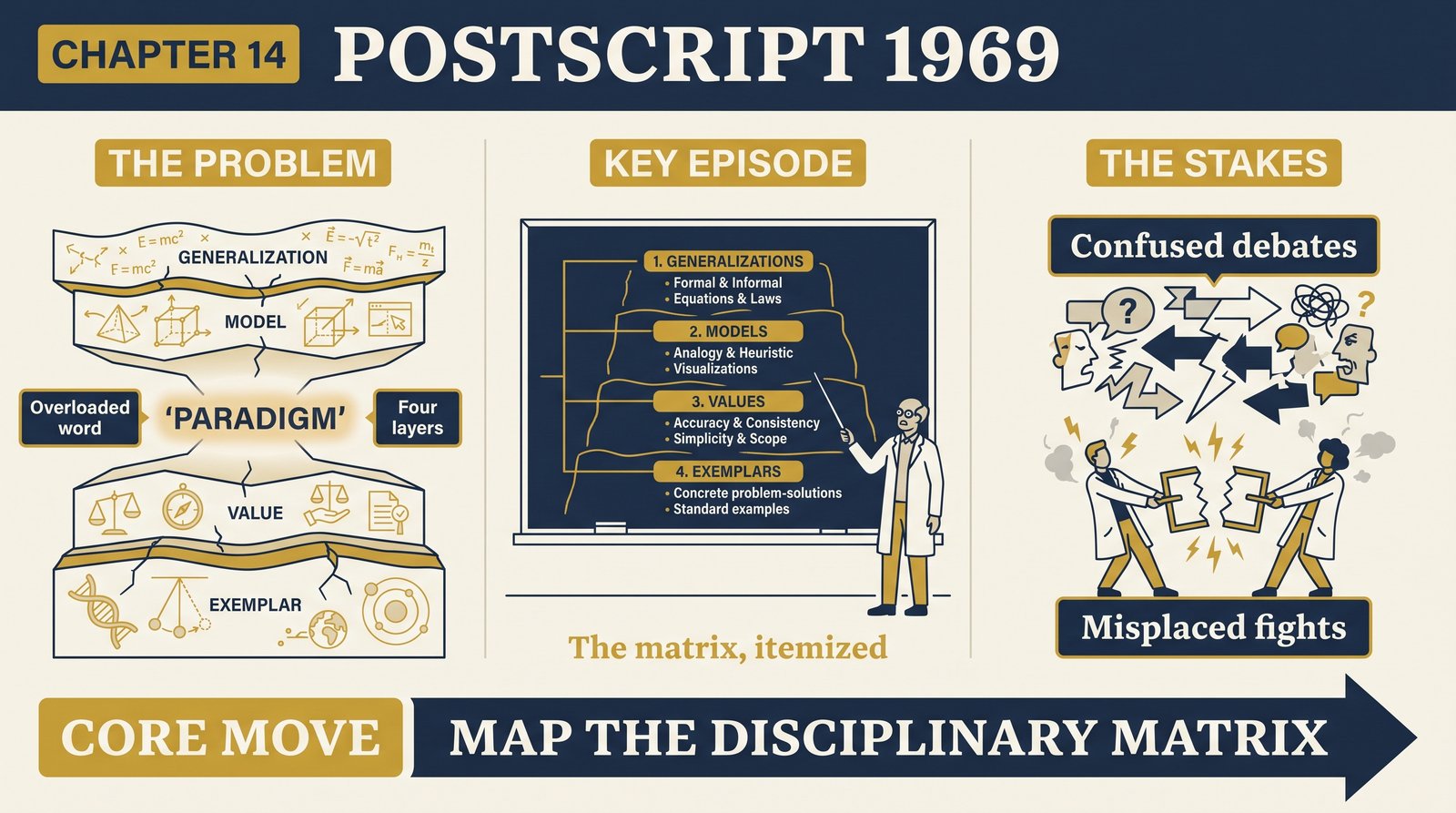
Seven years of criticism, answered. Kuhn splits the overloaded word "paradigm" in two: the disciplinary matrix — the entire constellation a community shares (symbolic generalizations, metaphysical models, values, exemplars) — and the exemplar — the concrete problem-solutions that do the deepest work. He recenters the whole theory on community structure, refines incommensurability into partial communication breakdown (translatable with effort), and rebuts the irrationalism charge.
The Problem It Solves
The book's own anomalies. Masterman's 21 senses of "paradigm"; the circularity of defining communities by paradigms and paradigms by communities; the charge that incommensurability makes theory choice irrational and communication impossible. The Postscript is Kuhn doing normal science on his own theory — articulating it under critical pressure.
Key Episode
The structure of the disciplinary matrix, itemized: (1) symbolic generalizations like f = ma, deployable without debate; (2) shared models, from heuristic analogies to metaphysical commitments; (3) values — accuracy, consistency, scope, simplicity, fruitfulness — shared across communities yet weighted individually; (4) exemplars, the trained similarity-relations from which all the rest gets its content. Plus the sharpened claim about values: their shared presence holds communities together, while their variable application usefully spreads the community's risk across options.
The Shift
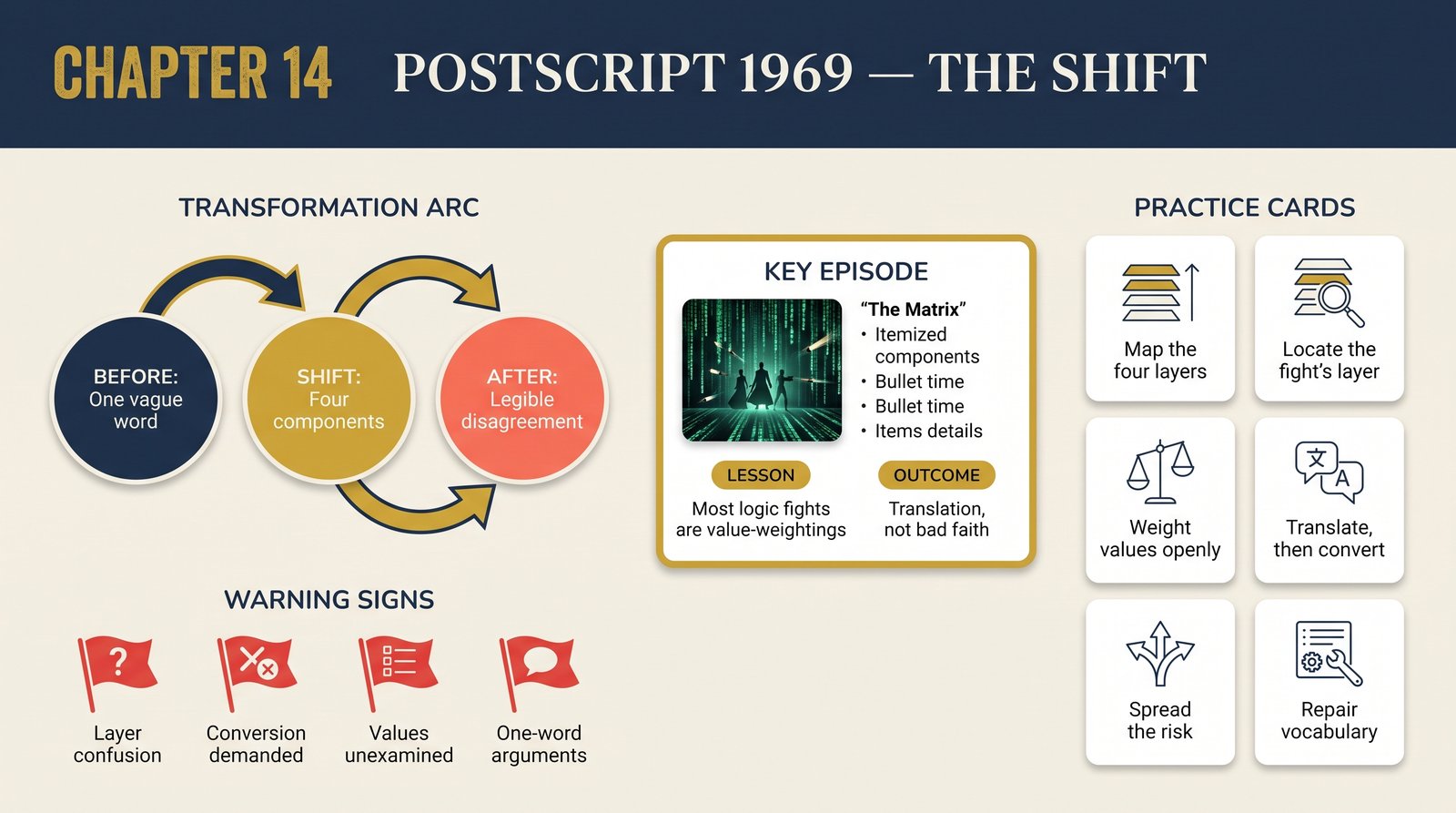
From monolithic "paradigm" to layered community cognition, and from incommensurability-as-mysticism to incommensurability-as-translation-problem: rival paradigm speakers are like speakers of different languages — communication is partial, translation laborious, and conversion ("going native") distinct from mere understanding. Knowledge, meanwhile, is relocated: it lives in trained similarity-perception, tacit and embodied, not in rules.
Critiques & Rivals
Did the clarification give too much away? Some readers found post-Postscript Kuhn disappointingly moderate — values-based choice looks close to ordinary methodology. Others (Feyerabend) thought even this too tame; realists still rejected the final section's denial that theories approach truth. Kuhn's own verdict: the book's central claims survive intact once vocabulary is repaired.
Modern Application
The disciplinary matrix is a diagnostic for any expert community: What formulas do we deploy without debate? What models are we committed to? What values do we all cite but weight differently? What exemplars trained us? Map those four layers for your team and disagreements become legible — most "logic" fights are actually exemplar or value-weighting differences. And treat cross-team conflict as translation work: partial communication is the normal case, not bad faith.
Key Terms
- Disciplinary matrix — generalizations + models + values + exemplars
- Exemplar — shared concrete problem-solutions; the deepest sense of "paradigm"
- Values — shared criteria, individually weighted; the community's risk-spreader
- Translation vs. conversion — understanding a rival framework vs. living in it
Key Quotes
"The paradigm as shared example is the central element of what I now take to be the most novel and least understood aspect of this book."
"Individual variability in the application of shared values may serve functions essential to science."
Reflection Questions
- Map your team's disciplinary matrix: which layer generates your recurring disagreements?
- Where are you demanding conversion from someone who has only (and legitimately) achieved translation?
- Which value — accuracy, scope, simplicity, fruitfulness — do you overweight, and what does that cost?
Connections
- Refines Priority of Paradigms and Resolution
- The values framework is the bridge to Lakatos's rational reconstruction (companion book, forthcoming)