Chapter 9 — Optimism
Core Thesis
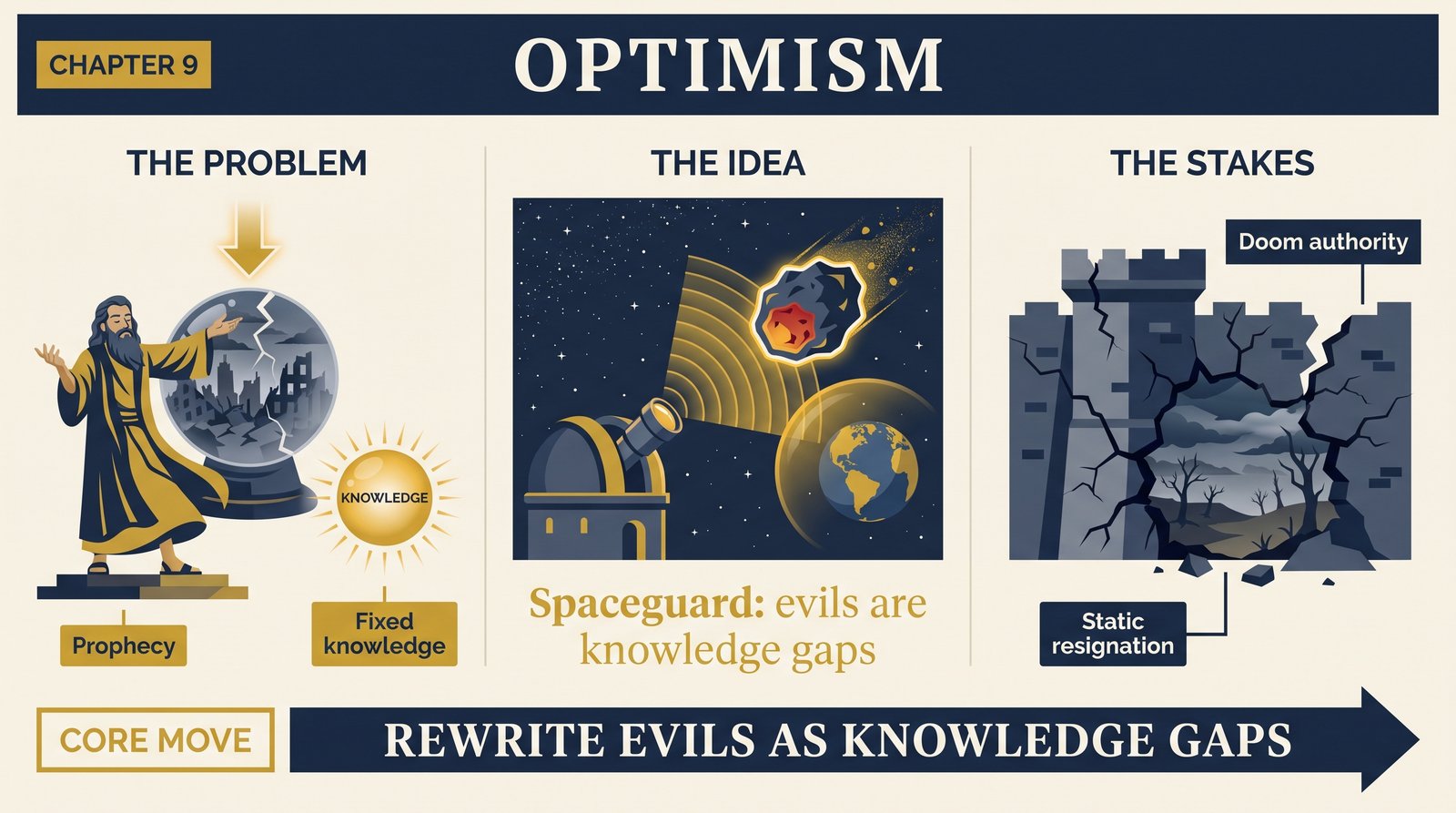
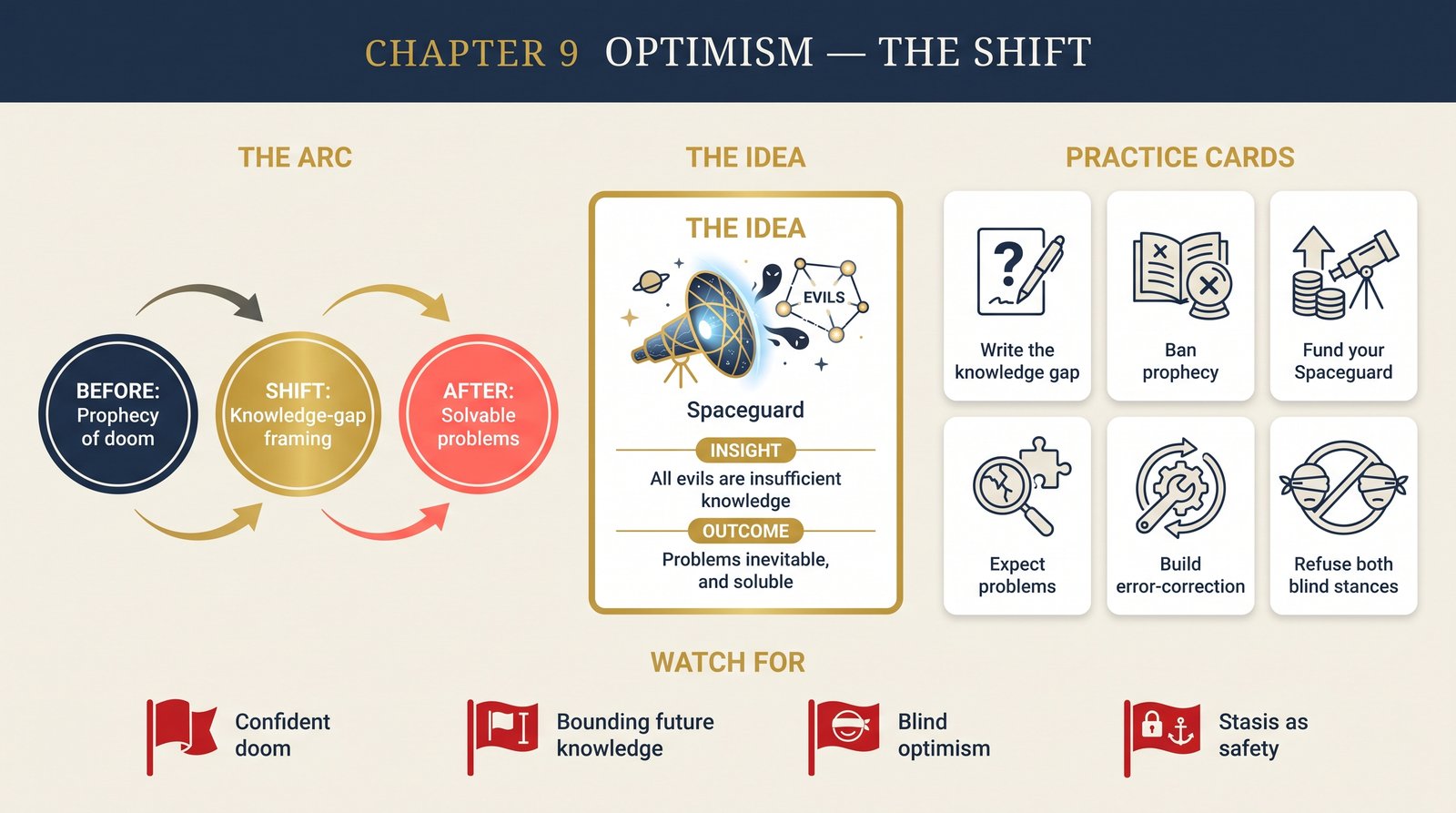
All evils are caused by insufficient knowledge. That is Deutsch's principle of optimism — not a mood but a factual claim paired with a methodological stance: problems are inevitable, and problems are soluble. Optimism, properly defined, is the proposition that all failures — all evils — are due to lack of knowledge, and that knowledge can be created by criticizable conjecture. Pessimism, in all its forms, is a prophecy — and prophecy (claiming to know the unknowable growth of future knowledge) is the underlying error.
The Problem It Solves
The recurring authority of doom. From Malthus to Rees's "final century," pessimists extrapolate present knowledge into futures where problems are fixed and knowledge is not — systematically underweighting the one variable that has broken every previous ceiling. Deutsch names the mirror error too: blind optimism (proceeding as if bad outcomes were impossible). Both go wrong the same way — by prophesying instead of explaining.
Key Episode
The Spaceguard parable in reverse: an asteroid impact would once have been a "natural disaster"; for a civilization that funds sky surveys, it is a preventable failure of knowledge-deployment. And history's laboratory: Athens' brief golden age of criticism versus Sparta's engineered stasis — a civilization optimized to prevent change, which therefore could not correct its own errors. The deepest case: why the Enlightenment's "mini-enlightenments" (Athens, Florence) died — they lacked the knowledge to defend the tradition of criticism itself.
The Shift
From optimism/pessimism as temperaments to a precise epistemic principle: never prophesy the bounds of future knowledge; treat every evil as a solvable knowledge-gap; expect problems, and build the error-correcting institutions that outlast any particular solution. The wealth-test flips accordingly: a civilization's safety is measured not by the problems it has avoided but by its capacity to solve the ones that arrive.
Critiques & Rivals
Precautionary thinkers reply that some errors (existential ones) permit no error-correction — asymmetric stakes justify prophecy-shaped caution. Deutsch's counter: stagnation is itself the riskiest strategy, since unknown threats require knowledge-growth to meet. Critics also probe "all evils": is death by ancient plague a knowledge-failure of its victims? (Deutsch: of civilization, yes — cures existed in the space of possible knowledge.) The debate structures today's existential-risk discourse.
Modern Application
Institutionalize the principle: for every persistent evil on your team's map (outages, churn, burnout), write it as a knowledge-gap statement — "we don't yet know how to X" — and it becomes a research agenda instead of weather. Ban prophecy in planning: scenarios and error-budgets, yes; confident declarations of what can't be done or can't go wrong, no. And fund your Spaceguard: surveillance of the problems you'd rather not think about.
Key Terms
- Principle of optimism — all evils are due to insufficient knowledge
- Blind pessimism / blind optimism — twin prophecy errors
- Problems are inevitable & soluble — the book's twin refrain
Key Quotes
"All evils are caused by insufficient knowledge."
"Problems are inevitable. Problems are soluble."
Reflection Questions
- Rewrite your three most persistent problems as "we don't yet know how to..." statements — what agenda appears?
- Where does your planning prophesy (confidently bounding future knowledge) rather than explain?
- What's your Spaceguard — the survey you should fund for problems you'd rather not imagine?
Connections
- The infinite room for solutions: Chapter 8
- The static societies that chose otherwise: Chapter 15