Concept 3 — The Research Programme
Core Thesis
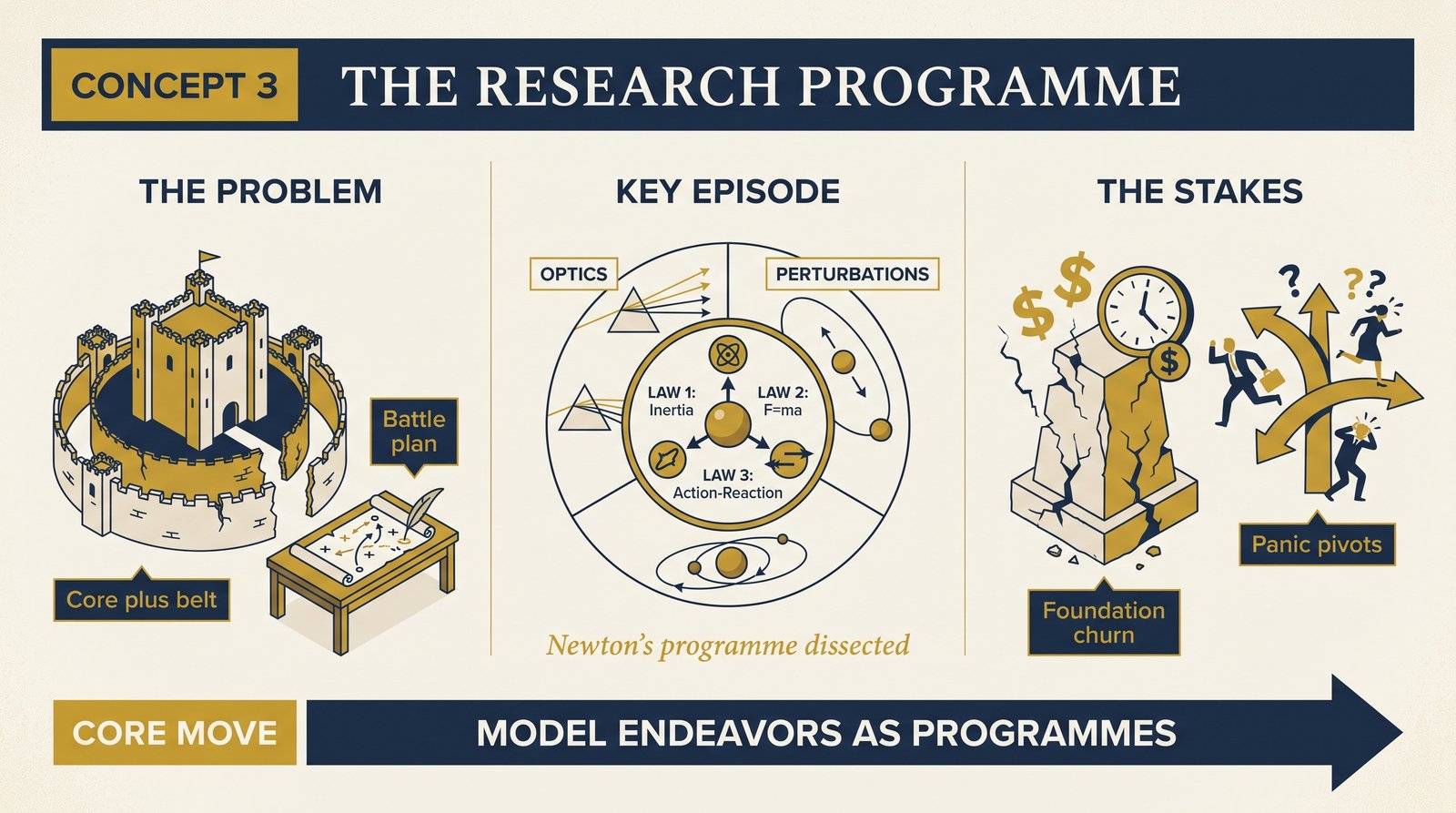
The unit of scientific achievement is not the theory but the research programme: a developing sequence of theories bound together by a hard core of unrevisable commitments, a protective belt of adjustable auxiliaries, and heuristics — rules telling researchers what to avoid (negative heuristic) and what to pursue (positive heuristic). Newtonian mechanics, Marxism, Freudianism: each is a programme, and each is appraised as a whole, over time.
The Problem It Solves
Kuhn's paradigm captured something real — the tenacity, the shared commitments — but wrapped it in sociology. Lakatos rebuilds it as logic: the paradigm's "dogmatism" becomes the negative heuristic (a methodological decision, not blind faith); normal science's puzzle-solving becomes the positive heuristic's planned agenda. Everything Kuhn described, reconstructed as rational strategy.
Key Episode
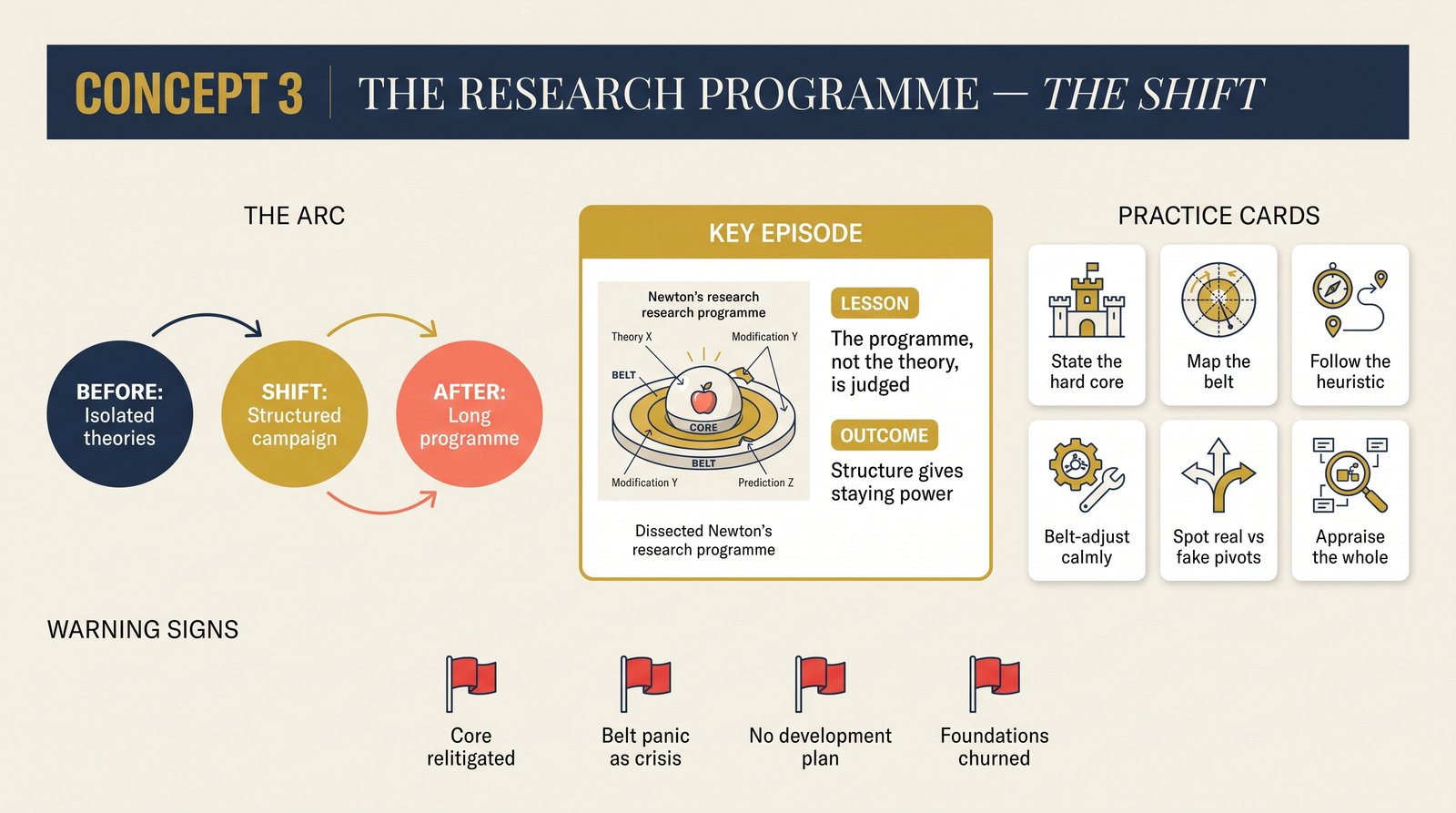
The Newtonian programme in full dress: hard core — the three laws plus universal gravitation; protective belt — geometrical optics, planetary shapes, perturbation assumptions, atmospheric refraction; positive heuristic — the planned march from point-planets to spinning oblate spheroids to interplanetary perturbations. Anomalies hit the belt, never the core; the heuristic told each generation which idealization to relax next.
The Shift
From theories as isolated claims to programmes as strategies with structure. Science stops being a pile of propositions and becomes a small number of long-running campaigns, each with protected foundations, sacrificial outworks, and a battle plan.
Critiques & Rivals
How sharply can core and belt be distinguished in practice? Historians find the boundary negotiated, not given. And who decides what's core? Lakatos: the community's methodological decision — which reopens the door to the sociology he wanted to expel. Kuhn noted the deep similarity to his own view, minus the label "irrational."
Modern Application
Model any serious endeavor as a programme. A startup: hard core = the founding bet ("developers will pay for X"); belt = pricing, packaging, channels, features; positive heuristic = the roadmap's planned idealization-lifting. Most "pivots" are belt adjustments; a real pivot changes core — and that founds a new programme. Knowing which layer you're touching prevents both panic and drift.
Key Terms
- Research programme — theory-sequence + hard core + belt + heuristics
- Negative heuristic — do not aim refutations at the core
- Positive heuristic — the planned agenda of programme development
Key Quotes
"The basic unit of appraisal must be not an isolated theory or conjunction of theories but rather a 'research programme'."
"All scientific research programmes may be characterized by their 'hard core'."
Reflection Questions
- State your project's hard core in one sentence. Can your team?
- Which current "crisis" is actually a routine belt adjustment?
- Does your roadmap embody a positive heuristic — or just react to the loudest anomaly?