Chapter 16 — The Evolution of Creativity
Core Thesis
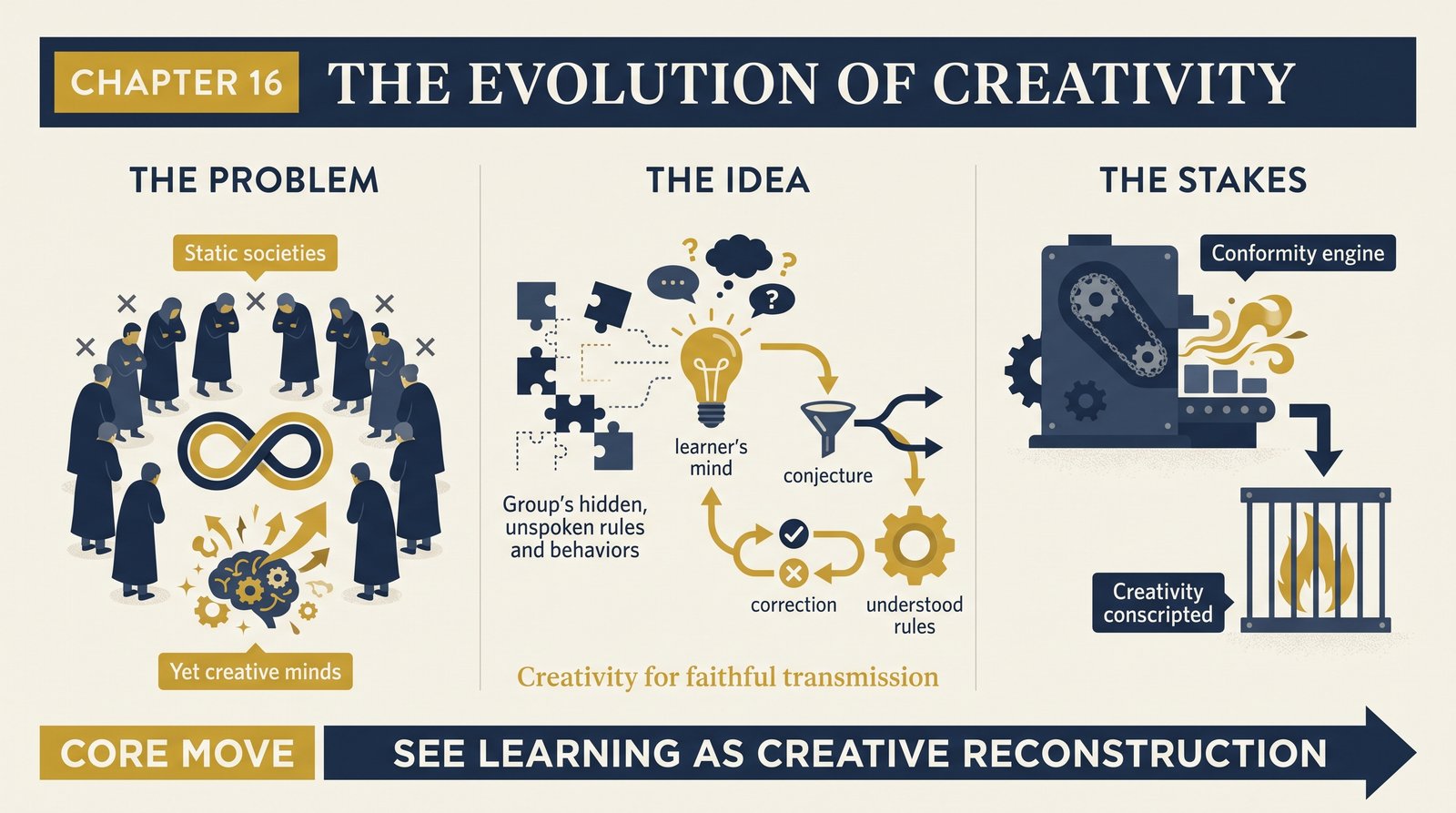
Deutsch poses an evolutionary puzzle and answers it with an inversion. Why did human creativity evolve at all, given that early human societies were static — hostile to new ideas, punishing deviation? His answer: creativity evolved not to innovate but to transmit existing culture faithfully. To acquire the complex, unspoken memes of one's tribe, a child must creatively reconstruct the hidden rules behind others' behavior — an act of conjecture and criticism. Creativity's original survival value was high-fidelity conformity.
The Problem It Solves
The paradox that creativity — engine of change — arose in societies that suppressed change. If innovation got you killed, selection should have eliminated the innovative. Deutsch dissolves it: the same faculty that could innovate was selected because it was necessary for learning to conform. Copying complex behavior isn't imitation of movements; it requires guessing the meanings and rules generating them — creativity in service of sameness. Only much later, and rarely, was that faculty turned outward toward genuine novelty.
Key Episode
The child mastering tribal life: not mimicking gestures but inferring the unstated norms — when to speak, what a ritual means, which rules override which — by conjecturing explanations of others' conduct and correcting them against feedback. Deutsch argues this demands the same explanatory creativity later used for science; a purely imitative animal could not acquire a human culture at all. The tragic corollary from Chapter 15: static societies then bent this magnificent faculty toward reproducing anti-rational memes — creativity weaponized against itself.
The Shift
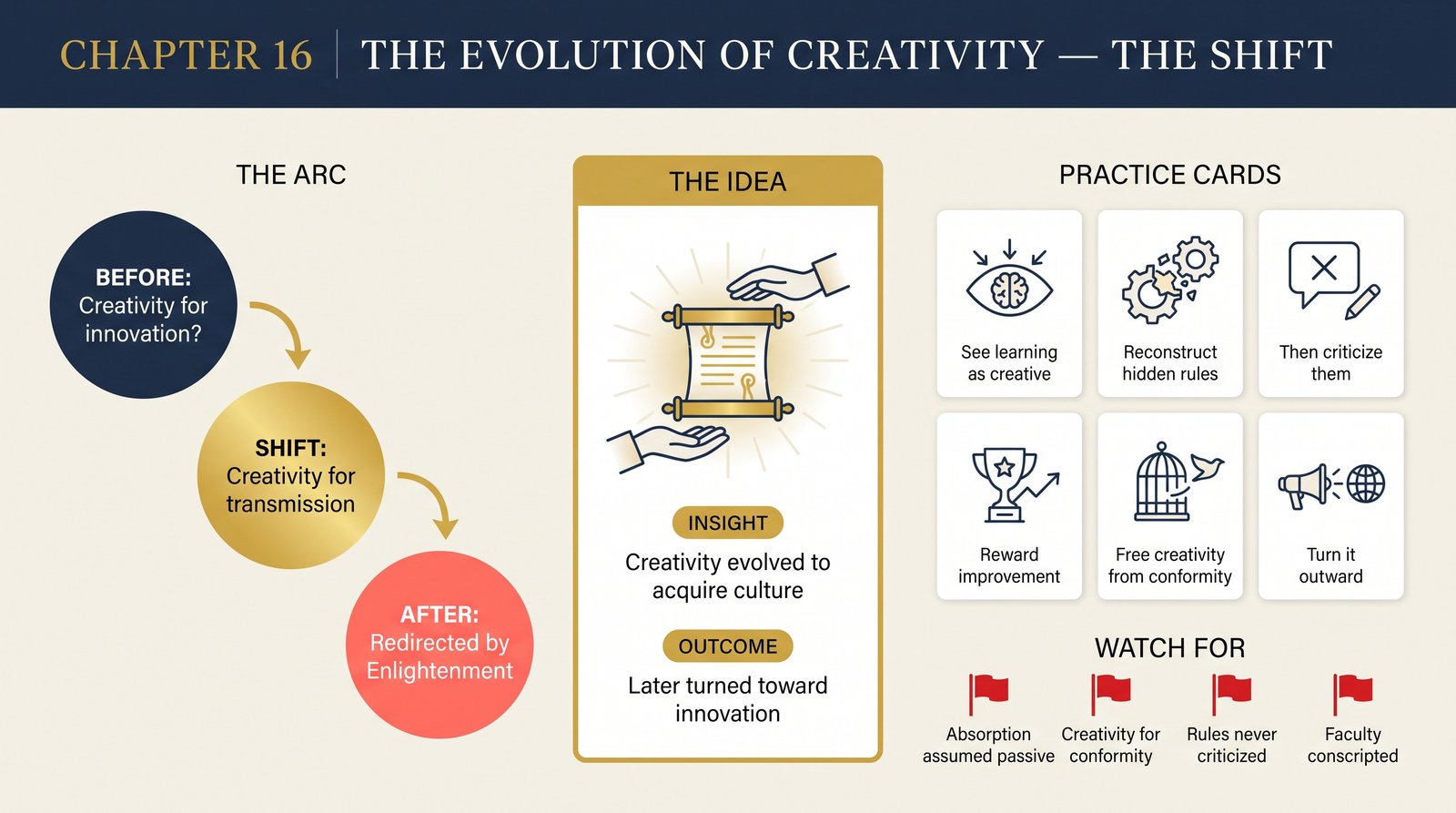
From creativity-as-innovation to creativity-as-acquisition: the capacity to create new explanations was selected for cultural transmission, and only the Enlightenment redirected it, systematically, toward criticism and progress. This unifies the book's threads — the universal explainer (Ch 3, 7), meme evolution (Ch 15), and the rarity of dynamic societies — into one origin story for the human mind's defining power.
Critiques & Rivals
Cognitive scientists offer rival accounts of creativity's origin (social-cognition arms races, sexual selection, tool-use cascades) that don't route through Deutsch's transmission argument. Some doubt the sharp static-society premise the puzzle relies on. Others question whether faithful cultural learning really needs explanatory creativity rather than powerful imitation plus statistical learning — the same fault line as the AGI debate in Chapter 7.
Modern Application
Recognize that acquiring a rich practice is itself a creative act — which reframes onboarding, apprenticeship, and expertise. Learning your craft deeply is not passive absorption; it's conjecturing the hidden rules behind masters' choices and testing them. The organizational lesson doubles Chapter 15's: the same creative faculty your people use to learn "how we do things" can be turned toward improving them — but only if the culture rewards criticism rather than conscripting creativity into pure conformity.
Key Terms
- Creativity for transmission — its original selective role: faithful cultural acquisition
- Meme acquisition — reconstructing hidden rules by conjecture
- Redirected creativity — the Enlightenment turn toward innovation
Key Quotes
"Our creativity evolved... in order to keep our behaviour the same as that of our fellow tribesmen."
"To imitate a behaviour, one must first understand it — and understanding is an act of creativity."
Reflection Questions
- Where in your work is deep learning actually creative reconstruction disguised as "just absorbing best practices"?
- Is your team's creativity mostly spent reproducing "how we do things" or improving them?
- What hidden rules did you have to conjecture to master your craft — and could you now criticize them?
Connections
- The universal explainer this faculty constitutes: Chapter 7
- Static societies that captured it: Chapter 15