Chapter 9 — The Nature and Necessity of Scientific Revolutions
Core Thesis
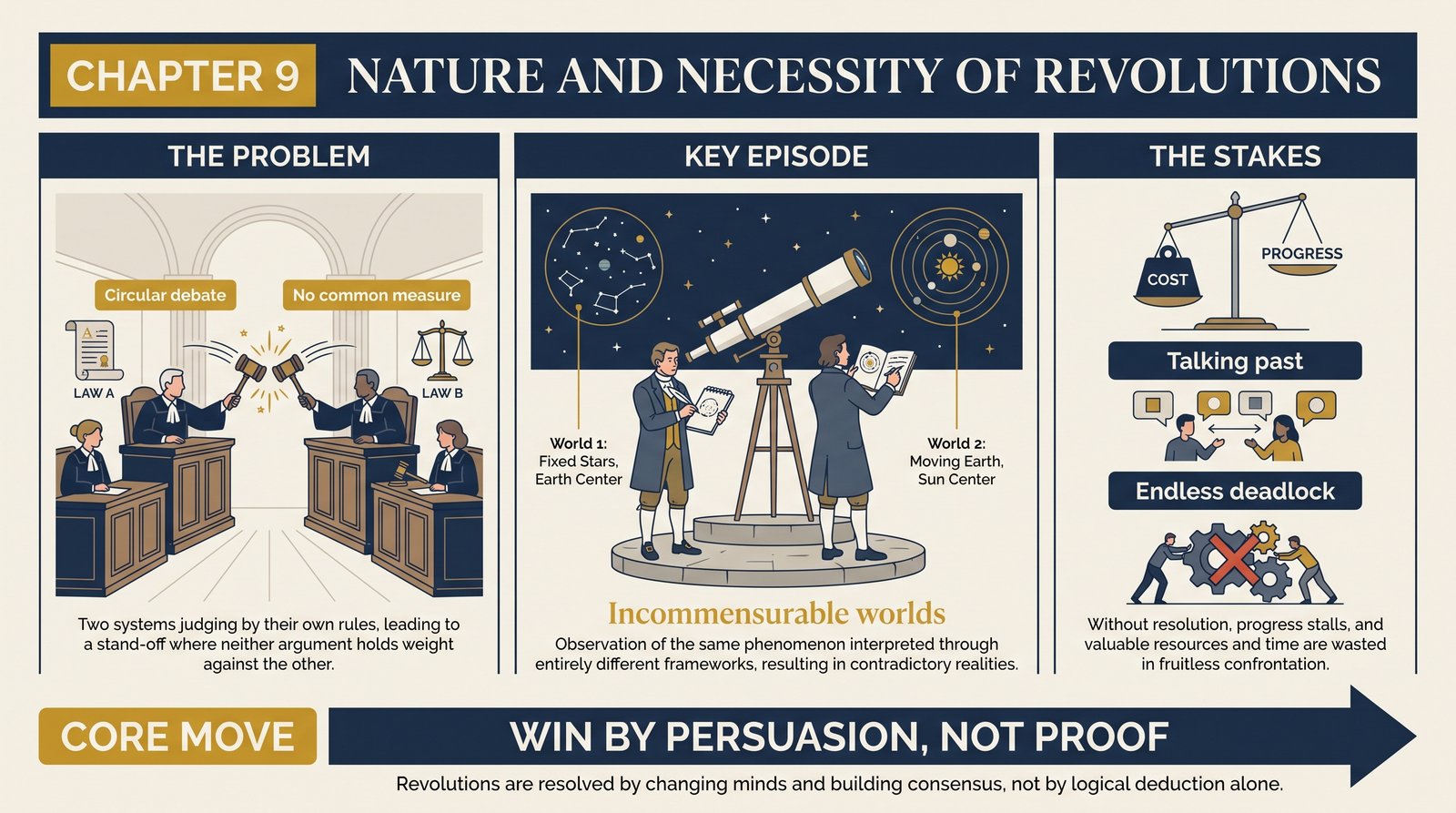
Scientific revolutions parallel political ones. A revolution is a noncumulative episode in which an older paradigm is replaced in whole or in part by an incompatible new one — and, as in politics, the choice between competing paradigms cannot be settled by the normal rules, because those rules are themselves part of what's in dispute. Each paradigm argues in its own circle; persuasion, not proof, decides.
The Problem It Solves
The comfortable view that new theories simply extend old ones (Newton as a "special case" of Einstein). Kuhn dismantles this: Einsteinian mass, space, and time are conceptually different beasts from their Newtonian namesakes. The derivation that recovers Newton's equations changes the meaning of every symbol in them. If accepting relativity, you cannot also hold what Newtonians meant.
Key Episode
The political analogy itself: revolutions begin with a growing sense that existing institutions have ceased to meet the problems they created, proceed through a period when society is divided between competing institutional frameworks, and end by means — mass persuasion, force of demonstration — outside the old institutions' rules. Kuhn maps each stage onto paradigm change, including the polarization into camps that no shared procedure can arbitrate.
The Shift
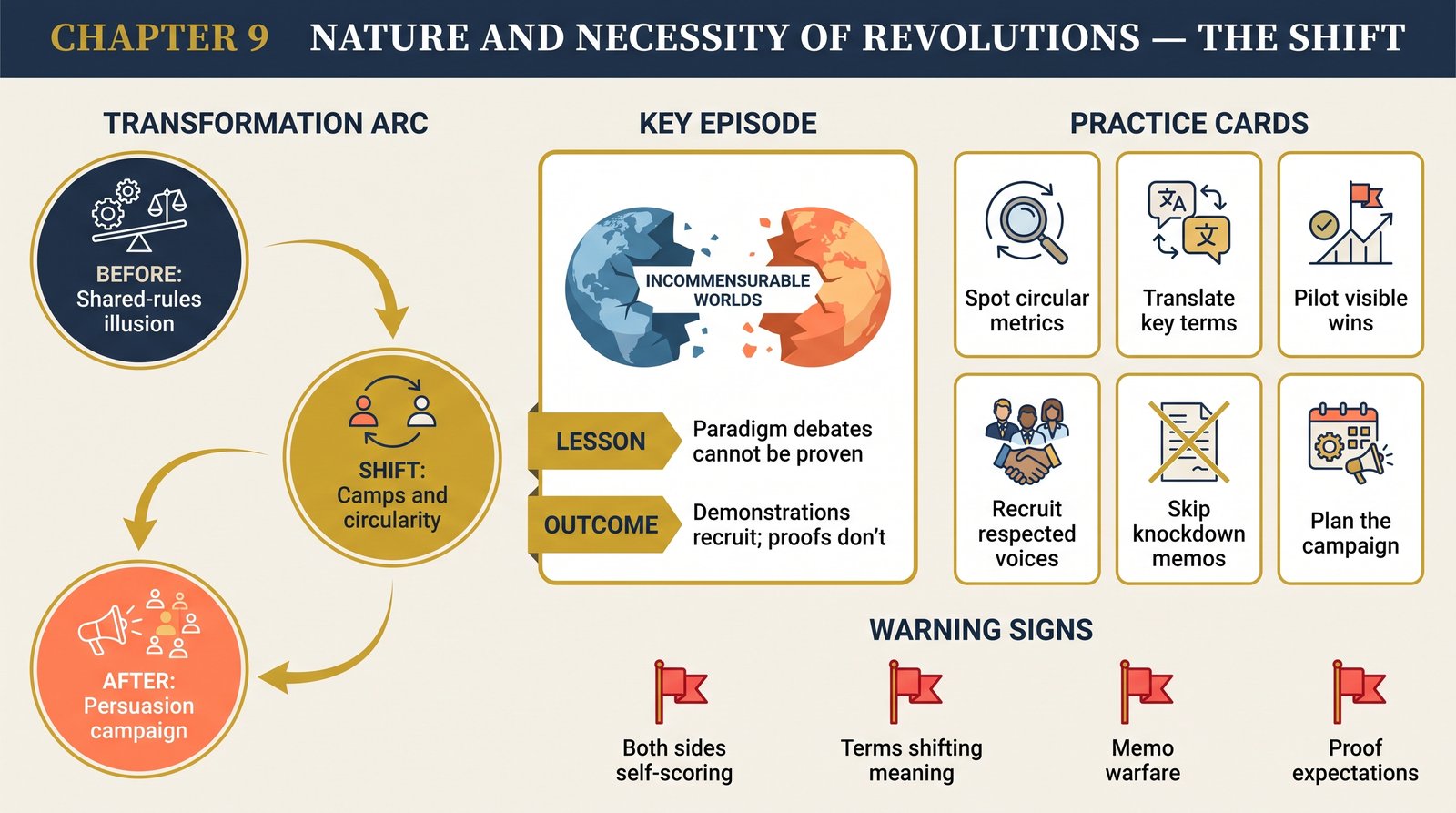
From science-as-accumulation to science-as-punctuated-equilibrium. Also a logical point with teeth: paradigms are not merely incompatible, they are incommensurable — they disagree about what the problems are, what counts as a solution, and what the words mean. That's why paradigm debates talk past each other and why logic and experiment alone can't close them.
Critiques & Rivals
The chapter drew the "irrationalism" charge: if rules can't decide, is theory choice mob psychology? Kuhn spent the rest of his career insisting no — shared values (accuracy, scope, simplicity, fruitfulness) operate even when rules fail. Structural realists counter that mathematical structure carries over across revolutions, making them more cumulative than Kuhn allows.
Modern Application
Platform migrations, org redesigns, strategy reversals: expect the debate to be paradigm-shaped. Each side's metrics validate itself ("uptime!" vs. "velocity!"), and the argument is circular by nature. Resolution comes from demonstrations that recruit — pilot wins, defections of respected figures, new hires raised in the new framework — not from a knockdown memo. Plan revolutions as persuasion campaigns, not proofs.
Key Terms
- Scientific revolution — noncumulative replacement of one paradigm by an incompatible one
- Incommensurability — no common measure: different problems, standards, meanings
- Circularity of paradigm debate — each paradigm justifies itself by its own criteria
Key Quotes
"Like the choice between competing political institutions, that between competing paradigms proves to be a choice between incompatible modes of community life."
"Though each may hope to convert the other to his way of seeing his science and its problems, neither may hope to prove his case."
Reflection Questions
- In your current big disagreement, are the two sides using each other's success criteria — or each their own?
- What would a "demonstration that recruits" look like for the change you're championing?
- Which terms in your debates ("quality," "value," "done") have silently changed meaning between camps?
Connections
- The perceptual version of the same claim: world-view change
- How such debates actually end: Resolution