Chapter 10 — A Dream of Socrates
Core Thesis
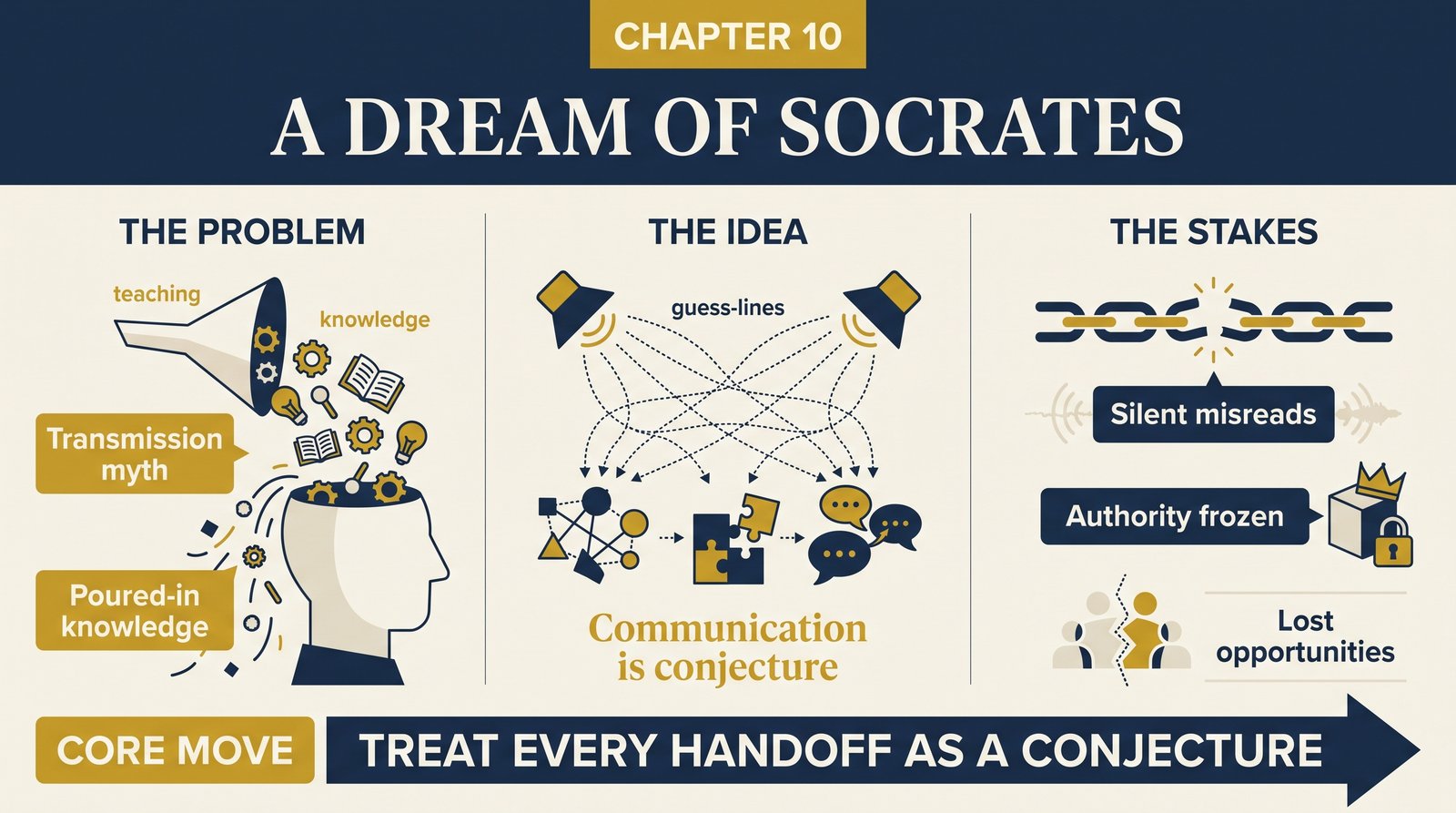
A philosophical dialogue — Deutsch's homage to and correction of Plato. Hermes visits the sleeping Socrates and teaches, by relentless questioning, the book's epistemology: knowledge comes not from authority, revelation, or the senses, but from conjecture corrected by criticism; and all communication is itself conjectural — listeners guess speakers' meanings and err productively. Even a god cannot pour knowledge into a mind; Hermes can only help Socrates create it himself.
The Problem It Solves
Two founding myths of Western epistemology at once: the justificationist reading of Socrates/Plato (knowledge as justified true belief anchored in authority — ultimately, the Forms) and the transmission model of teaching (knowledge flows from knower to learner). The dialogue dramatizes their replacement: fallibilism about all sources, and learning as active reconstruction — with misunderstanding not as noise but as the mechanism by which ideas mutate and sometimes improve.
Key Episode
The dialogue's sly frame: Hermes teaches Socrates fallibilism; Socrates recounts the dream to his students; and young Plato, taking notes, misunderstands systematically — hearing "knowledge cannot be transmitted" and writing down doctrines of authoritative Forms and philosopher-kings. Deutsch stages the origin of justificationism as history's most consequential productive misunderstanding — proving the dialogue's own thesis about communication in the act of its corruption.
The Shift
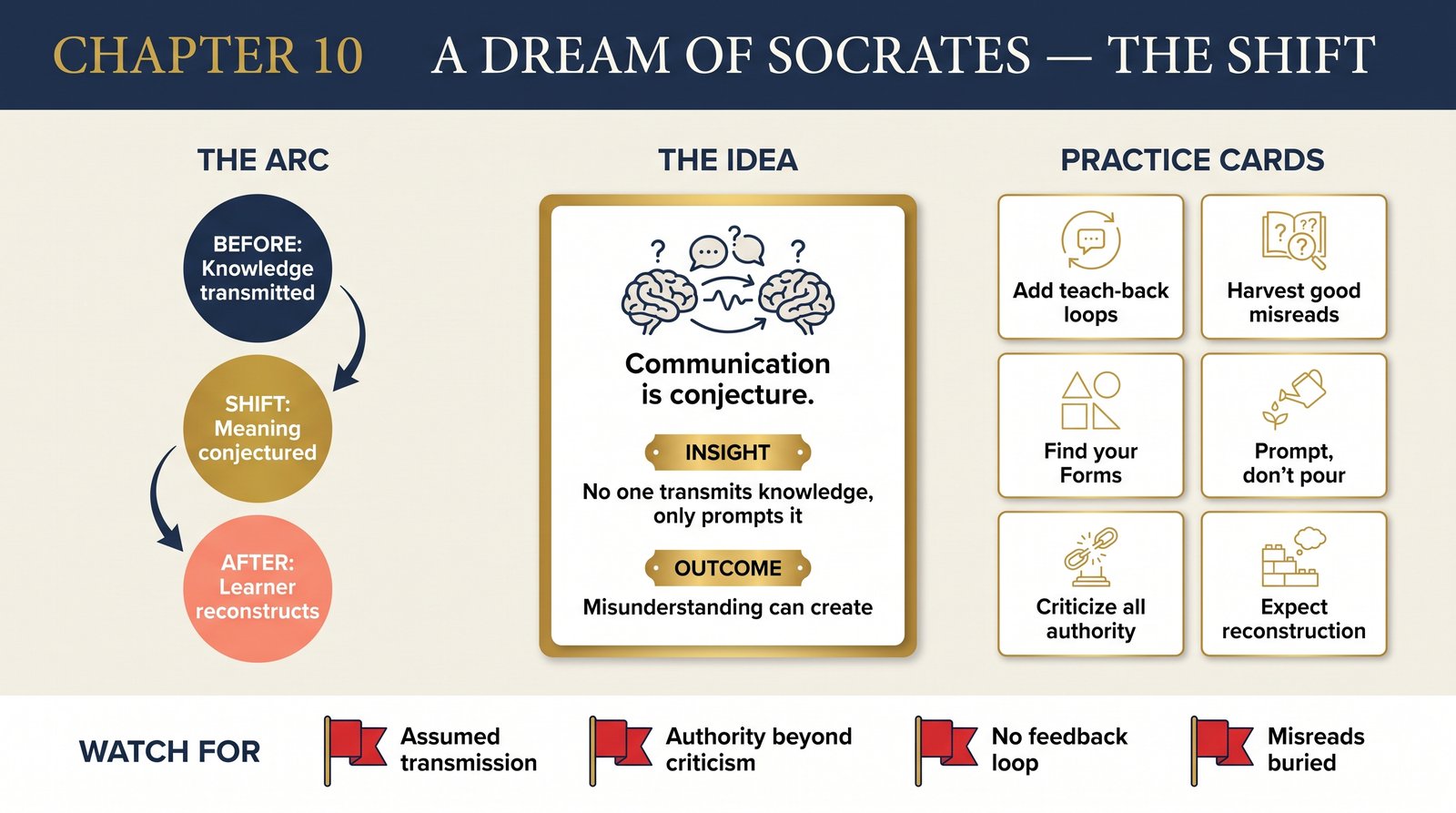
From knowledge-as-transmitted to meaning-as-conjectured: every act of listening, reading, or teaching is guesswork disciplined by criticism. Authority drops out at every level — divine (Hermes disclaims it), textual (Plato corrupts it), pedagogical (students rebuild, not receive). The Socratic method itself is recast: not eliciting innate truths (Meno's paradox dissolved) but provoking conjecture and supplying criticism.
Critiques & Rivals
Classicists note the historical liberties (cheerfully conceded — it's a dream). Justificationists reply that fallibilism self-undermines: is "all knowledge is conjectural" itself conjectural? (Deutsch/Popper: yes, and none the worse.) Education theorists split: constructivist pedagogy claims the mantle of learning-as-reconstruction, while critics blame that same doctrine for abandoning instruction — a fight over the chapter's practical moral.
Modern Application
Treat every handoff as a conjecture-generator: specs, briefs, and lectures are not pipes but prompts — the receiver will build something different, so build feedback loops that surface the difference early (teach-back, red-teaming the spec, worked examples). And harvest productive misunderstanding: when someone "gets it wrong" in an interesting way, they may have created something — Plato did, catastrophically well.
Key Terms
- Fallibilism — no source of knowledge is authoritative
- Conjectural communication — meaning is guessed, then corrected
- Productive misunderstanding — error as mutation in idea-evolution
Key Quotes
"No one can teach anyone anything, except by helping them to work it out for themselves."
"Every mind creates its own version of what it hears."
Reflection Questions
- Which handoff in your work assumes transmission where reconstruction is happening — and what surfaces the gap?
- When did a misreading of your idea improve it?
- What authority (document, leader, tradition) functions as Forms in your organization — beyond criticism?
Connections
- The epistemology dramatized: Chapter 1 and Chapter 4
- How ideas replicate through imperfect copying: Chapter 15