Chapter 13 — Progress through Revolutions
Core Thesis
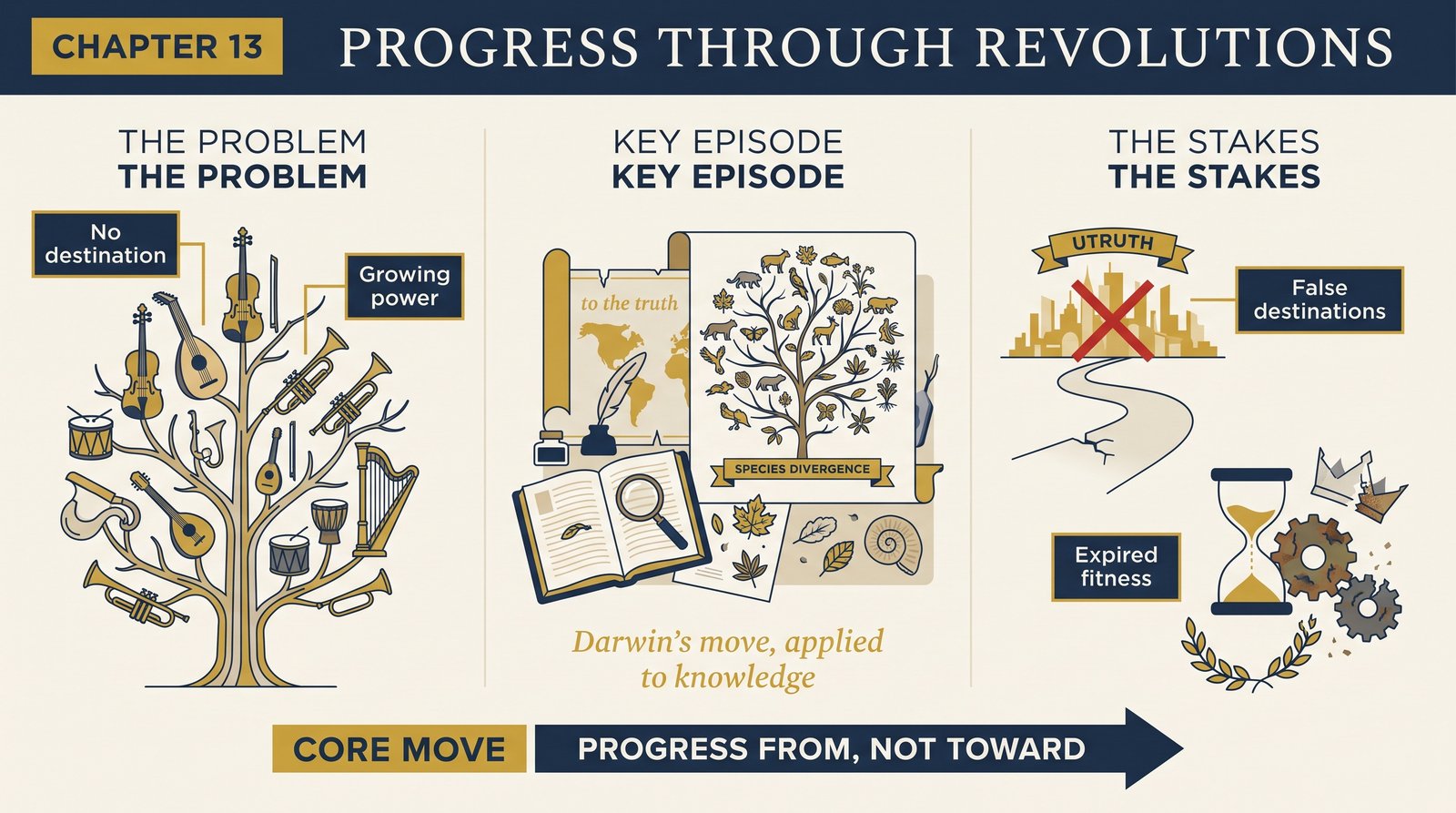
Science progresses — but from, not toward. Kuhn's closing move is an evolutionary analogy: as Darwin removed the goal from biological evolution, Kuhn removes the goal from scientific development. Later science is better at puzzle-solving than earlier science — more problems solved, more precision — without needing to be closer to a final truth. Progress is real, directional, and goalless.
The Problem It Solves
The nagging worry the whole book creates: if revolutions replace rather than extend, and no paradigm-neutral standard exists, why does science so obviously work? Kuhn's answer separates two things everyone had fused: instrumental progress (undeniable — puzzle-solving power grows) and teleological progress (unnecessary — "closer to the truth" does no explanatory work). Science can be the most progressive human enterprise without approaching anything.
Key Episode
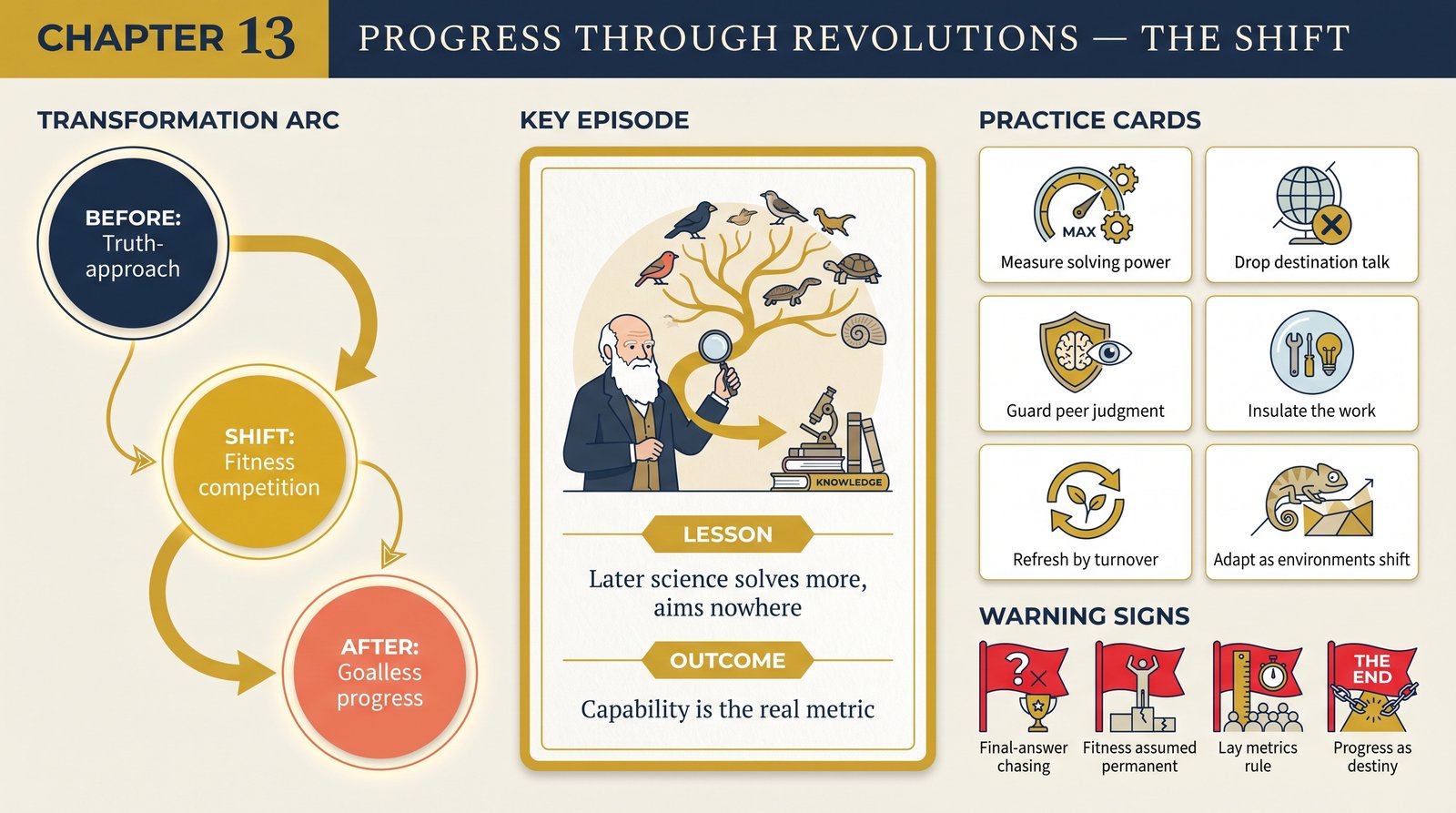
Part of the answer is sociological: science looks uniquely progressive partly because the victors write the textbooks (Chapter 11), but mostly because of the community's peculiar structure — insulated from lay demands, sharing rigorous training, judging work only by peers. Kuhn's list of what makes a field progress reads today like a design spec: shared exemplars, autonomy from external pressure, a communication network, and generational turnover through education.
The Shift
From truth-approach to fitness-increase. The evolutionary analogy: paradigms are selected by competition for puzzle-solving capacity within an environment of anomalies, the way organisms are selected by reproductive fitness — no telos required, and irreversibility guaranteed. Kuhn ends by asking what knowledge of the world could mean under this picture — the question his critics, and his own later work, chased for decades.
Critiques & Rivals
Scientific realists find this the book's deepest error: the no-miracles argument (science's success would be miraculous unless theories approximately track truth) directly targets this chapter. Structural realists offer the compromise — structure accumulates across revolutions even as ontologies churn. Kuhn held the line: he saw no coherent sense in "closer to the truth," and his final work recast development as speciation of scientific lexicons.
Modern Application
Measure progress as capability, not destiny. Teams chasing "the right architecture" or "the final org design" mistake the game: there is no destination, only increasing problem-solving fitness under changing environments. This liberates: you don't need to justify a change as The Truth, only as solving more of what currently blocks you. And it warns: today's winner is fit for today's anomalies — environments shift, and fitness expires.
Key Terms
- Progress from — development away from primitive beginnings, toward no fixed goal
- Evolutionary analogy — paradigm selection as goalless fitness competition
- Instrumental vs. teleological progress — puzzle-solving power vs. truth-approach
Key Quotes
"We may, to be more precise, have to relinquish the notion, explicit or implicit, that changes of paradigm carry scientists and those who learn from them closer and closer to the truth."
"The developmental process described in this essay has been a process of evolution from primitive beginnings... But nothing that has been or will be said makes it a process of evolution toward anything."
Reflection Questions
- What would change in your work if you optimized "solves more problems" instead of "approaches the right answer"?
- Which fitness of yours — skill, product, strategy — is adapted to an environment that's shifting?
- Does your team's definition of progress smuggle in a destination nobody has justified?
Connections
- Answers the tension built since Chapter 9
- The lexical-speciation successor idea threads into the Postscript