Chapter 3 — The Spark
Core Thesis
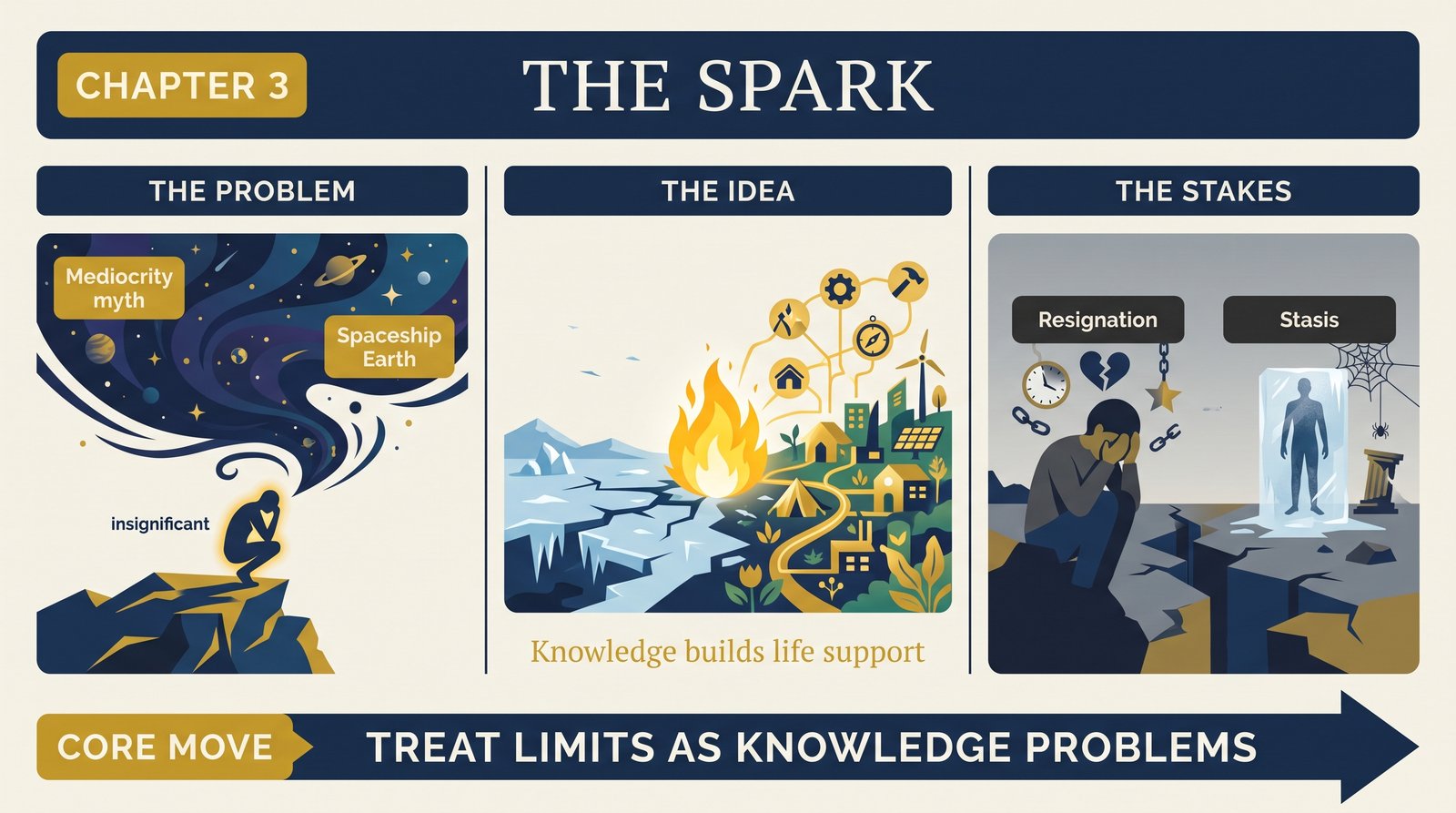
Two reigning humilities are false. The Principle of Mediocrity ("we are nothing special — chemical scum on a typical planet") and Spaceship Earth ("the biosphere is our life-support system, uniquely suited to us"). Deutsch refutes both with one move: people are universal explainers and constructors. Anything not forbidden by the laws of physics is achievable by people with the right knowledge — which makes people the most significant entities in the cosmic scheme, and makes every place in the universe equally (in)hospitable pending knowledge.
The Problem It Solves
A civilization's self-image sets its ambitions. Mediocrity counsels resignation (our understanding must stay parochial); Spaceship Earth counsels stasis (stay within the support system's limits). Both, Deutsch shows, are factually backwards: intergalactic space kills humans in seconds, but so would the Great Rift Valley winter without knowledge — humans survive anywhere only by creating knowledge, and with enough of it can thrive anywhere, Earth included.
Key Episode
The corrected picture of our habitat: a typical place in the universe is intergalactic vacuum at 2.7 kelvin. Earth's biosphere, romanticized as a nurturing mother, never supported humans comfortably — early humans in the Rift Valley died of exposure, starvation, and parasites amid what pastoral imagination calls paradise. What changed wasn't the biosphere; it was knowledge: fire, clothing, agriculture, medicine. Life support was built, not given.
The Shift
From "how insignificant we are" to "how significant knowledge-creators are": people (human or otherwise) are the only known systems with unbounded reach — the universe's way of being comprehensible includes us comprehending it. The chapter's slogan-level inversion: the Earth is not our spaceship; knowledge is.
Critiques & Rivals
Ecologists bristle: doesn't this license recklessness toward the biosphere? Deutsch's answer (developed in Chapter 17): no — it relocates the duty from preserving to knowing; problems are inevitable, and only knowledge-growth handles them. Anthropic-principle cosmologists contest the physics of "typicality"; theologians and deep ecologists contest the axiology. The claim that physics forbids nothing else — the "momentous dichotomy" — remains the boldest and most contested plank.
Modern Application
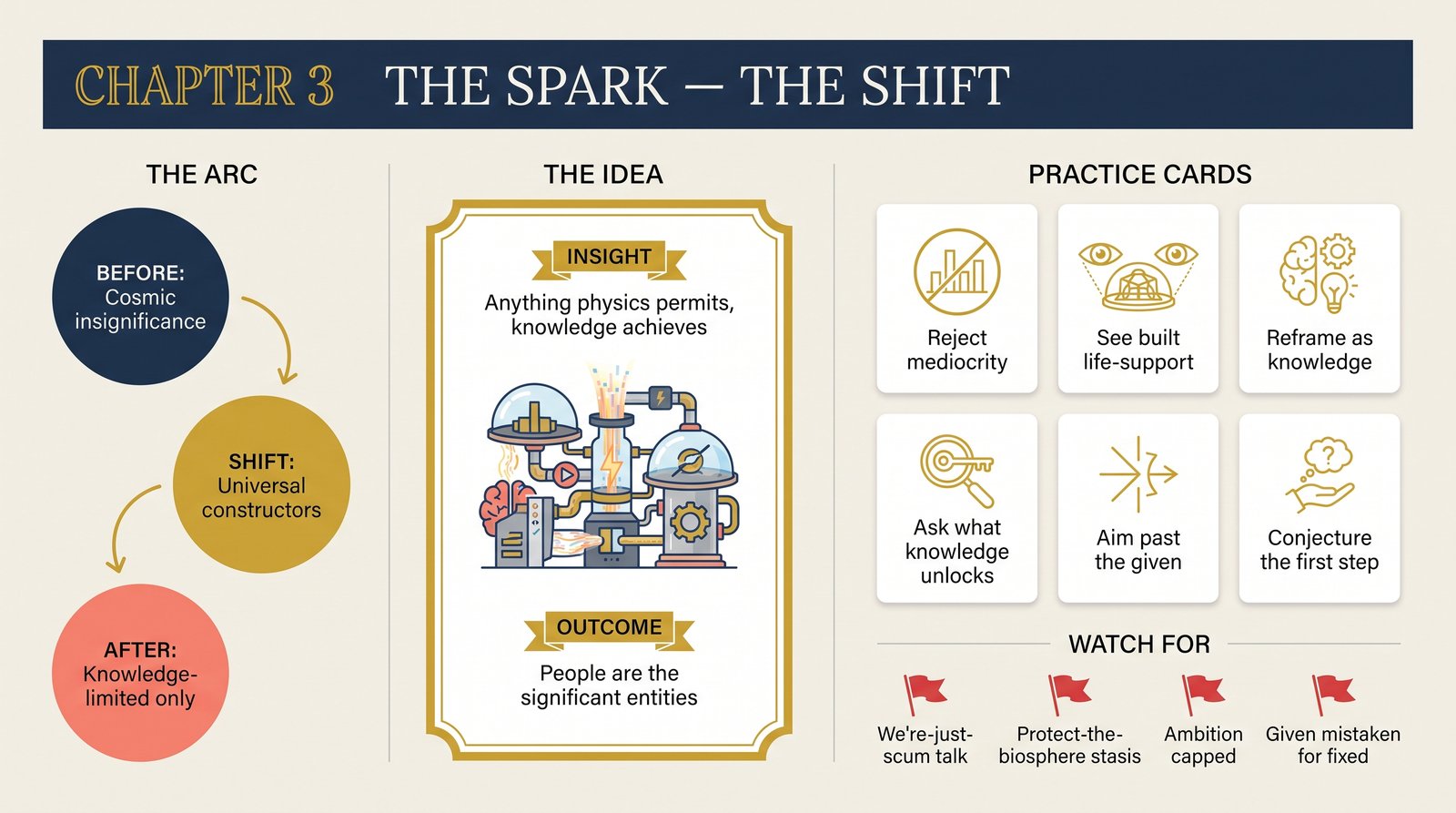
Diagnose your organization's self-image. Mediocrity-culture ("we're a small player, we adapt") and Spaceship-culture ("protect the legacy system, it sustains us") both cap ambition at the status quo. The Deutschian alternative: any outcome not forbidden by the laws of your domain is a knowledge problem. The question shifts from "what does our environment permit?" to "what knowledge would make it permit more?"
Key Terms
- Principle of Mediocrity — "nothing significant about humans" (rejected)
- Spaceship Earth — "the biosphere is our tailored life-support" (rejected)
- Universal constructor/explainer — people; the momentous dichotomy's engine
Key Quotes
"Every problem that is interesting is also soluble... anything that is not forbidden by the laws of nature is achievable, given the right knowledge."
"The Earth's biosphere is incapable of supporting human life... it is only knowledge that makes it possible."
Reflection Questions
- Where does mediocrity-humility cap your team's ambitions below physics?
- What "life support" in your work is actually built knowledge wearing the costume of a given?
- Which impossible-seeming goal is merely knowledge-limited — and what's the first conjecture?
Connections
- What creates that knowledge: Chapter 4
- The sustainability debate this reframes: Chapter 17