Chapter 8 — A Window on Infinity
Core Thesis
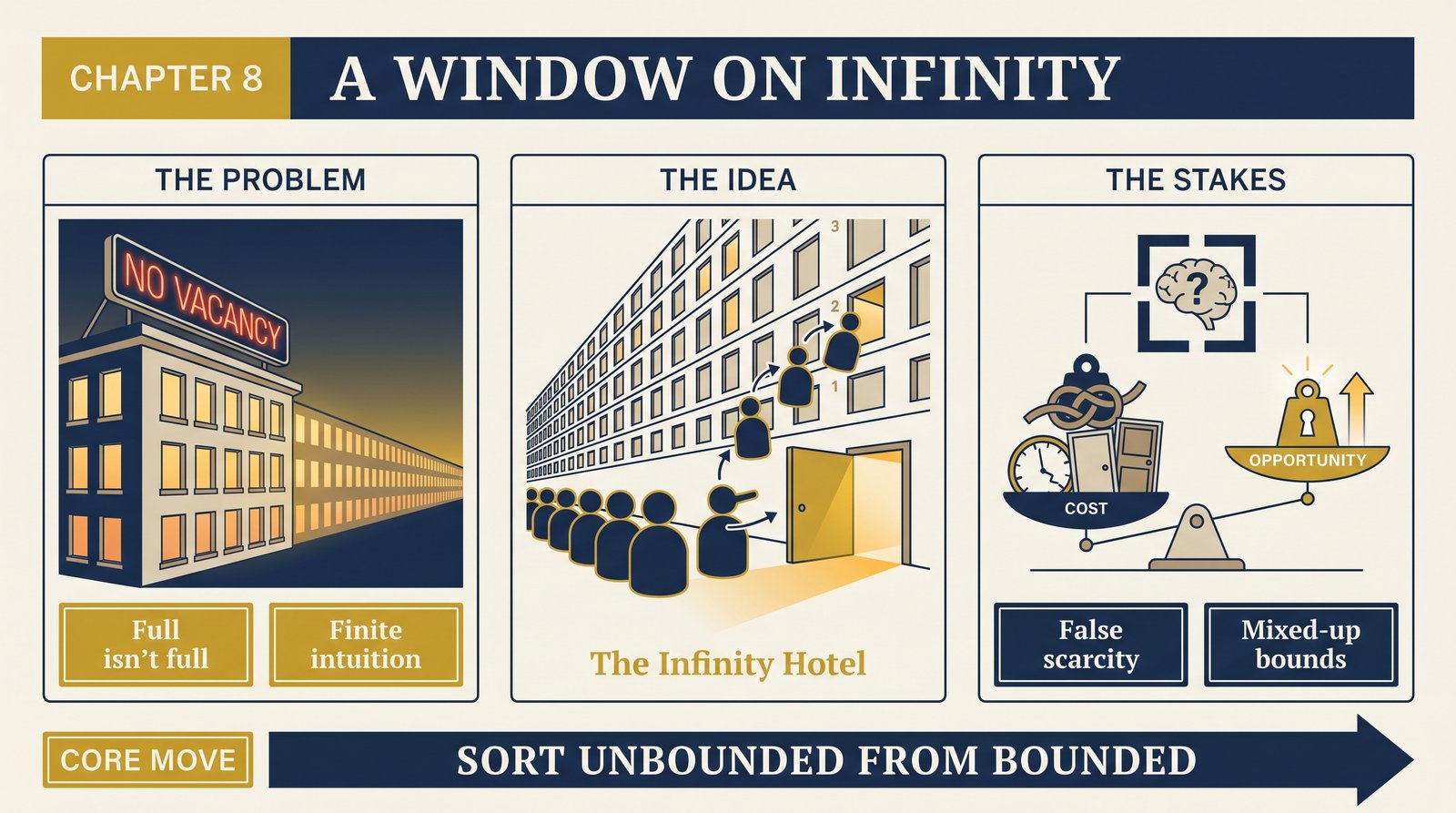
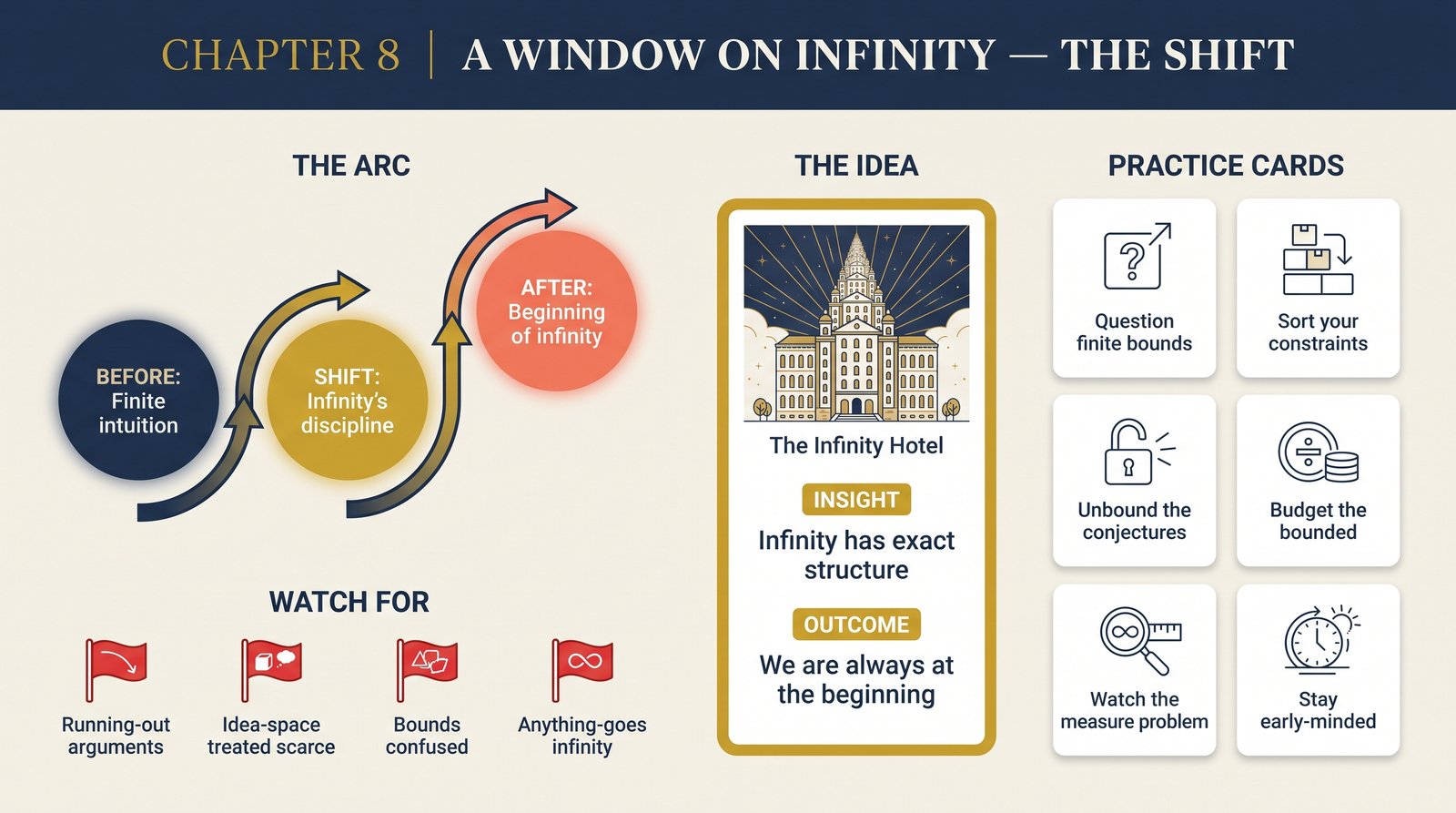
Infinity is not exotic — it is the ordinary working environment of anyone who takes unbounded progress seriously. Deutsch tours Hilbert's Infinity Hotel to train the intuition: with infinitely many rooms, "full" never means "no vacancy"; whole infinities can be absorbed by shuffling. The moral: where knowledge-creation is concerned, we are always at the beginning of infinity — every achieved state is negligible beside what remains, and "running out" arguments quietly assume finitude they haven't earned.
The Problem It Solves
Finite intuition misapplied to unbounded processes. Arguments of the form "there are only so many ideas / resources / niches" import bounds from parochial experience. The chapter also dissolves puzzles about probability and typicality in infinite sets (there's no uniform "random room" in the hotel — anthropic reasoning beware), grounding Chapter 3's cosmology and Chapter 9's optimism in careful mathematics.
Key Episode
Infinity Hotel's management problems, played for keeps: every room full, a new guest arrives — everyone moves up one, room 1 free. Infinitely many new guests? Everyone to double their room number; all odd rooms free. Infinitely many coaches each with infinitely many passengers — still absorbable. But: the hotel generates waste faster than any disposal, and "the passengers' union" paradoxes show some tasks are impossible even there. Infinite ≠ anything-goes; it has exact structure.
The Shift
From infinity-as-metaphor to infinity-as-discipline: which quantities in a domain are genuinely unbounded (explanations, error-corrections, digital copies), which are bounded (energy density, speed), and which puzzles come from mixing them up. Also the mathematical anchor for the book's title: progress has no natural ceiling because explanation-space, unlike any physical warehouse, is infinite.
Critiques & Rivals
Finitists and constructivists in mathematics reject completed infinities outright — the hotel, they'd say, illustrates grammar, not fact. Physicists note nothing physically realizable is known to be infinite; Deutsch agrees on instantiation while insisting the reach of knowledge (an abstraction — Chapter 5) is genuinely unbounded. Anthropic-reasoning practitioners contest his measure-theoretic pessimism about "typical observers."
Modern Application
Sort your constraints. Teams routinely treat idea-space as scarce (defending one concept as if it were the last) and physical constraints as negotiable (schedules, attention, energy) — exactly backwards. Conjecture-space is Infinity Hotel: another rival explanation always has a room. Meanwhile actual bounds (compute budgets, attention, trust) obey conservation laws. Optimism about the unbounded, arithmetic about the bounded.
Key Terms
- Infinity Hotel — Hilbert's intuition-trainer for countable infinity
- Beginning of infinity — every state is early relative to unbounded progress
- Measure problem — no uniform probability over infinite sets
Key Quotes
"In an infinite hotel, 'full' does not mean what it means elsewhere."
"We are always at the beginning of infinity."
Reflection Questions
- Which "we're running out of ideas" argument in your field smuggles in a finite bound?
- What do you treat as scarce that is actually unbounded — and vice versa?
- If your project is at the beginning of infinity, what changes about this quarter's stakes?