Chapter 4 — Normal Science as Puzzle-Solving
Core Thesis
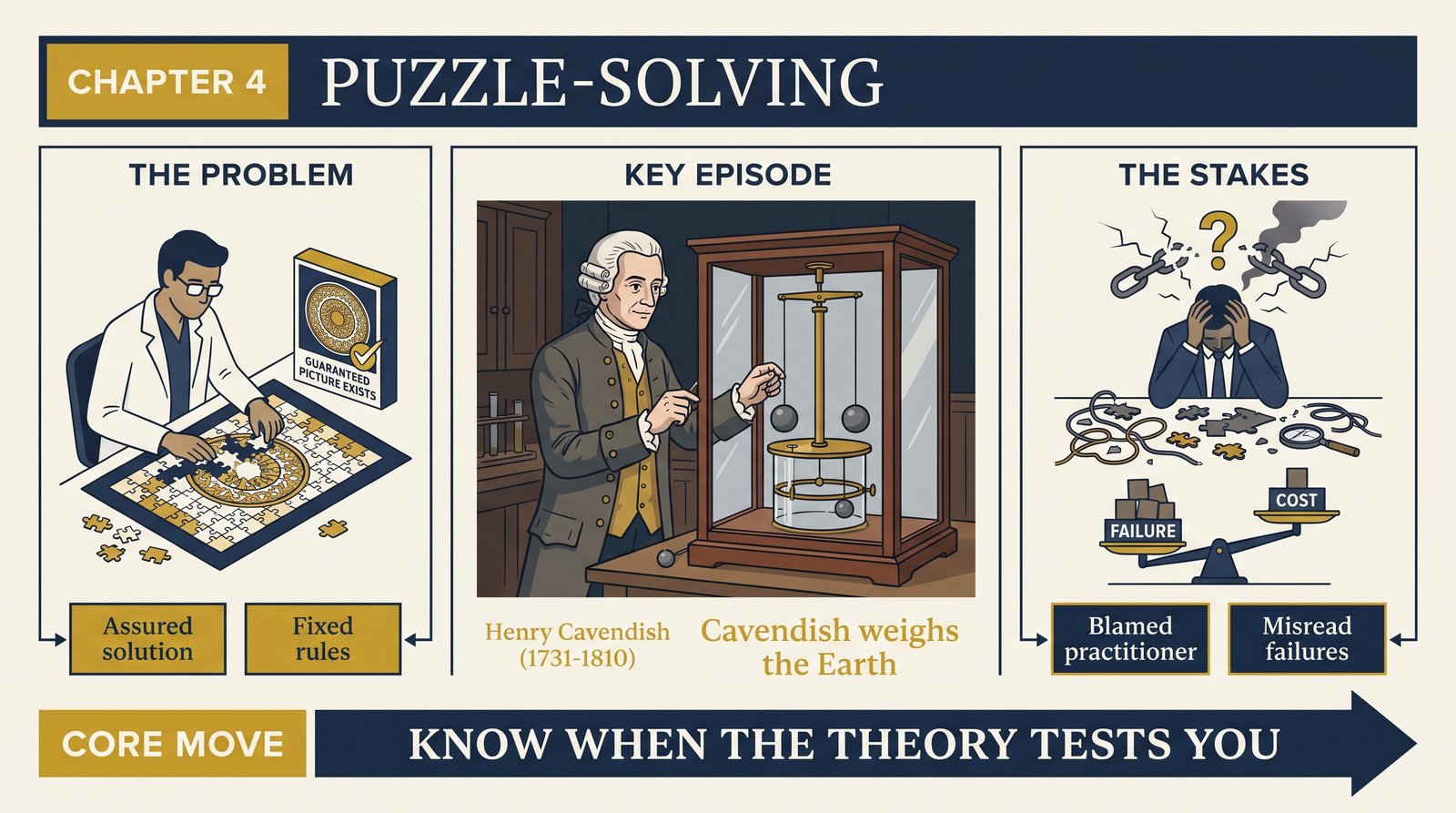
Normal research problems are puzzles: challenges where a solution is assured to exist, the rules constrain admissible moves, and failure discredits the scientist rather than the theory. Like a chess problem or crossword, the fascination isn't the outcome's importance — it's the test of ingenuity against known constraints.
The Problem It Solves
Why do brilliant people devote careers to questions whose answers are largely known in advance? Because the paradigm guarantees the puzzle has a solution, and solving what nobody else could solve is the professional achievement. This also explains scientific motivation without invoking noble truth-seeking: the drive is craftsmanlike — to be the one who cracked it.
Key Episode
The measurement of Cavendish's gravitational constant, or the decades-long refinement of atomic weights in nineteenth-century chemistry. Nobody doubted Newton or Dalton; the challenge was making apparatus and analysis good enough. A scientist who failed had failed as a puzzle-solver — "a poor carpenter blames his tools," and a poor scientist gets blamed, not the paradigm.
The Shift
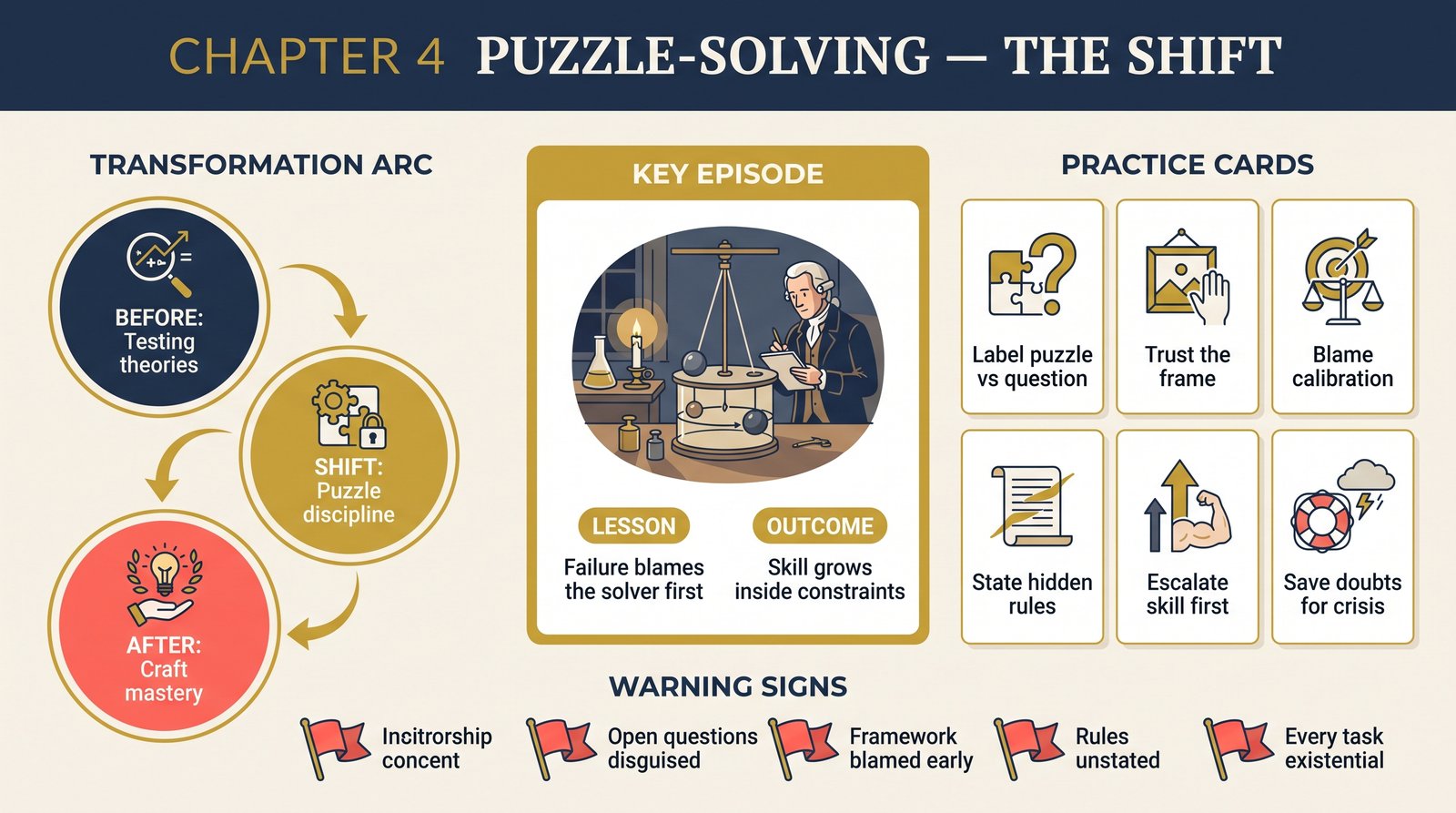
From "scientists test theories" to "theories test scientists." During normal science, the paradigm is not on trial. This reverses Popper exactly: a failed prediction reflects first on the practitioner's skill, and only after repeated, resistant failure does it begin to reflect on the framework.
Critiques & Rivals
Popper: this is dogmatism institutionalized. Lakatos tried a synthesis — research programmes with a protected "hard core," where the negative heuristic forbids aiming refutations at foundations, mirrors Kuhn's puzzle-solving while keeping a rational reconstruction. Critics also note some sciences (parts of social science) generate puzzles without assured solutions — are they then not normal sciences?
Modern Application
Well-run engineering and operations teams work in puzzle mode: the architecture is fixed, the ticket has a definition of done, failure means escalate-your-skill not redesign-the-system. Burnout and chaos follow when management turns every task into an open question — or when a genuinely open question is disguised as a routine puzzle. Name which mode a task is in before assigning it.
Key Terms
- Puzzle — a problem with an assured solution and rules constraining acceptable solutions
- Rules — explicit and implicit commitments: laws, instruments, metaphysics, standards
- Assured solution — the paradigm's guarantee that makes sustained effort rational
Key Quotes
"Though intrinsic value is no criterion for a puzzle, the assured existence of a solution is."
"It is a poor carpenter who blames his tools... only the practitioner is blamed, not his tools."
Reflection Questions
- Which of your current problems are puzzles (solution assured) and which are open questions dressed as puzzles?
- When you fail at a task, do you first suspect your skill or your framework — and is that calibrated?
- What rules constrain your solutions so silently you'd struggle to state them?
Connections
- Where the rules come from — and why they're not really rules: Priority of Paradigms
- What happens when a puzzle refuses solution: Crisis