Law 15: The Law of Fickleness
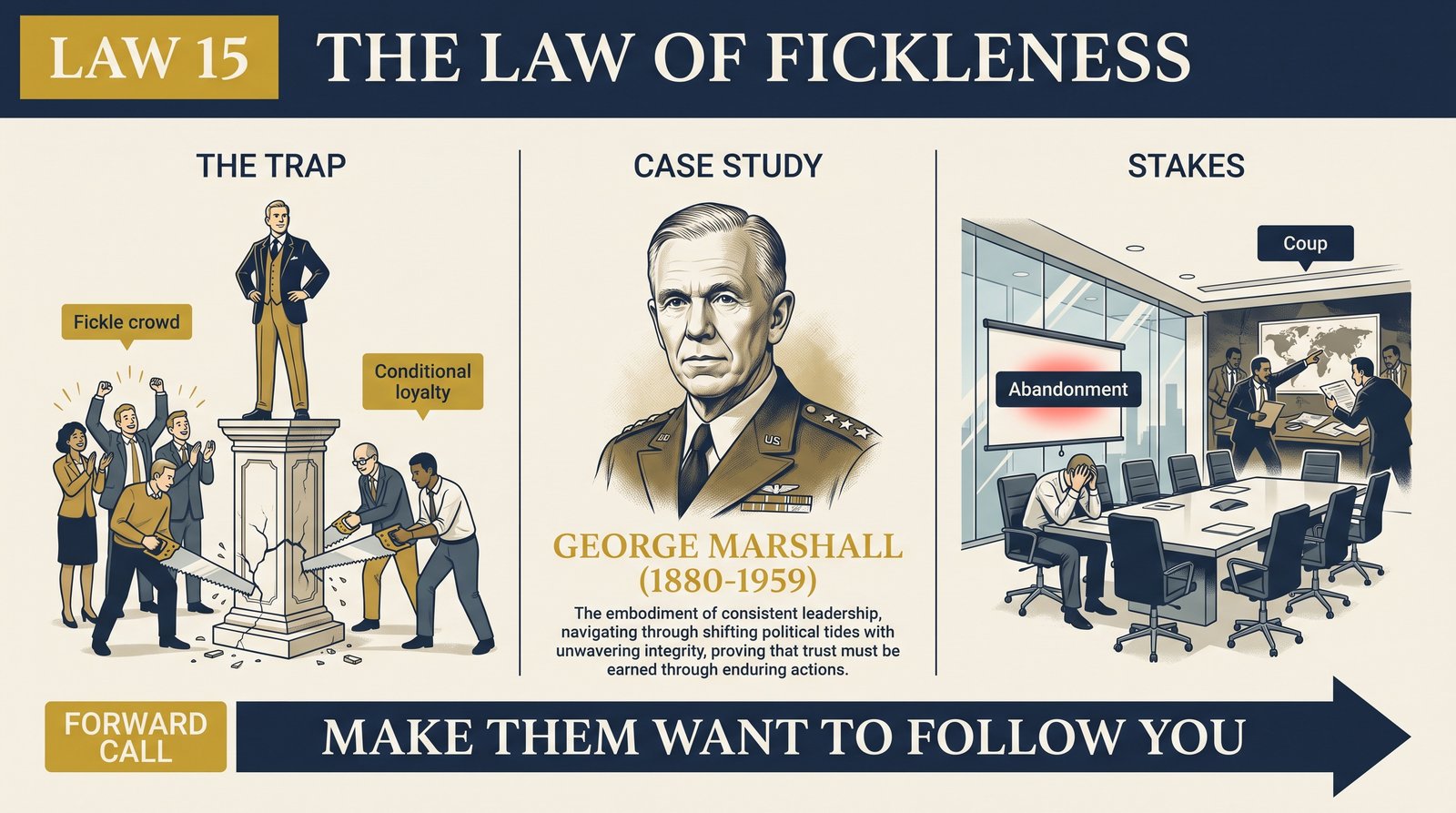
Directive: "Make Them Want to Follow You"
Core Concept
Leadership is one of the oldest human problems, and the history of every civilization is partly the history of its failure modes: leaders who were idolized and then destroyed, movements that crested and collapsed, institutions that commanded devotion for a generation and then provoked contempt in the next. Greene's Law of Fickleness begins from the observation that this volatility is not accidental or irrational — it is the predictable consequence of human psychology's deep ambivalence about authority. People need to be led. They also resent the dependency that being led entails. These two drives are simultaneously present in every follower, and the unstable equilibrium between them is what makes leadership so treacherous.
The desire to be led is genuine and deep. Living in a complex, uncertain world with other complex people creates enormous anxiety, and a leader who projects competence, conviction, and direction offers relief from that anxiety. People want someone to trust, someone whose judgment they can defer to without having to evaluate every decision for themselves. This is not weakness — it is the rational response to the cognitive limitations of any individual trying to navigate collective action. But the dependency this creates is experienced as uncomfortable, even humiliating, and so followers simultaneously idealize their leaders and remain primed to find them disappointing.
The idealization itself is the setup for the fall. When people project too much onto a leader — too much wisdom, too much goodness, too much certainty — they are inevitably disappointed by the reality. No human being can sustain the idealized image. When the cracks appear — when the leader makes a mistake, when they reveal an ordinary human failing, when circumstances make their limitations visible — the disillusionment can be total and the backlash savage. The same people who were most ardent in their admiration are often most vicious in their condemnation, because their disappointment is proportional to their previous idealization.
This is the fickleness of the law's title: followers' loyalty is not a stable property but a conditional, volatile one, maintained by the leader's continuous performance of an increasingly impossible ideal. Leaders who understand this — who build their authority on something more durable than the emotional projections of followers — create the only form of leadership that actually survives contact with reality.
The Human Weakness
The fundamental weakness on the leader's side is the intoxicating effect of followers' idealization. When people project extraordinary qualities onto you — wisdom, courage, moral authority — the temptation is to begin believing your own image. This leads to progressively worse decisions, because the leader stops seeking honest feedback (which might disturb the idealized image), stops admitting uncertainty (which would appear as weakness), and stops learning (because the image of complete competence cannot accommodate a posture of learning). The leader who believes their own publicity is on the path to catastrophic failure.
On the follower side, the weakness is the tendency to transfer personal psychological needs onto authority figures in ways that have nothing to do with those figures' actual qualities. People project onto leaders the qualities they wish their parents had had, the certainty they cannot find in themselves, the moral clarity they cannot sustain individually. This projection is invisible to the people experiencing it — they believe they are making a sober assessment of the leader's qualities when in fact they are doing something much more personal and much less rational. This is why followers can be genuinely shocked when a leader they deeply admired reveals a serious flaw: the flaw was always there, but it was invisible behind the projective screen.
A third weakness is what Greene identifies as the universal desire for a leader who will validate the group's existing beliefs rather than challenge them. People say they want honest leadership; in practice, they punish leaders who deliver genuinely inconvenient truths. The leader who tells a military unit that their recent tactics are failing, who tells an organization that its business model is obsolete, who tells a political movement that its chosen enemy is not actually the source of its problems — this leader faces enormous hostility, because honest feedback disrupts the group's self-image. The result is a powerful selection pressure for leaders who perform agreement and validation rather than those who deliver genuine assessments.
Historical Figure: General George Marshall (World War II Era)
Greene presents General George Marshall as the exemplary case of genuine authority in the modern era — not because Marshall was charismatic or beloved, but because he was trusted. The distinction is everything. Marshall served as Army Chief of Staff throughout World War II, overseeing the transformation of a 189,000-man peacetime army into an eight-million-man global fighting force, coordinating the Allied strategy across multiple theaters, managing the egos of commanders including Eisenhower, Patton, and MacArthur, and maintaining his credibility with both Roosevelt and Churchill while also dealing with Congress. He did this without the dramatic public charisma of a Churchill, without the warrior glamour of a Patton, and without the political popularity of an Eisenhower. What he had was something rarer and more durable.
Marshall's authority rested on four foundations that Greene traces carefully. First, consistency: Marshall's behavior was so predictable that people could determine his response to a situation simply by knowing his values. He did not change his positions based on who was in the room or what they wanted to hear. His honesty was not situational. This predictability was itself a form of power — people knew where they stood with Marshall, and this reliability created a foundation of trust that survived every political turbulence. Second, he spoke hard truths to power at the cost of personal advancement. When he believed a strategy was wrong, he said so to Roosevelt directly, politely, but without softening. When he believed a general was failing, he said so and acted accordingly, even when that general had political protectors. He famously refused to lobby for his own advancement and turned down opportunities to command major operations because he believed other officers were better suited.
Third, Marshall demonstrated manifest competence that everyone — allies, enemies, subordinates, superiors — could see and verify independently. His logistical and organizational genius was not a matter of self-promotion; it was visible in the results. When you gave Marshall a problem, the problem got solved, and solved in a way that was efficient, fair, and coherent with the broader strategic picture. This competence was not specialized — it was systemic, the ability to see complex interdependencies across an enormous enterprise. Fourth, and perhaps most distinctively, Marshall consistently subordinated his personal interests and ambitions to the mission. He turned down opportunities for personal glory. He gave credit to his subordinates. He absorbed blame rather than deflecting it. This selflessness was not performed; it was structural — it was how Marshall operated by default, and people could see the difference between it and the performative selflessness of political leaders.
Greene contrasts Marshall explicitly with leaders who pursued charisma and likability as their primary strategies. Such leaders do well in good times, when the gap between image and reality is easily papered over. In crises — when hard decisions must be made, when some people's interests must be sacrificed for others', when failure must be acknowledged — they are exposed. Their followers' loyalty, which was always partly a projection of what followers wished the leader were, collapses when the leader cannot sustain the image. Marshall, who never tried to project an idealized image, never had this problem. His authority became more solid under pressure rather than less, because pressure revealed the character that had always been there.
The Transformation
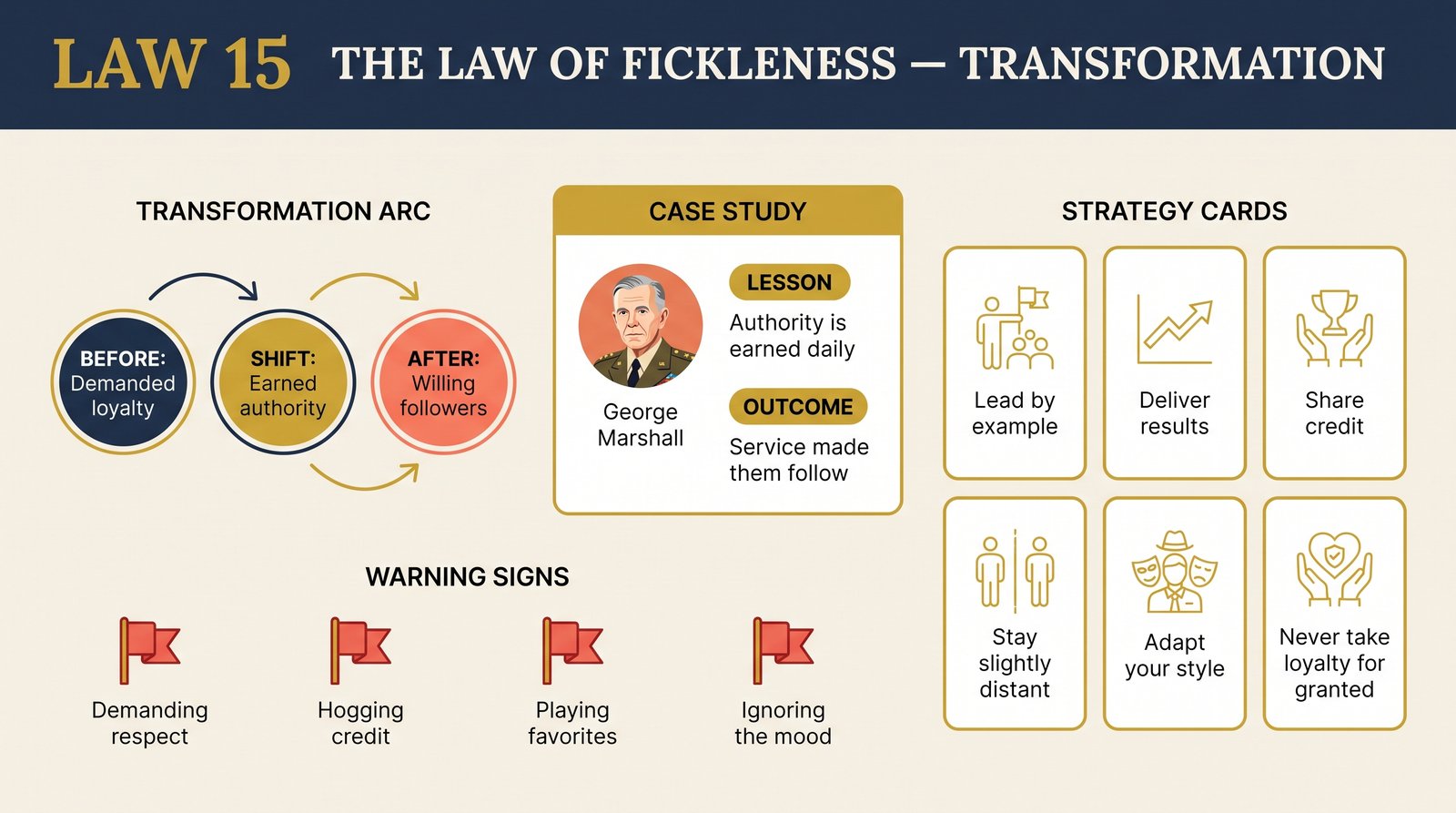
Building genuine authority, in Greene's framework, begins with the decision to optimize for trust rather than affection. These are different targets, and the strategies that produce them are often in direct conflict. Affection is maximized by agreement, validation, and performance of the qualities the audience most wants to see. Trust is built by consistency — doing what you say you will do, maintaining your positions under pressure, treating people equitably regardless of their status, and allowing your track record to speak rather than your self-promotion. The leader who consistently prioritizes affection over trust gradually erodes the foundation of genuine authority; the leader who prioritizes trust over affection sometimes sacrifices short-term popularity but builds something that compounds over time.
The second element of transformation is developing what Greene calls the capacity to "absorb blame and spread credit." This runs directly counter to the natural psychological impulse, which is to take credit for successes and attribute failures to circumstances or other people. The leader who does the opposite — who publicly gives credit to the team for wins and accepts personal responsibility for failures — does something counterintuitive: they accumulate moral authority. Followers are acutely sensitive to this quality because it is so rare. A leader who takes blame creates safety — people can take risks, make mistakes, and admit difficulties without fear of being thrown under the bus. This safety enables the kind of honest communication that makes organizations genuinely functional.
Third, Greene prescribes a deliberate practice of delivering inconvenient truths — not brutally or cruelly, but consistently and honestly. Leaders who routinely soften their assessments to spare feelings or maintain popularity are training their followers to distrust their positive assessments as well. If people know you always say things are fine, "things are fine" becomes meaningless. If people know you will tell them when things are not fine, your positive assessments carry genuine weight. The leader who has built a reputation for honest critical assessment is also the leader whose expressions of confidence and approval mean something — because they are known to be accurate rather than automatic.
Practical Guide
- Let your behavior be your message. Before you try to communicate your values through speeches, memos, or explicit statements, ensure that your behavior already embodies them consistently. People attend to what you do far more closely than what you say, and incongruence between the two destroys credibility faster than almost anything else.
- Give credit specifically and publicly; absorb blame specifically and privately. When distributing credit, name the individuals who contributed and describe what they did. When absorbing blame, don't perform it publicly (which becomes its own form of attention-seeking) — simply take responsibility, fix the problem, and move on without requiring recognition for having done so.
- Deliver hard truths early and directly. Problems that are communicated late, softened, or delivered obliquely are exponentially harder to solve. Build a discipline of being the person who raises the uncomfortable issue early, in the room, with the relevant people present. This is frightening in the short term and trust-building over time.
- Never change your position under pure social pressure. Distinguish between updating your view based on new evidence or compelling argument (good — this is called learning) and changing your stated position because people seem unhappy with it (corrosive — this teaches people that pressure works on you). The former builds credibility; the latter destroys it.
- Spend disproportionate time with the people doing the actual work. Leaders who are visible only in formal hierarchical contexts (meetings, presentations, official communications) lose touch with ground truth and also communicate, implicitly, that they care about appearances rather than reality. Regular informal contact with people at all levels of an organization serves both functions.
- Maintain your values under pressure. The test of genuine character, as opposed to performed character, is what you do when following your values costs you something — approval, opportunity, an easy win. Look for these moments and treat them as tests; how you respond to them determines what your authority is actually built on.
- Manage the idealization problem actively. When followers project excessive qualities onto you, gently but consistently correct the record. Express genuine uncertainty when you have it. Share examples of your mistakes and what you learned from them. An authority figure who actively works to maintain realistic follower perceptions is building something far more durable than one who enjoys the inflation.
Modern Application
The startup CEO in a crisis: A technology company's CEO has built her authority on vision and charisma — investors, employees, and press have responded enthusiastically to her confident, inspiring communication style. When the company hits a significant product failure and needs to make a round of layoffs, the charisma-based approach breaks down: followers who projected exceptional competence and certainty onto her experience the failure as a betrayal of their idealization. Law 15's prescription is to lead through the crisis with radical transparency — honest communication about what went wrong, specific accountability for leadership failures (including her own), and clear articulation of the path forward. This will feel worse in the short term than managing the narrative, but it is the only approach that builds the kind of authority that survives difficult moments.
The middle manager caught between executive direction and team reality: A manager receives a strategic directive from above that he privately believes is misguided and that he knows his team will find demoralizing. The temptation is to perform alignment with the executive direction while privately sympathizing with the team's resistance — to be a people-pleaser in all directions simultaneously. Law 15's prescription is the harder path: honest communication upward about his actual assessment (delivered respectfully and with specific reasoning), and honest communication downward about the constraints and his own position within them. Being honest in all directions, even when it costs him approval, is the only approach consistent with building genuine authority.
The political leader facing an inconvenient truth: A politician whose movement has consistently promised economic benefits that the evidence suggests are not materializing faces a choice: double down on the narrative (pleasing to followers in the short term, corrosive of trust over time) or acknowledge the complexity and begin adjusting the message toward reality (painful in the short term, potentially trust-building over time). History's most durable political leaders — Lincoln, Churchill, Marshall — chose the honest path and paid short-term costs that were recovered through the accumulation of credibility. Those who chose the narrative have good short-term poll numbers and destroyed long-term trust.
The experienced professional becoming a mentor: Someone transitioning into a mentoring or senior advisory role needs to resist the temptation to perform certainty and wisdom — to play the role of all-knowing senior — rather than embodying genuine experience, including honest acknowledgment of the limits of that experience. Mentors who present themselves as having all the answers train their mentees to be dependent rather than capable; mentors who model intellectual honesty, continued learning, and genuine uncertainty combined with hard-won judgment create mentees who develop genuine independent capability. The former approach may feel more authoritative; the latter builds more durable influence.
Warning Signs
- You find yourself adjusting your stated position based on the emotional temperature of the room rather than on new information or argument — you are building authority on sand.
- Your followers show a pattern of extreme idealization followed by harsh disillusionment — this is the fickleness of the law's title operating in your own authority relationships, a signal that you have allowed or encouraged excessive projection.
- You avoid delivering bad news or critical assessments to protect the positive emotional atmosphere of your team or organization — you are prioritizing affection over the honest communication that builds trust.
- You take credit for successes that belong substantially to your team and deflect blame for failures toward circumstances or other people — you are destroying the moral authority that genuine leadership requires.
- Your authority is highly context-dependent: strong in formal settings or when things are going well, but fragile under pressure or in informal contexts — a sign that it is built on performance rather than character.
- You notice that people do not bring you their real problems or honest assessments — they bring you what they think you want to hear. This is the organizational consequence of having optimized for approval rather than truth.
Key Quotes
"The fickleness of those we lead is not a character flaw in them; it is the predictable consequence of leading them in ways that require them to project rather than to genuinely trust."
"Marshall's power was paradoxical: he had no interest in power for its own sake, and this indifference was the source of his authority. People trusted him precisely because they knew he was not managing their perceptions for his own advancement."
"The leader who builds on charisma builds on sand. The follower's admiration is partly a projection of their own needs, and when those needs are disappointed — as they inevitably will be — the admiration collapses into its opposite."
Reflection Questions
- What is the primary source of the authority you currently hold in the relationships and roles where you have influence? Is it trust built on track record and consistency, or something more fragile — charisma, formal position, or the favorable projections of people who don't know you well yet?
- Think of a leader you have admired and then become disillusioned with. What specifically happened to produce the disillusionment? Was the quality you admired real, or were you projecting? What does this tell you about managing others' projections of you?
- When have you last changed a stated position under pure social pressure — not because of new evidence, but because people seemed unhappy with your view? What would it have cost you to maintain your position, and was that cost actually as high as it felt?
- How do the people you lead or influence bring you bad news? Do they bring it early and directly, or do they delay, soften, and manage your reaction? What does their behavior tell you about the authority environment you have created?
- What is the hardest truth you currently hold about a situation or organization you are responsible for — the thing you know but have not fully said? What would it cost you to say it, and what is the cost of not saying it?
Connected Laws
- Law 14: The Law of Conformity — The fickleness of followers is partly a consequence of the group dynamics explored in Law 14. Followers who have partially dissolved their individual identity into a leader's charismatic narrative are especially volatile — their loyalty is the product of group-level emotional contagion rather than individual assessment, and it can reverse with equal speed. Leaders who understand Law 14 are more careful about the emotional dynamics they create in their groups.
- Law 7: The Law of Defensiveness — Building genuine authority requires the ability to deliver unwelcome truths without triggering defensive reactions that make those truths unprocessable. Law 7's exploration of how to soften resistance by first confirming people's self-opinion provides the tactical complement to Law 15's strategic framework — you can be honest while also being skillful about how you deliver honesty.
- Law 16: The Law of Aggression — The aggression explored in Law 16 is particularly relevant to leadership because leaders are its primary targets. Understanding that followers' hostility, criticism, and rebellion often have an aggressive component — rooted in the resentment of dependency described in Law 15's core concept — helps leaders respond to opposition more strategically rather than reactively.