Chapter 6 — The Jump to Universality
Core Thesis
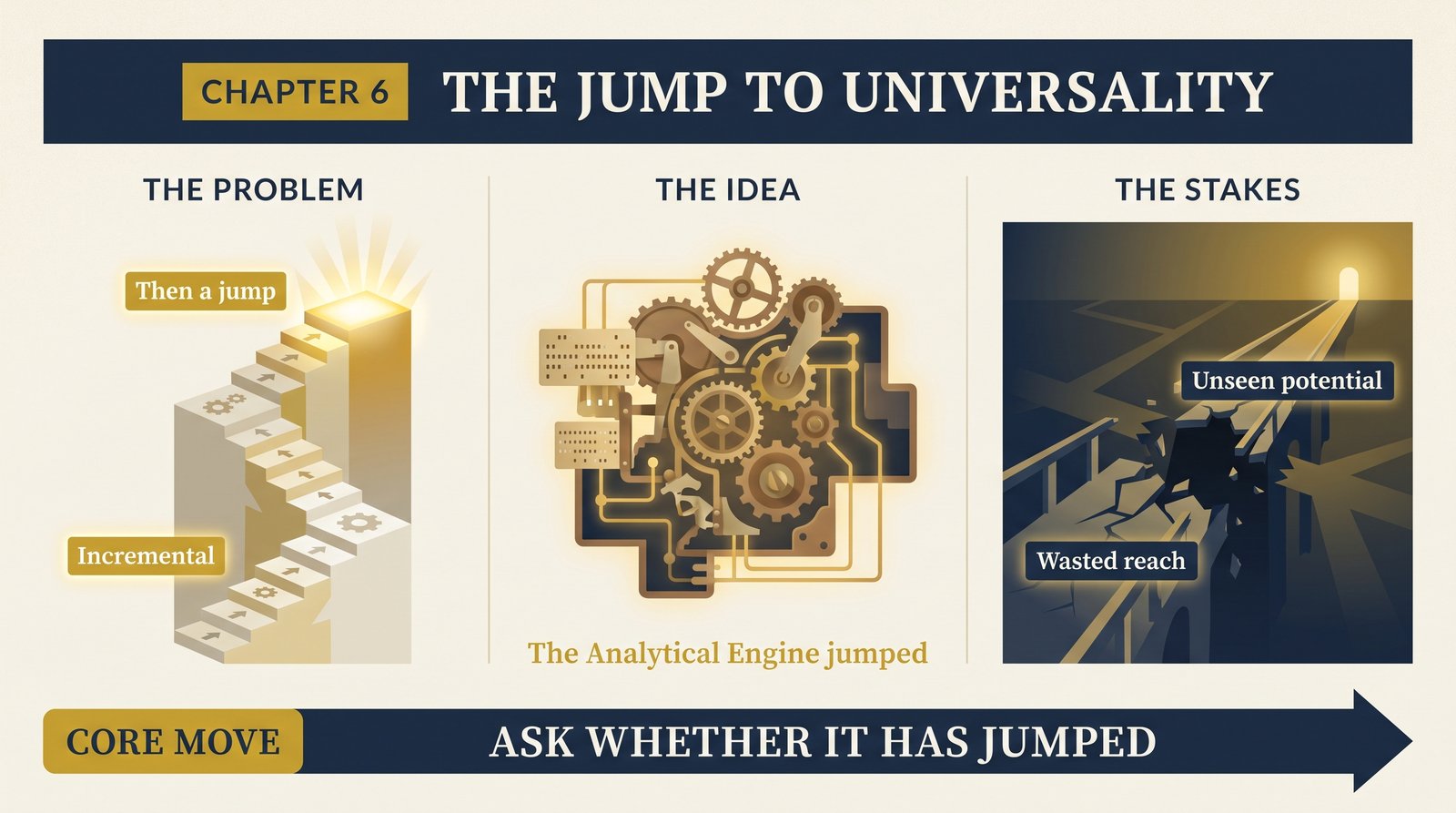
Some systems, built incrementally for parochial purposes, cross a threshold and suddenly become universal — capable of everything in their domain. Alphabets (all words of the language, then all possible words), positional numerals (all numbers), movable type (all documents), the computer (all computations), DNA's code (all terrestrial biochemistry — and far beyond). The jump is discontinuous, usually unintended, and repeatedly unnoticed by its own makers.
The Problem It Solves
Why progress isn't smooth: small improvements accumulate, then one more step changes the kind of thing you have. And why potential goes unexploited: universality regularly arrives before anyone has the philosophy to see it. The chapter is a theory of the most consequential threshold in technology and biology — and of the blindness that accompanies it.
Key Episode
Charles Babbage and the Analytical Engine: universal computation designed in brass, a century early — and neither Babbage nor his government grasped what universality meant, funding it (barely) as a better navigation-table machine. Deutsch pairs him with the genetic code: universal for billions of years before organisms existed that could exploit most of its reach — universality waiting, unnoticed, in the substrate. Also the counter-case: Roman numerals — kept deliberately non-universal; parochialism as a choice.
The Shift
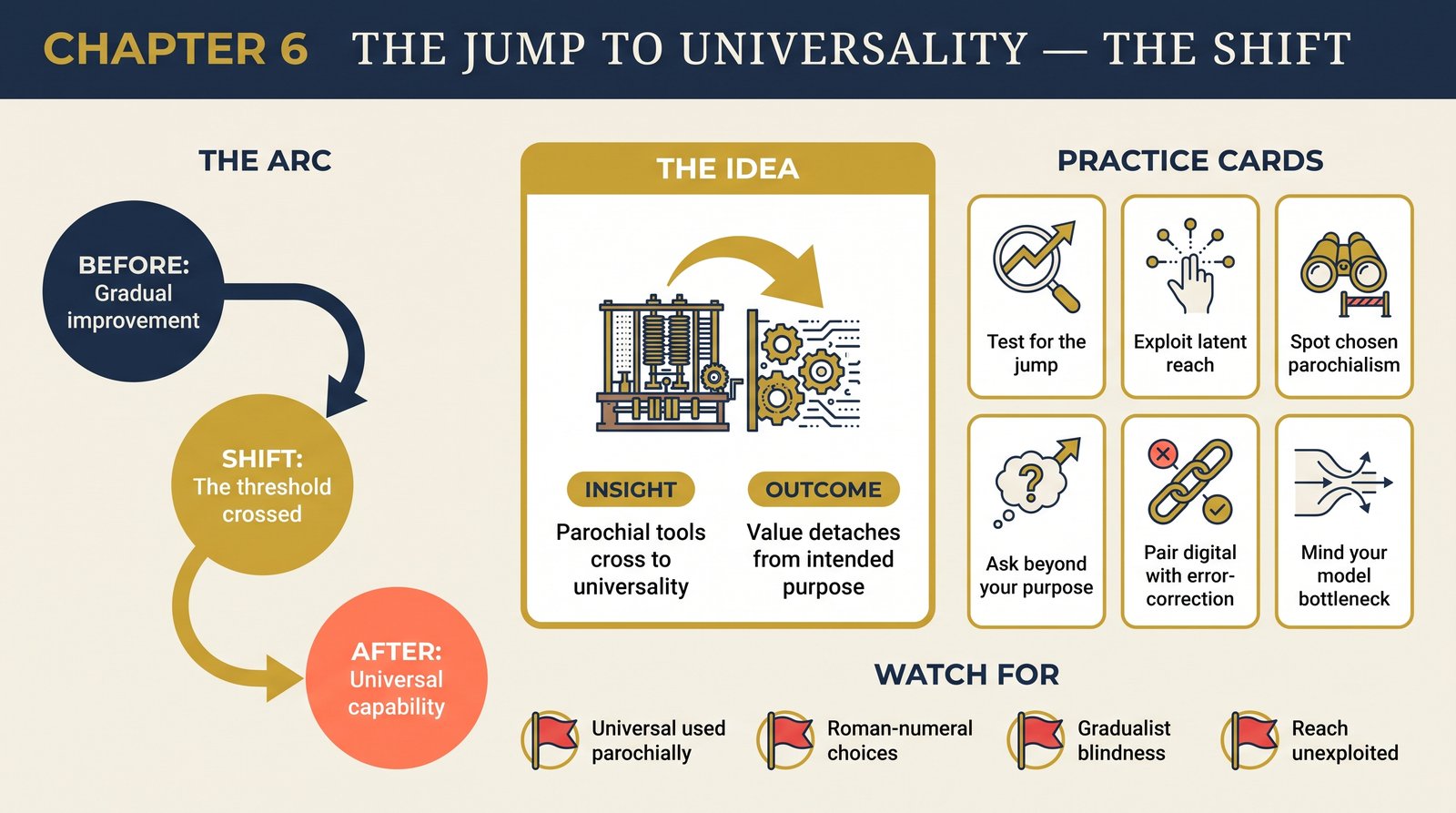
From gradualism to threshold-thinking: ask of any evolving system not "how good is it?" but "has it jumped?" — and from intended use to latent reach: the value of a universal system exceeds any purpose its builders had. Digital universality also explains error-correction's necessity: only discrete alphabets can be copied indefinitely against noise — universality and digitality travel together.
Critiques & Rivals
Skeptics note "universality" is domain-relative (universal for computation isn't universal for cooking) — Deutsch agrees; the point is the jump's structure, not omnipotence. Historians complicate the clean stories (printing and alphabets evolved messily). The deep rival is continuity-thinking in AI: the belief that enough incremental tweaks yield general intelligence gradually — Deutsch holds AGI requires its own jump (Chapter 7).
Modern Application
Evaluate platforms and skills by jump-status. A tool that does one more thing per release is parochial; a tool that becomes programmable has jumped — its future value detaches from its roadmap. Same test for careers: skills with universality (writing, programming, modeling) compound across domains. And Babbage's warning: when you've built something universal, your own mental model is the bottleneck — ask what it can do, not what you built it for.
Key Terms
- Universality — capability for all tasks in a domain
- The jump — the discontinuous threshold to universality
- Parochialism — deliberate or accidental confinement to local purposes
Key Quotes
"In every case the jump to universality happened as an unintended consequence of solving a parochial problem."
"Babbage and [Ada] had no way of knowing that they had already come across the last great step: universality."
Reflection Questions
- Which system in your stack has quietly jumped — and is still being used parochially?
- What Roman-numeral choice is your field making — deliberate non-universality for control's sake?
- If your best tool is universal, what is it capable of that nobody has asked it for?
Connections
- The abstraction that makes "all computations" precise: Chapter 5
- The jump still pending: artificial creativity