Law 7: The Law of Defensiveness
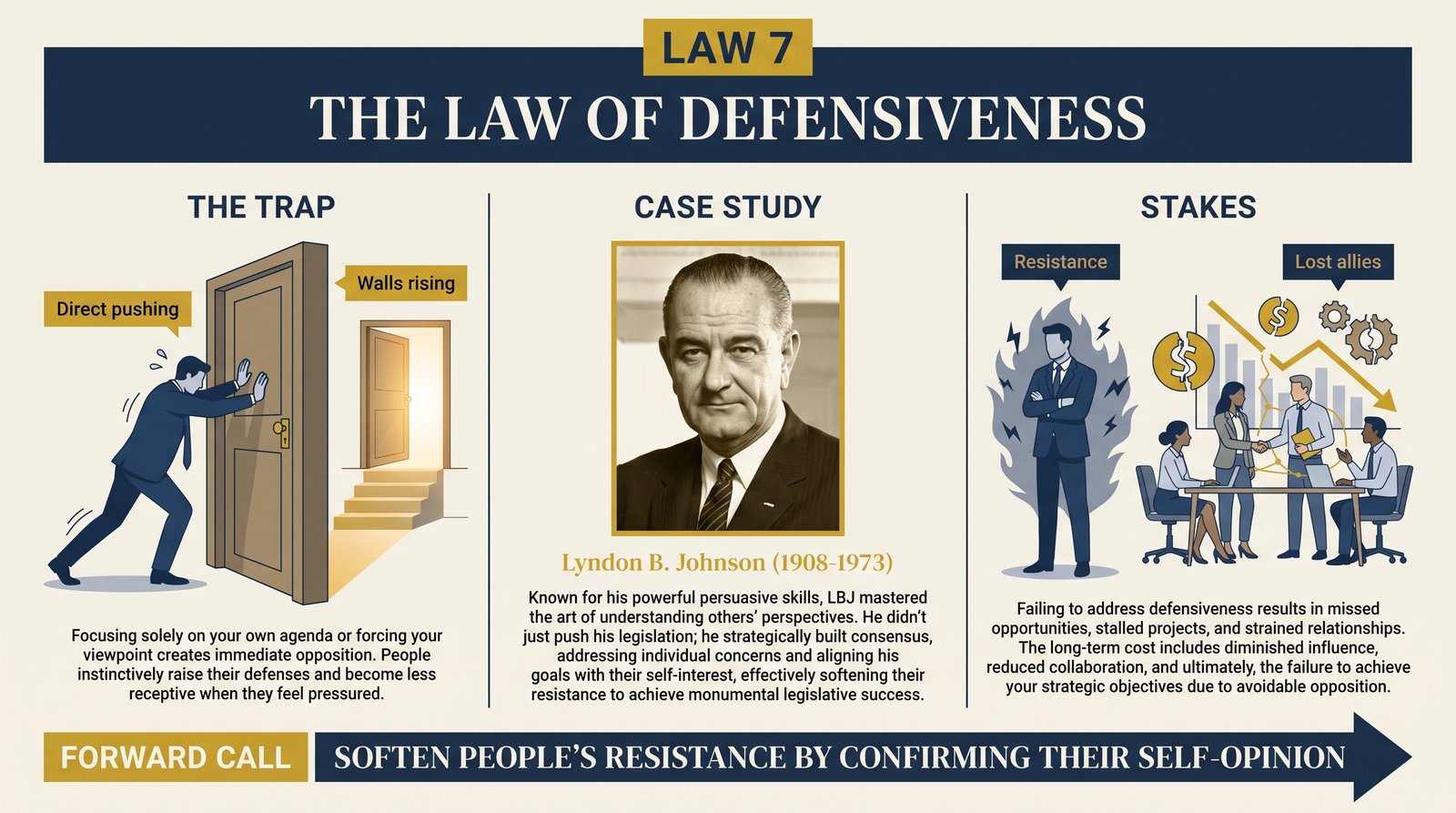
Directive: "Soften People's Resistance by Confirming Their Self-Opinion"
Core Concept
Every human being walks through the world with a carefully constructed self-opinion — a mental portrait that casts them as intelligent, moral, fair-minded, and independent. This self-image is not vanity in the superficial sense; it is the psychological foundation upon which a person's sense of dignity and coherence rests. It is assembled over a lifetime from choices, identifications, and defenses, and it is fiercely protected even when the person is unaware they are protecting it. When you approach someone with a request, an argument, or a proposal, you are not merely offering information — you are, implicitly, bumping up against this self-image.
The fundamental problem with direct persuasion — logic, argument, evidence, pressure — is that it almost invariably triggers what Greene calls the "No" reflex. The moment a person senses that they are being pushed, that their independence of judgment is being challenged, or that the persuader thinks they know better, a defensive wall goes up. The content of the argument ceases to matter. The person is now defending their autonomy and intelligence, not evaluating ideas. This is why skilled lawyers, salespeople, and intelligent friends often fail to change minds: their very competence communicates a subtle threat.
Greene observes that this dynamic is invisible to most would-be persuaders because they remain inside their own perspective. They think in terms of their message — how good it is, how clear, how logical. They do not think in terms of the emotional state they are generating in the other person. But the emotional state is everything. A person who feels validated, respected, and unthreatened is genuinely open to new ideas. A person who feels even faintly criticized, patronized, or manipulated will reject even the best idea with unconscious efficiency.
The Law of Defensiveness is therefore not a technique but a perceptual shift: move from thinking about what you want to say to thinking about what the other person needs to feel. The former is about your agenda; the latter is about creating the conditions under which influence actually becomes possible. This shift requires genuine curiosity about how the other person sees themselves, what they are proud of, what they fear having questioned — and a willingness to meet them there before asking them to move anywhere.
The Human Weakness
The core vulnerability here is the depth of human investment in self-image. People will sacrifice money, relationships, and even accuracy to maintain their sense of being intelligent, righteous, and in control of their own choices. Cognitive dissonance research confirms this systematically: when facts contradict self-image, people tend to reject the facts, not the self-image. This is not stupidity — it is the mind's way of maintaining functional coherence. But it creates a profound vulnerability to anyone who understands it, and a profound trap for anyone who does not.
The most common mistake is what Greene calls "the logician's fallacy" — believing that superior arguments win. They rarely do. Arguments activate the ego's defense system. Even when a person secretly recognizes they are losing an argument, the act of conceding feels like a defeat of self, and so they double down. The more skilled the arguer, the more threatened the listener feels, and the more entrenched the resistance becomes. Many historical disasters — in politics, business, and personal life — have come from this error. The person with the best case, convinced of their rightness, pushed harder and harder, and achieved nothing except entrenchment.
There is also a secondary weakness on the persuader's side: impatience. Effective influence along the lines Greene describes is slow, patient, and requires genuine attention to another person. Most people are too focused on their own agenda, too sure of their position's merits, and too unwilling to spend time validating someone they believe is wrong. This impatience is what drives them back to direct argument — which feels like action but achieves only the satisfying sensation of having made one's case.
Historical Figure: Lyndon B. Johnson (U.S. Senate and Presidency, 20th Century)
Lyndon Johnson is Greene's central example of a master practitioner of indirect influence — not through charm or charisma in the traditional sense, but through a meticulous, almost obsessive study of the people he needed to move. Before approaching a senator, a donor, or a political ally, Johnson invested extraordinary time in understanding that person's self-image: what they were proud of, what they feared, what they secretly wanted recognition for, what they believed about themselves that others had failed to acknowledge. He built dossiers — mental and sometimes literal — on each person he needed.
When Johnson approached someone for a favor, a vote, or cooperation, he came armed not with arguments but with affirmations. He would begin by acknowledging something the person genuinely cared about, something that confirmed their sense of their own importance and intelligence. He would frame his request in terms of the other person's stated values and self-interest, so that agreeing felt consistent with who they believed themselves to be. He was famous for his "Treatment" — an overwhelming, physically intimate form of engagement in which he made a person feel as though they were the most important individual in the world, seen and valued in a way they rarely experienced.
Crucially, Johnson made people feel that the idea was theirs, or that they were arriving at it independently. He would plant a notion, step back, let the person develop it in their own mind, and then be there to confirm it when they announced it as their own conclusion. Senators who thought they were convincing Johnson often found, in retrospect, that Johnson had guided the entire conversation to an end he had decided upon before the meeting began. This was not manipulation in the crude sense — Johnson genuinely tried to frame requests in ways that served the other person's real interests. But it was mastery of the fundamental law: never make someone feel that they are being moved. Make them feel that they are moving themselves.
Greene notes that Johnson's power diminished when he reached the presidency and the subject was Vietnam — a situation where his usual tools of direct human contact gave way to abstraction, ideology, and the isolation of high office. Surrounded by men who confirmed his self-image rather than people who pushed back, Johnson became susceptible to the very grandiosity and defensiveness he had so skillfully navigated in others. The Law of Defensiveness applies as much to the persuader as to the persuaded.
The Transformation
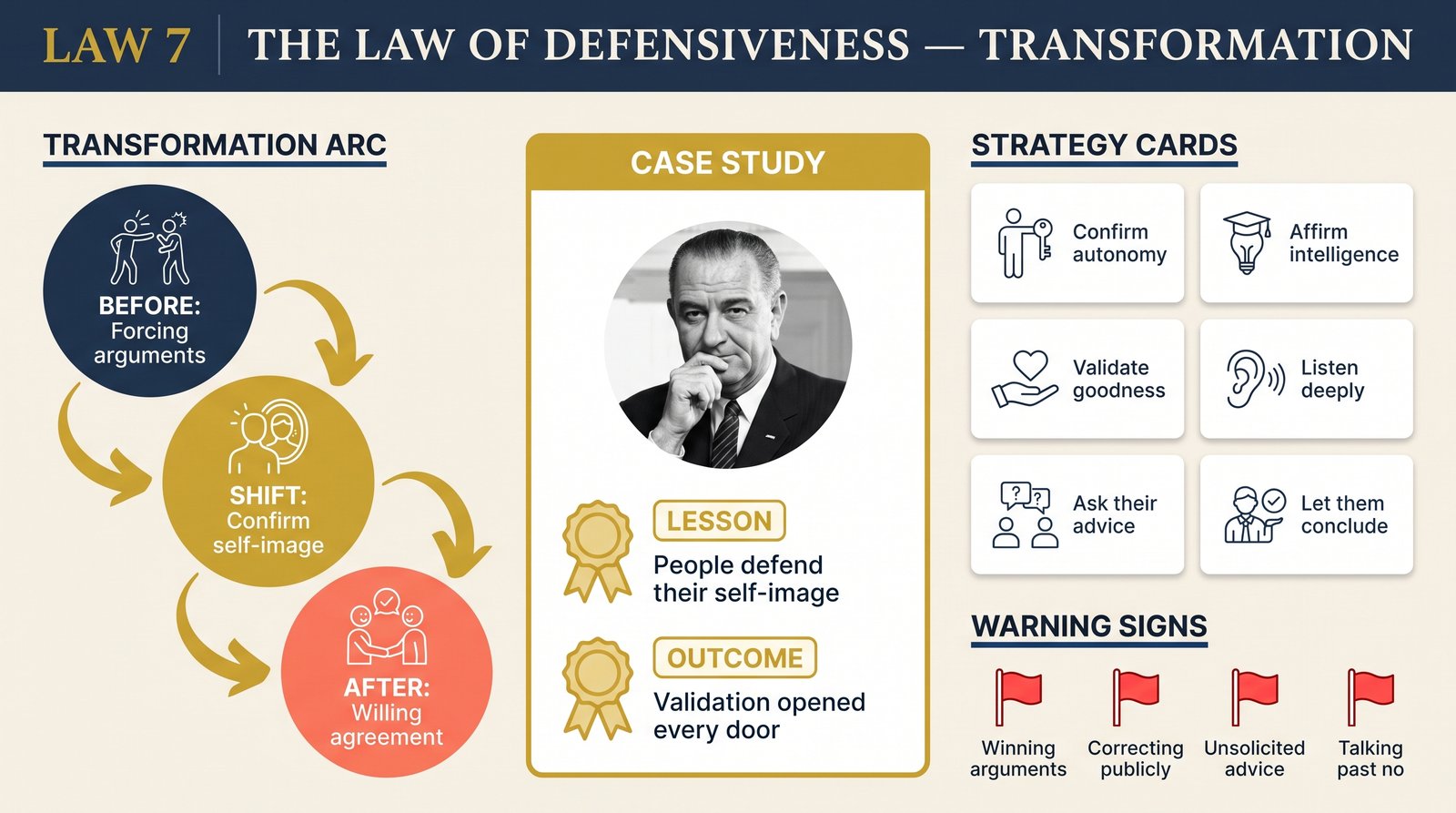
The transformation required by this law is fundamentally attentional: from self-focused to other-focused. Most people approach persuasion as a broadcasting task — crafting and projecting their own message. The transformation asks you to approach it as a reception task — understanding the other person's internal world with enough accuracy that your message arrives not as a challenge but as a confirmation.
Greene identifies what he calls the "5 Channels" of indirect influence — five frameworks for working with rather than against the listener's self-image. First, frame every request in terms of the other person's self-interest: not what you need, but what they gain. Second, appeal to their need to feel autonomous — give them choices, never ultimatums, so they experience their compliance as a decision freely made. Third, validate their intelligence or taste before making any ask; a person who feels seen as discerning and capable is far more open than one who feels they are being educated. Fourth, use indirect suggestion rather than direct requests — plant ideas in questions, observations, or hypotheticals, and let the person develop them. Fifth, when possible, make them feel the idea was theirs from the beginning.
The deeper transformation is in the quality of attention you bring to other people. This law requires what might be called "strategic empathy" — genuine curiosity about how another person thinks, what they value, and what threatens them. This is not manipulation if it is grounded in respect; it is simply the recognition that people are not rational machines that process arguments, but emotional beings who respond first to how they feel and second to what they think. Working with this reality, rather than against it, is the mark of genuine social intelligence.
Practical Guide
- Before any important conversation, build a self-image profile: What does this person pride themselves on? What do they fear having questioned? What have they publicly committed to? What does their body language and self-presentation communicate about their sense of identity? This preparation is not optional — it is the work.
- Open with genuine validation: Find something real and specific to acknowledge — not flattery, which people detect and resent, but genuine recognition of something the person actually deserves credit for. This lowers the defensive wall before you say anything that matters.
- Never argue directly against their position: If their view is wrong, ask questions that let them discover the flaw themselves. "What do you think would happen if...?" is far more powerful than "That won't work because...". The insight they arrive at through their own reasoning becomes part of their self-image rather than a threat to it.
- Frame requests in their language, not yours: Use the values, terms, and priorities they have expressed. If they care about efficiency, frame your proposal as efficient. If they care about fairness, frame it as fair. Do not ask them to adopt your framework; enter theirs.
- Give them the choice, not the conclusion: Present options rather than demands whenever possible. People will fight a conclusion; they will own a choice. Even if the options are limited, the act of choosing preserves their sense of autonomy.
- Make them the author, not the audience: When planting an idea, phrase it as a question or a half-formed thought: "I wonder if it might make sense to..." or "You probably know better than I do, but it seems like..." Let them complete and claim the idea.
- Match your emotional register to their needs: If they are anxious, be calming and reassuring. If they are proud, be admiring. If they are suspicious, be transparent. Your emotional tone is as persuasive as your words — often more so.
Modern Application
In workplace leadership: A manager who brings a direct report a "must-do" instruction will get compliance and resentment. A manager who frames the same task as an opportunity for the report to demonstrate expertise, or who asks the report how they would approach a problem before revealing the solution, generates genuine buy-in. The task gets done better and the relationship strengthens. This approach takes more time in the short run and dramatically less time over the long run.
In negotiation and sales: The most common error in negotiation is leading with your own needs. Effective negotiators spend the first portion of any negotiation doing nothing but understanding the other side's self-image: what are they proud of in their business, what do they believe makes them distinctive, what would make agreeing feel consistent with how they see themselves? A deal structured to confirm the other party's self-image closes faster and generates fewer post-close complications than one that feels like a concession.
In personal relationships: Attempts to change a partner's or family member's behavior through criticism almost always fail — they trigger defensiveness and entrench the pattern. The same change approached through curiosity ("What would you need to feel comfortable with X?"), validation ("I know you care deeply about Y, and I think this connects to that"), and genuine respect for their autonomy succeeds far more reliably. This is not about being indirect to the point of dishonesty — it is about choosing the path that actually works.
In public communication and writing: Arguments that confirm the reader's existing sense of themselves as thoughtful, fair-minded, and capable of changing their mind are far more effective than arguments that imply the reader has been foolish. The best persuasive writers do not attack their readers' prior positions — they offer a path by which the reader can update their view while feeling that the update is consistent with their intelligence and good faith.
Warning Signs
- You feel the urge to correct someone who is wrong in front of you: This urge is almost always a trap. Correcting triggers defensiveness and achieves nothing except your momentary satisfaction of being right. The question to ask is not "Are they wrong?" but "What do I actually want to achieve here?"
- Your arguments are getting more elaborate and detailed: When you find yourself adding more evidence, more logic, more examples — escalating your case — this is a sign that the other person is not receiving your argument but defending against it. Adding more content will not help; changing approach is necessary.
- The other person is repeating themselves: Repetition is a classic defensiveness signal. They are not saying something new; they are reasserting the position you have implicitly threatened. Stop arguing and start listening.
- You have started to feel contempt for the other person's resistance: Contempt is the enemy of influence. The moment you privately conclude that someone is being unreasonable or stupid, it leaks into your communication and confirms their sense that you do not respect them.
- You are leading with your own needs: Any sentence that begins with "I need you to..." or "You have to understand..." has framed the conversation around your requirements. Reframe around their benefit or autonomy.
- You are surprised that a good argument failed: If you are regularly surprised that logic and evidence fail to persuade people, this is the signal to study this law more deeply. Surprise indicates a model of human behavior that does not match reality.
Key Quotes
- "The best way to convince people is to make them think they are convincing themselves." — paraphrased from Greene's synthesis of the law
- Greene on Johnson: "He had an uncanny ability to sniff out each person's particular insecurities and dreams... He could sense what people needed to hear to feel validated, and he gave it to them, making them lower their usual resistance to his entreaties."
- "The harder you push people, the more you will find their resistance stiffening. It is the nature of social dynamics." — Robert Greene, The Laws of Human Nature
Reflection Questions
- Think of a recent situation where direct argument failed to persuade someone. What was their self-image in that moment, and how did your approach threaten it?
- Who in your life do you most consistently fail to influence? What do they most deeply believe about themselves, and how could you frame your communication to confirm rather than challenge that belief?
- When have you experienced someone using these techniques on you effectively? How did it feel different from being argued at?
- Where in your own behavior do you mistake "making your case" for "achieving influence"? What does that cost you?
- What would change in your most important relationships if you spent the first five minutes of every difficult conversation focused entirely on understanding the other person's self-image rather than preparing your own argument?
Connected Laws
- law-11-grandiosity — Grandiosity is the self-image inflated past reality. Understanding Law 7 helps you recognize when someone's defensiveness is driven by grandiose self-perception, requiring extra care in validation and an even more indirect approach to honesty.
- law-10-envy — Envy is triggered when someone's self-opinion is threatened by another's visible advantage. The tools of Law 7 — confirming self-image, appealing to autonomy — are the primary defenses against generating envy in those you work with.
- law-08-self-sabotage — The defensive resistance described in Law 7 is itself a form of self-sabotage: people block good ideas and productive relationships to protect a self-image. Understanding both laws together reveals how internal attitude and interpersonal dynamics reinforce each other.