Concept 6 — The Positive Heuristic
Core Thesis
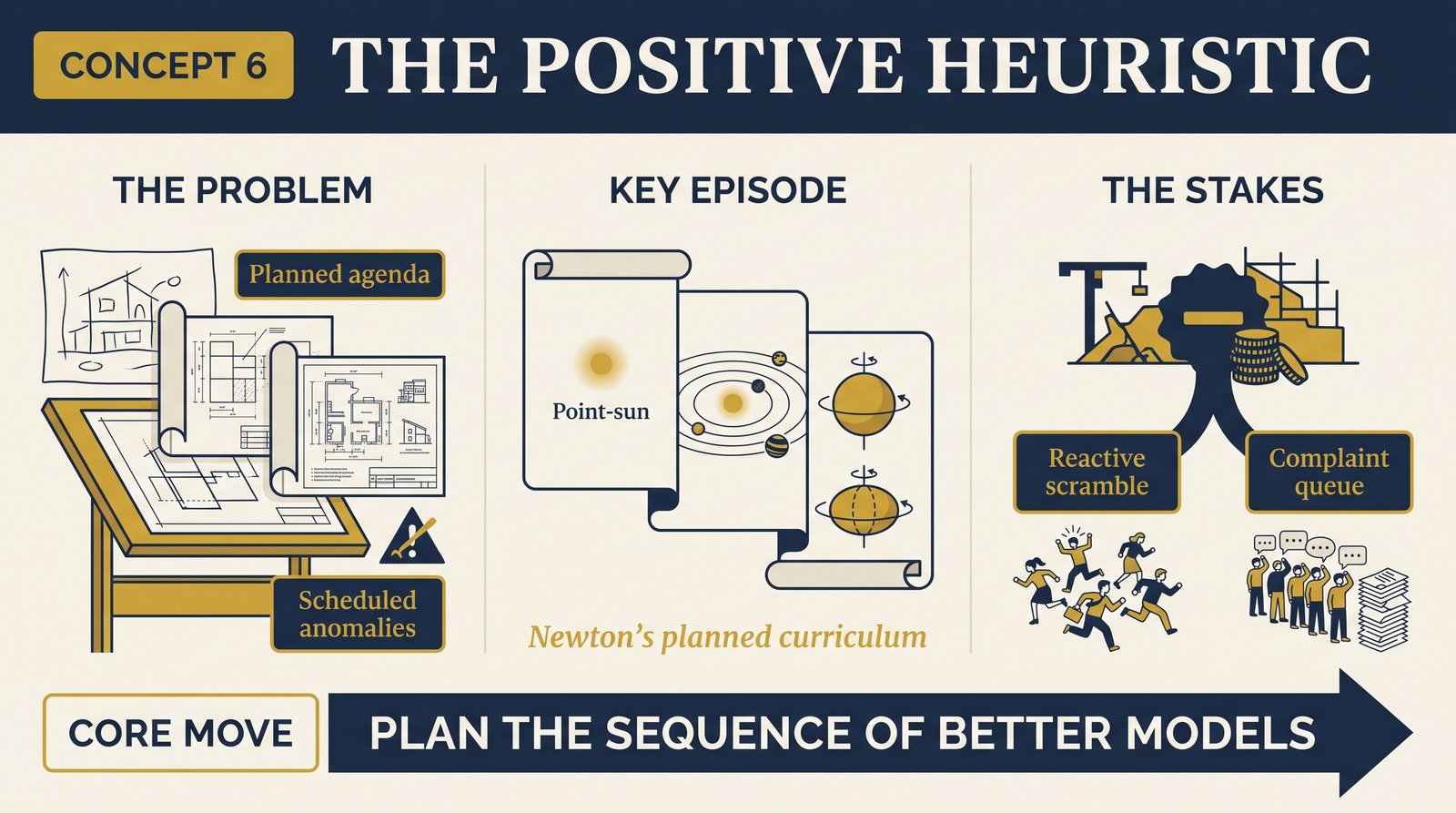
The positive heuristic is the programme's battle plan: a partially articulated agenda that tells researchers which problems to tackle in which order, how to modify the belt, which idealizations to lift next. It lets scientists work in a planned sequence of increasingly realistic models — largely ignoring actual anomalies, because the plan already anticipates the refutations of each crude stage.
The Problem It Solves
Two mysteries at once. Why aren't scientists paralyzed by the ocean of anomalies? Because the heuristic pre-schedules them: today's model is known-false by design, and its failures are next quarter's agenda. And what fills Kuhn's "puzzle-solving" with direction? Not the paradigm's gravity but a plan — the relative autonomy of theoretical science, where the sequence of problems is chosen by the programme, not dictated by nature's complaints.
Key Episode
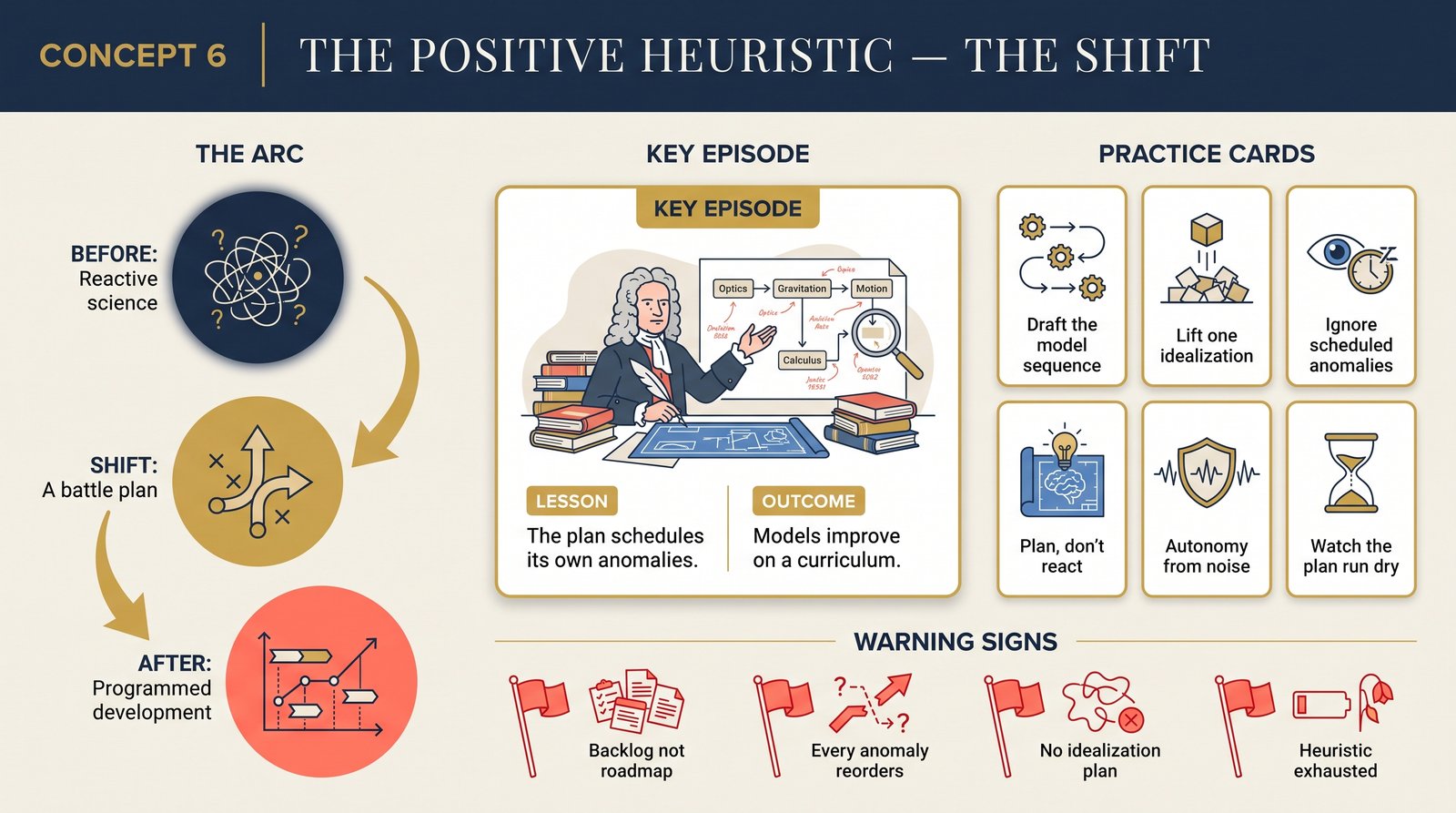
Newton's planned march, Lakatos's showpiece: first a point-sun and single point-planet; then multiple planets (mutual perturbations); then planets as extended balls; then spinning, bulging spheroids; then wobbling axes and interplanetary tides. Newton knew each stage was false before calculating it. The anomalies each stage would face were foreseen and queued. That's not response to refutation — that's a curriculum.
The Shift
From reactive science (anomaly arrives → scramble) to programmed science (models improve on schedule → anomalies met when the plan reaches them). The heuristic also explains why great programmes feel inevitable in hindsight: the sequence of papers was implicit in the founding idea, waiting to be unrolled.
Critiques & Rivals
How much of this is retrospective tidying? Historians doubt Newton possessed the plan as cleanly as the reconstruction shows. And heuristics run out — Lakatos concedes programmes can exhaust their positive heuristic and drift. Kuhn's rejoinder: what Lakatos calls a plan is exactly what exemplars-plus-training produce, no separate entity needed.
Modern Application
The difference between a roadmap and a backlog is the positive heuristic. A backlog reacts; a roadmap embodies a planned relaxation of idealizations — v1 assumes one region, one currency, benign users; v2 lifts one assumption; v3 the next. Teams with a real heuristic ignore most incoming anomalies rationally, because the plan already schedules them. If every anomaly reorders your priorities, you don't have a programme; you have a complaint queue.
Key Terms
- Positive heuristic — the planned agenda for developing the belt
- Relative autonomy of theory — problem choice driven by plan, not anomaly
- Sequence of models — deliberately false approximations, refined on schedule
Key Quotes
"The positive heuristic consists of a partially articulated set of suggestions or hints on how to change, develop the 'refutable variants' of the research programme."
"Which problems scientists working in powerful research programmes rationally choose, is determined by the positive heuristic of the programme rather than by psychologically worrying (or technologically urgent) anomalies."
Reflection Questions
- Write your project's model sequence: which idealization does each next version lift?
- Which anomalies can you now rationally ignore because the plan schedules them?
- Is your heuristic running out — when did the plan last generate a problem, rather than the bug tracker?
Connections
- The plan's raw material: protective belt
- When the plan stops paying: degeneration