Law 4: The Law of Compulsive Behavior
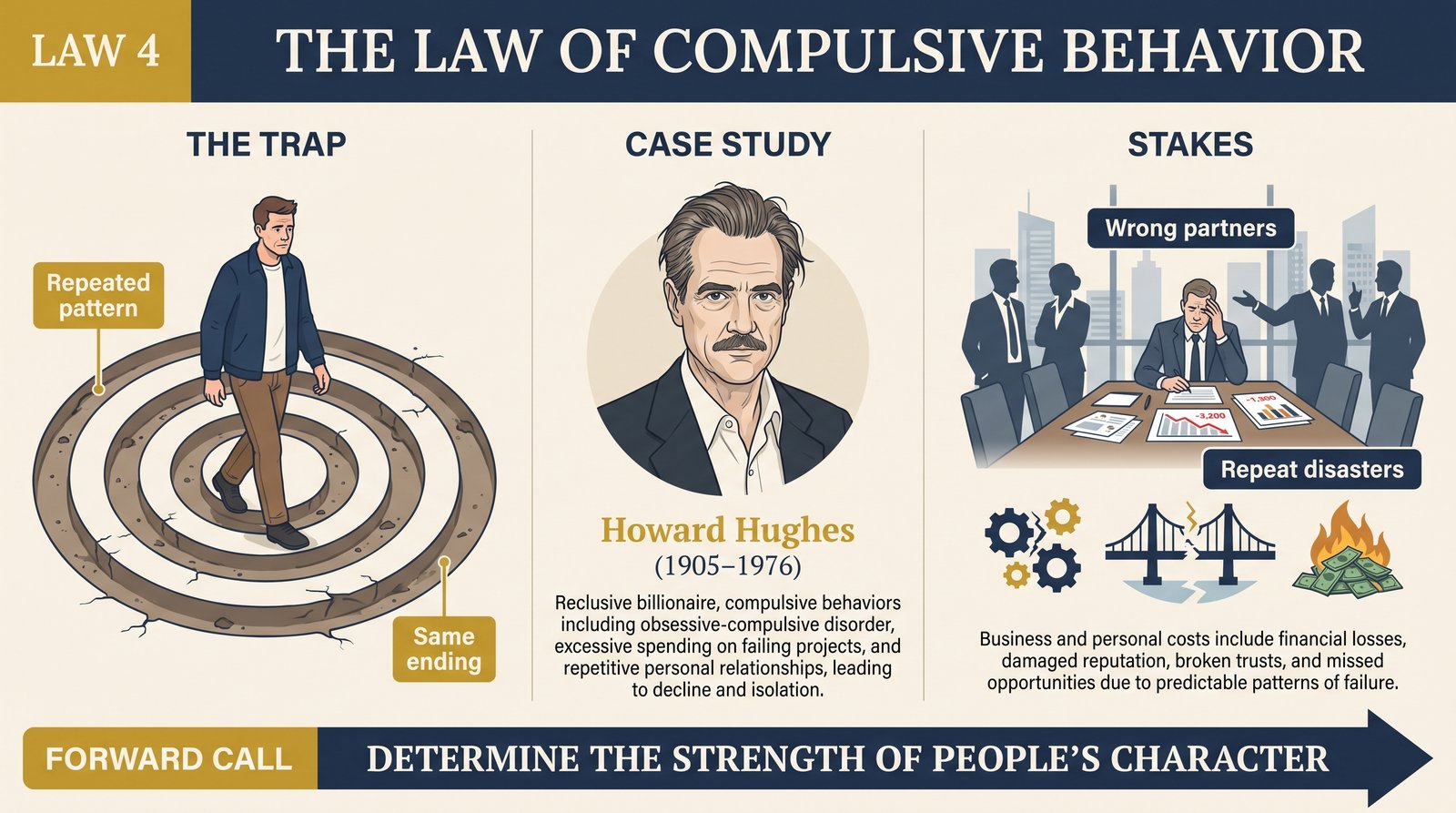
Directive: "Determine the Strength of People's Character"
Core Concept
Greene's fourth law cuts to something most people find uncomfortable: the degree to which behavior is compulsive rather than freely chosen. We carry a narrative of ourselves as deliberate agents who make decisions based on current circumstances and conscious reasoning. Greene argues this narrative dramatically overstates our freedom. The deeper truth is that character is largely shaped in the first decades of life through a combination of genetic temperament, early attachment experiences, family dynamics, and formative traumas — and that what gets formed in those early years runs like deep programming, generating the same patterns of response, relationship, and coping across radically different circumstances and decades.
The mechanism Greene identifies is that early experiences produce coping strategies — ways of managing the world that felt necessary and effective given the conditions in which they were forged. A child who grows up with an unpredictable parent develops hypervigilance and need for control. A child who is rewarded for exceptional achievement and punished for ordinariness develops performance anxiety and compulsive striving. A child who experiences early abandonment develops attachment patterns that will play out in every subsequent close relationship. These strategies made sense in the original context; the problem is that they persist long after the original context has ended, applied to situations where they do not fit, distorting behavior in ways the person themselves often cannot see.
What makes these patterns compulsive, in Greene's framework, is precisely their automaticity — they fire without deliberate choice, often below the level of conscious awareness, and they are resistant to rational argument because they are not rational strategies. They are emotional survival mechanisms that have become habitual. The person who compulsively micromanages does not consciously decide to do so because they believe it is the best management style; they micromanage because something in them becomes intolerable when they do not have control, and this intolerance was forged long before their current professional circumstances. The behavior feels necessary from the inside even when it is obviously destructive from the outside.
Greene's prescription is to understand this dynamic — both in others and in yourself — as a lens for reading character more accurately than surface behavior or self-report. The question he teaches is not "what does this person say they value or intend?" but "what is the compulsive pattern that runs through this person's history, regardless of what they say about themselves?" That pattern is the best available predictor of what they will actually do when circumstances press on their core vulnerabilities.
The Human Weakness
The specific trap this law describes has two sides. In reading others, the trap is focusing on behavior in specific situations rather than on the pattern across situations and time. Most people evaluate others based on their best behavior in favorable contexts — the job interview, the early months of a relationship, the business proposal. These contexts are the ones in which the person is most motivated to manage their presentation and least likely to be pressed by the circumstances that activate their compulsive patterns. The real character test comes under pressure, in unfamiliar situations, in conditions that create the specific stress the person is most vulnerable to. Reading character accurately means waiting for those conditions — or, better, learning to identify the pattern from the traces it leaves in the person's history before you are fully invested.
In reading yourself, the trap is the opposite: over-identifying with your deliberate self-image and under-noticing the compulsive patterns your behavior actually reveals. Most people have a clear narrative about their character — they are loyal, or principled, or caring, or resilient — and this narrative is maintained by selective attention to the behavior that confirms it and selective inattention to the behavior that does not. The person who considers themselves a generous friend but consistently cancels plans for other people when something more personally appealing emerges has a gap between self-narrative and behavioral pattern. The gap is diagnostic. The pattern tells the truth.
The deeper human weakness is the reluctance to trace the roots of these patterns — to examine the formative experiences that created them, to feel the emotional reality of how they were forged, and to do the sustained work of interrupting and revising them. This is painful, time-consuming, and requires a willingness to see yourself as less free and more determined than is comfortable. Most people choose instead to explain their repeated failures as bad luck or others' failings, which preserves the self-narrative but guarantees the pattern's continuation.
Historical Figure: Howard Hughes (United States, 1905–1976)
Howard Hughes is one of history's most spectacular examples of compulsive character expressing itself across an entire life. Greene traces the full arc: an extraordinary childhood dominated by a paranoid, germophobic mother who communicated to Hughes that the world was fundamentally dangerous and contaminating, that disaster was always imminent, and that control — meticulous, obsessive control — was the only defense against catastrophe. This template was installed before Hughes had any adult experience to counter it, and it ran, with increasing intensity, through every phase of his career.
In his early career as a filmmaker and aviator, the pattern was visible but manageable. His obsessive attention to detail made his films technically remarkable; his compulsive need to be involved in every decision made his productions chaotic and overbudget. His need for control drove him to buy stakes in every enterprise he touched rather than simply engaging with them as a customer or partner. His fear of contamination expressed itself in escalating rituals around food, touch, and physical environment. At each stage, the pattern was recognizable — but the resources to manage it, and the circumstances that partially accommodated it, kept it from becoming fully disabling.
What Greene shows through Hughes's later life is how compulsive patterns intensify under stress and how, without intervention, they progress rather than self-correct. By the end of his life, Hughes was living in complete isolation, consuming nothing but ice cream and milk, refusing to cut his nails or hair, and conducting all communication through an intermediary. His business empire was being quietly run by others while he remained locked in a sealed room, managing his terror of contamination through rituals that had consumed everything else. The man who had been one of the most dynamic and capable figures in American business had been consumed by the pattern that had always been running.
Greene's point is not that Hughes was uniquely unfortunate or pathologically extreme — the same dynamic operates at smaller scale in anyone whose compulsive patterns are never examined and revised. The entrepreneur who cannot delegate because their early experience taught them that others are incompetent and that control is survival; the executive whose need for public recognition drives decisions that serve their ego rather than the organization; the partner whose fear of abandonment produces exactly the clingy behavior that triggers the abandonment they fear — these are all versions of the same law at work. What Hughes illustrates, at operatic scale, is where the law leads when it is left unexamined.
The Transformation
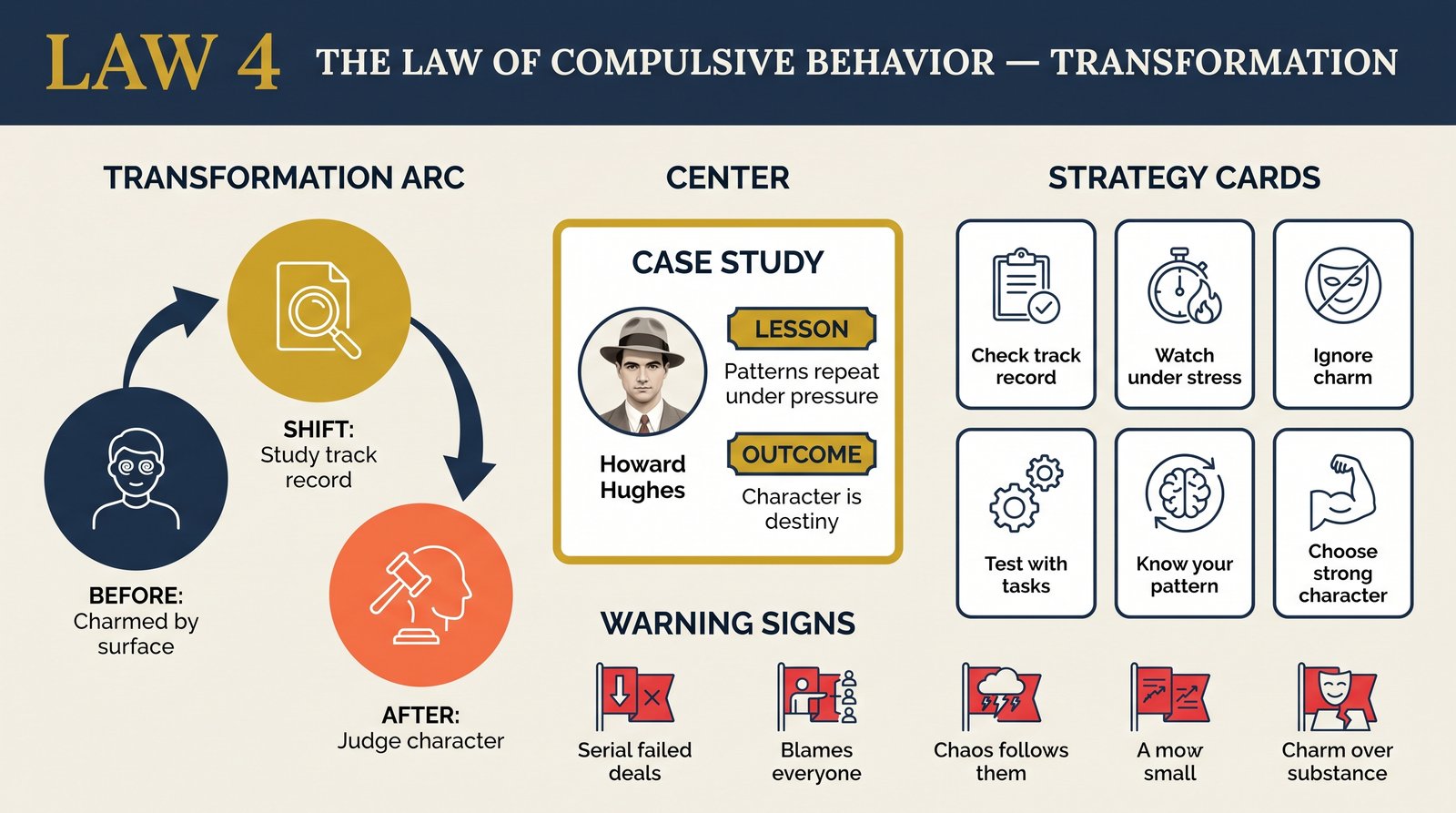
The transformation Greene prescribes operates on two levels. At the level of reading others, the shift is from event-based to pattern-based assessment. Instead of evaluating what someone did in a specific situation, you train yourself to look for the thread that connects their behavior across multiple situations and across time. What is the recurring theme? What does this person do compulsively, regardless of context? What types of situations activate their worst behavior, and what does that tell you about the compulsion driving it? This pattern-reading requires patience — it is built from observation over time rather than from any single data point — but the pattern it reveals is vastly more predictive than any individual behavior.
At the level of understanding yourself, the transformation requires what Greene calls "tracing the thread back" — the willingness to identify your own compulsive patterns by examining your behavioral history honestly and then tracing those patterns to their formative origins. This is not necessarily a therapeutic process in the clinical sense, though therapy is one path to it. It is fundamentally an act of honest self-archaeology: what do I do compulsively, across different contexts, that I cannot fully explain by rational intention? Where did that pattern come from? What was the original experience or relationship that made it feel necessary? What would it cost me, and what would I gain, if I interrupted it?
The deepest aspect of the transformation is developing what Greene calls "flexibility" — the capacity to respond to circumstances as they actually are rather than running the programmed response that feels compelled. This is a genuine form of freedom, but it requires first acknowledging the degree to which you are not currently free. The person who cannot see their compulsive patterns cannot step outside them; the person who sees them clearly has, at minimum, the possibility of choosing otherwise. Greene argues this is not just a personal but a strategic capacity — the person who can genuinely adapt their behavior to circumstances, rather than running the same pattern regardless of context, has an immense advantage in a complex and changing world.
Practical Guide
- Build a behavioral timeline for key people. Before entering a significant relationship — professional or personal — research the pattern of their past. How did their previous partnerships end? What types of situations have produced their worst behavior? What do people who have worked closely with them describe? The pattern across their history is more predictive than anything you will observe in early favorable interactions.
- Identify the compulsion trigger. Every compulsive pattern has specific conditions that activate it most reliably — a particular type of challenge to authority, a specific emotional need unmet, a situation that resembles the formative context. Identify what activates the pattern in the people you work closely with. This tells you what to manage and what to avoid.
- Watch behavior under pressure. The mask thins most consistently when people are under genuine stress, time pressure, or threat to their status. These moments reveal the compulsive pattern most clearly. Take what you see seriously — this is real character data, not an anomalous bad day.
- Trace your own recurring failures. Identify three situations or relationship types in which you have experienced repeated problems or similar outcomes. What is the common thread in your behavior across these situations? What pattern are you running that produces this outcome?
- Ask where your intense aversions come from. Compulsive avoidances are as diagnostic as compulsive behaviors. What situations do you avoid at disproportionate cost? What types of people make you immediately defensive or dismissive? These aversions are often inverted compulsions pointing toward the original wound.
- Assess whether the pattern is intensifying. In yourself and others, the key prognosis question is whether the compulsive pattern is gradually modulating — becoming more flexible, better calibrated — or intensifying under stress and age. Intensification without self-awareness is a warning signal about the person's long-term trajectory.
- Do not enter significant commitments hoping someone will change. Greene is direct about this: character patterns established over decades rarely change in the absence of major disruption, sustained therapeutic work, and genuine motivation. If the pattern you observe in someone is incompatible with what you need from the relationship, that is the relevant data. Base your decision on the pattern, not on who you hope they will become.
Modern Application
Co-founder and partnership selection: Failed business partnerships are one of the most common and costly sources of organizational destruction. The most reliable predictor of how a co-founder or partner will behave under the stress and conflict of a difficult business is their behavioral pattern in previous partnerships and high-stakes collaborations — not their self-description, not their performance in early positive-sum interactions. Greene's law suggests that the due diligence process for significant partnerships should include serious investigation of behavioral history across multiple contexts, specifically looking for the compulsive pattern that will emerge under pressure.
Family and intergenerational patterns: Compulsive patterns are often explicitly transmitted across generations — children learn to cope with the world by observing and internalizing their parents' coping mechanisms. The parent who manages anxiety through control produces children who either adopt the same strategy or develop compulsive submission as a counter-strategy. Understanding this law creates the possibility of genuinely interrupting intergenerational patterns rather than simply repeating them in slightly different contexts. The parent who has done the work of understanding their own compulsive patterns is in a fundamentally different position from the one who has not.
Personnel management and succession planning: Organizations frequently make the mistake of promoting people based on performance in their current role without asking whether the compulsive patterns that made them successful at one level will become destructive at the next. The individual contributor whose compulsive perfectionism produces extraordinary work quality often cannot delegate and therefore cannot lead teams effectively. The sales leader whose competitive drive and risk tolerance made them exceptional at closing deals may make reckless decisions when managing a P&L. Reading the pattern — not just the performance level — is essential for succession accuracy.
Romantic relationships and long-term partnership: The early phase of romantic relationships is notoriously a poor context for reading compulsive patterns, because infatuation suppresses everyone's worst tendencies and brings out their most adaptive behavior. Couples who invest real time before major commitment — who observe each other under stress, through conflict, across difficult circumstances, and in interactions with people who can do nothing for them — have far more accurate data about the compulsive patterns they will be living with for decades. Greene's law argues strongly for patience and observation before deep commitment.
Warning Signs
- Someone explains their repeated relational or professional failures exclusively in terms of other people's deficiencies — the pattern of attribution across their history never includes their own contribution.
- Their reaction to situations that threaten their control, status, or self-image is consistently disproportionate — the intensity of the reaction does not match the actual stakes.
- Early observation reveals a significant gap between their stated values about how they treat people and their actual behavior toward those with less power — subordinates, service workers, people who cannot help them.
- Their coping strategy — whatever it is: withdrawal, control, performance, charm — appears with remarkable consistency across different contexts and relationships, suggesting compulsion rather than adaptive response.
- When they encounter situations that should prompt them to revise their approach, they instead intensify the same strategy — doing more of what is not working rather than genuinely adapting.
- You observe a pattern of burning bridges — former partners, employers, or collaborators who are now enemies or estranged — without any apparent self-reflection on their contribution to these ruptures.
Key Quotes
"We like to think of ourselves as free — that we respond to circumstances as they present themselves. The reality is that we are run by deep programs laid down in our earliest years, programs that fire the same responses to the same triggers regardless of the circumstances we are actually in."
"Howard Hughes did not choose to end his life sealed in a room, eating nothing but ice cream, consumed by his terror of contamination. He was running a program that had been running since childhood. The tragedy is not that it ran — it is that it was never examined."
"The most reliable test of character is not what people do when things are going well. It is what pattern of behavior persists across all the situations life puts them in — the situations they choose and the situations they cannot avoid."
Reflection Questions
- Identify a pattern that has appeared more than twice in your professional or personal life — a type of conflict that recurs, a type of relationship that ends the same way, a type of situation that consistently produces a specific outcome. What is your role in creating this pattern?
- What do you do automatically, without deliberate choice, when you feel your control slipping? When you feel unvalued? When you feel exposed? Trace each response — where do you think it came from?
- Think of someone whose compulsive pattern has significantly affected your life. What were the early signs of that pattern that you missed or rationalized? What would you look for earlier next time?
- Greene argues that genuine character change requires first seeing the pattern clearly and then genuinely wanting to interrupt it. Which of your own patterns do you most resist seeing clearly, and why?
- Where in your life are you currently hoping that someone's pattern will change without evidence that they are actually working to change it? What are you not allowing yourself to see about what that pattern predicts?
Connected Laws
- law-01-irrationality — Compulsive patterns are irrationality in its most crystallized form: the emotional survival strategies forged in early experience continue to drive behavior regardless of whether they serve current rational interests.
- law-03-role-playing — The compulsive pattern is precisely what breaks through the social mask — the performance can be managed, but the pattern appears across contexts and over time, which is why reading patterns is more reliable than reading any single interaction.
- law-02-narcissism — Deep narcissism is itself a compulsive pattern forged in early experience, typically around needs for validation and control; Hughes's paranoid isolation and Stalin's paranoid purges are both narcissistic compulsion expressed at scale.