Concept 2 — Sophisticated Falsificationism
Core Thesis
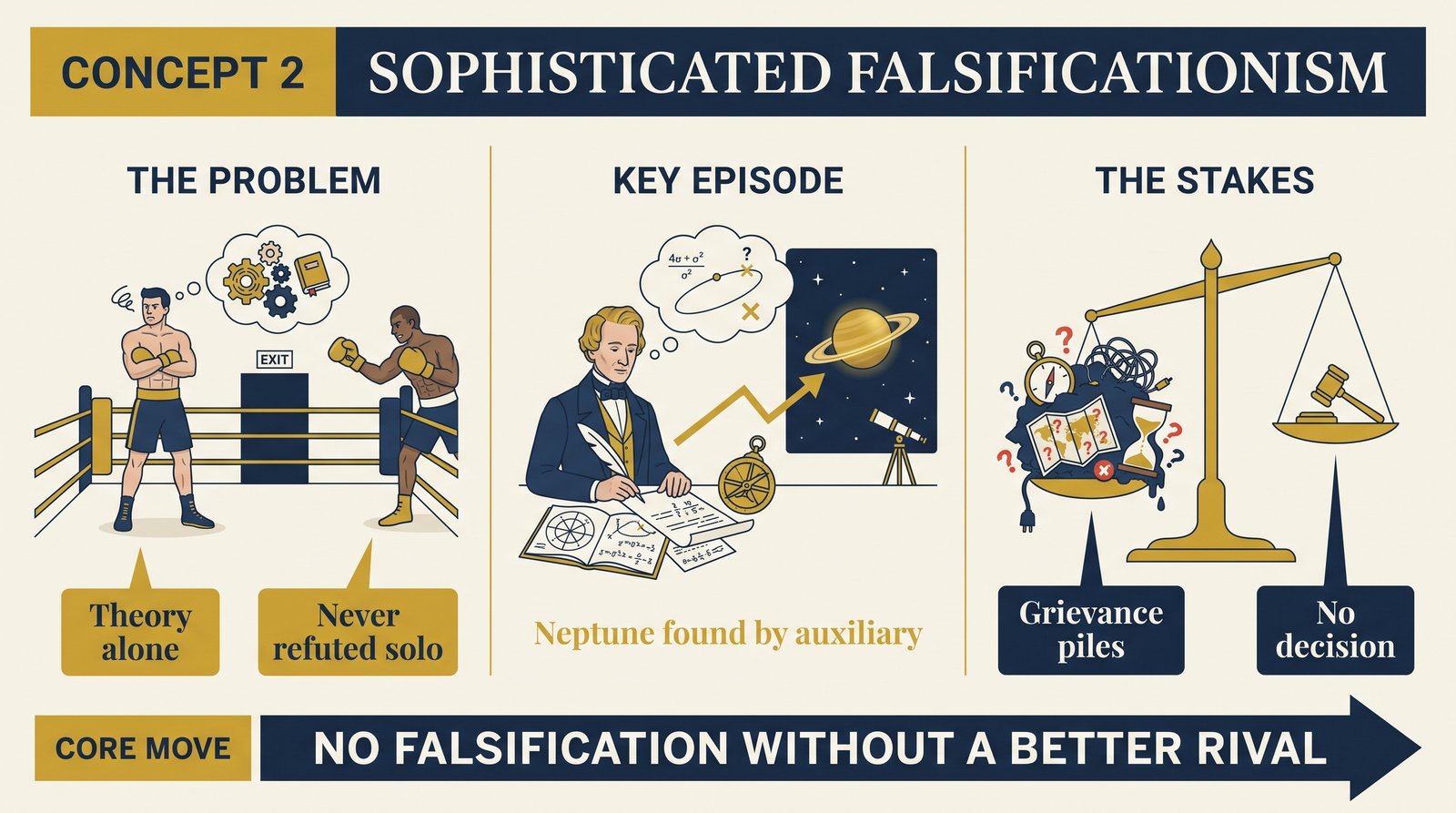
Lakatos's repair of Popper: a theory is never falsified by evidence alone — it is falsified only when a better theory arrives. "Better" has three parts: the rival predicts novel facts the old theory forbids, explains the old theory's successes, and some of the novel predictions get corroborated. Refutation without replacement is no refutation at all; science is a contest of theories, not a duel between theory and nature.
The Problem It Solves
Two fatal defects of naive falsificationism. First, theories never face nature alone (the Duhem problem): every test involves auxiliary assumptions, so blame can always be shifted. Second, all theories are born into an ocean of anomalies; if anomalies killed, nothing would survive infancy. Sophisticated falsificationism relocates the decision: not "does evidence contradict theory?" but "does a rival digest the evidence better?"
Key Episode
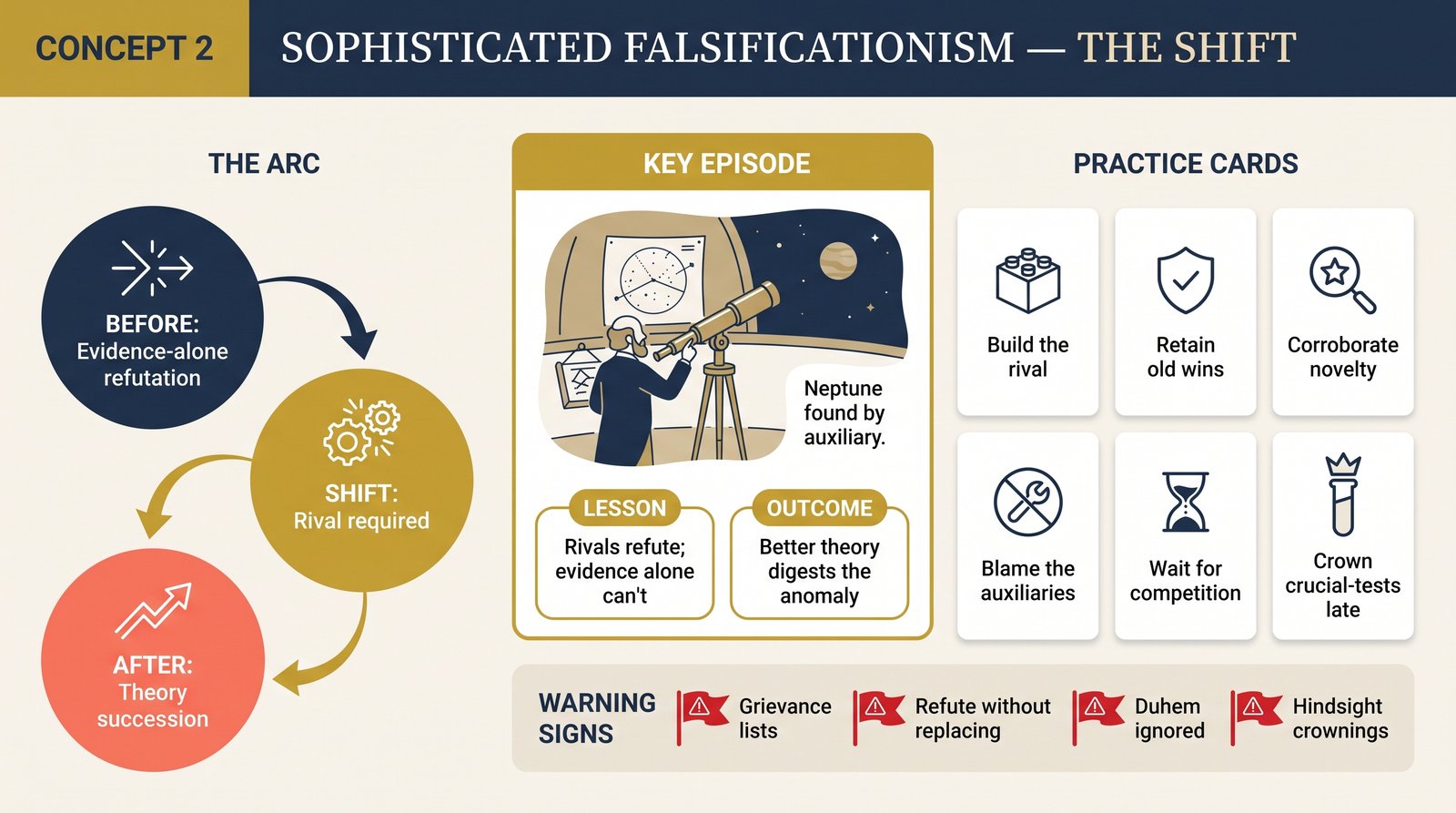
The white raven problem, Lakatos-style: observing anomalies in Uranus's orbit did not falsify Newton — astronomers postulated an unseen planet, and Le Verrier's calculation found Neptune exactly where the auxiliary hypothesis required. The same maneuver tried for Mercury (planet "Vulcan") failed forever — but Newton still wasn't abandoned until Einstein offered a theory that predicted Mercury's perihelion and everything Newton got right.
The Shift
From falsification-as-execution to falsification-as-succession: the unit of appraisal doubles (theory plus rival), the verdict waits for competition, and "crucial experiments" are recognized as crucial only in hindsight, after a rival wins. Popper's logic survives, but the trigger changes hands.
Critiques & Rivals
Popper resisted: this makes refutation hostage to invention — a theory could reign unchallenged forever merely for lack of rivals. Lakatos accepts that consequence; so does history. Feyerabend radicalized it: if rivals are required for refutation, then proliferating theories is a scientific duty — even wild ones.
Modern Application
The operational rule from Kuhn's crisis chapter gets its logic here: never retire a system on bug reports; retire it on a benchmarked rival. An architecture, vendor, or strategy with known failures is unfalsified until the alternative exists that keeps its wins and fixes its losses — and demonstrates one new win besides. Build rivals; don't collect grievances.
Key Terms
- Duhem problem — tests hit theory-plus-auxiliaries, never theory alone
- Novel fact — a prediction not used in constructing the theory
- Crucial experiment — an honorific bestowed retrospectively
Key Quotes
"There is no falsification before the emergence of a better theory."
"The proponents of a research programme may even 'thrive on' anomalies: an ocean of anomalies is a challenge, not a refutation."
Reflection Questions
- What grievance list are you maintaining that needs to become a rival prototype?
- Which "crucial experiment" in your field's lore was actually decided by the winner's later success?
- What auxiliary assumptions absorb the blame when your main framework misses?
Connections
- The machinery that manages anomalies: protective belt
- What "better sequence" means precisely: progressive problemshifts