Chapter 8 — The Response to Crisis
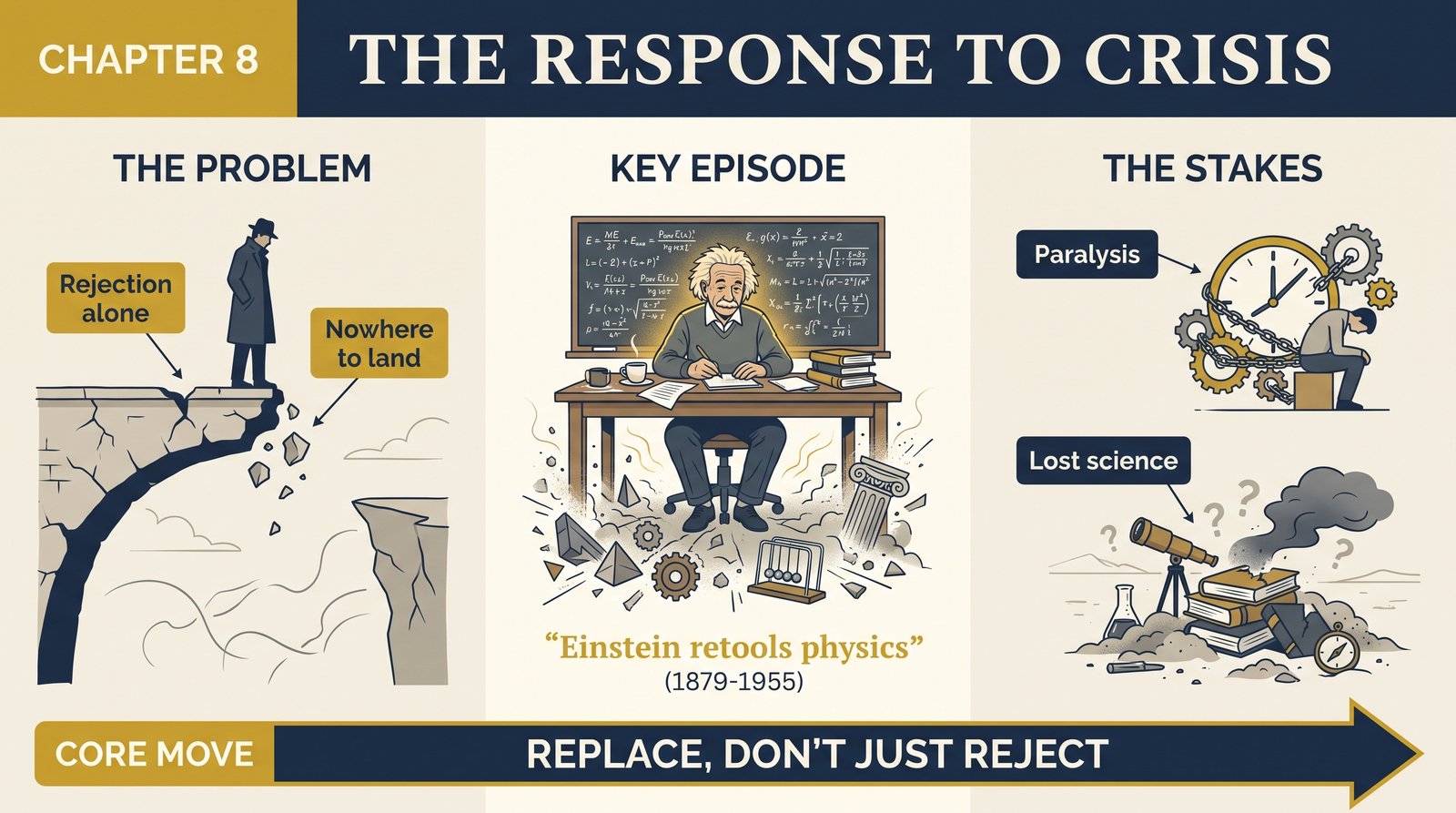
Core Thesis
Even in deep crisis, scientists do not treat anomalies as Popperian refutations, and they do not abandon a paradigm until an alternative candidate is available. To reject one paradigm without substituting another is to reject science itself. Crisis loosens the rules, multiplies competing articulations, and drives some practitioners to philosophy — but the decision is always a comparison between paradigms, never between paradigm and nature alone.
The Problem It Solves
The falsificationist puzzle: every theory, at every moment, faces unsolved anomalies — so why isn't everything refuted always? Kuhn's answer: anomaly only becomes decisive when (a) it resists the field's best attacks, (b) it strikes fundamentals, and (c) a rival framework can claim it as a solved problem. Until then, it's just another puzzle on the pile.
Key Episode
The response to the failing Ptolemaic system: most astronomers patched epicycles for generations — rationally, because patching had always worked. Others, like Copernicus, turned to philosophical first principles and to alternatives (Neoplatonic sun-worship, ancient heliocentric hints). Kuhn also cites Einstein's testimony that, before relativity, it was "as if the ground had been pulled out from under one" — and notes the flight to first-principles debate that marks physics in every deep crisis.
The Shift
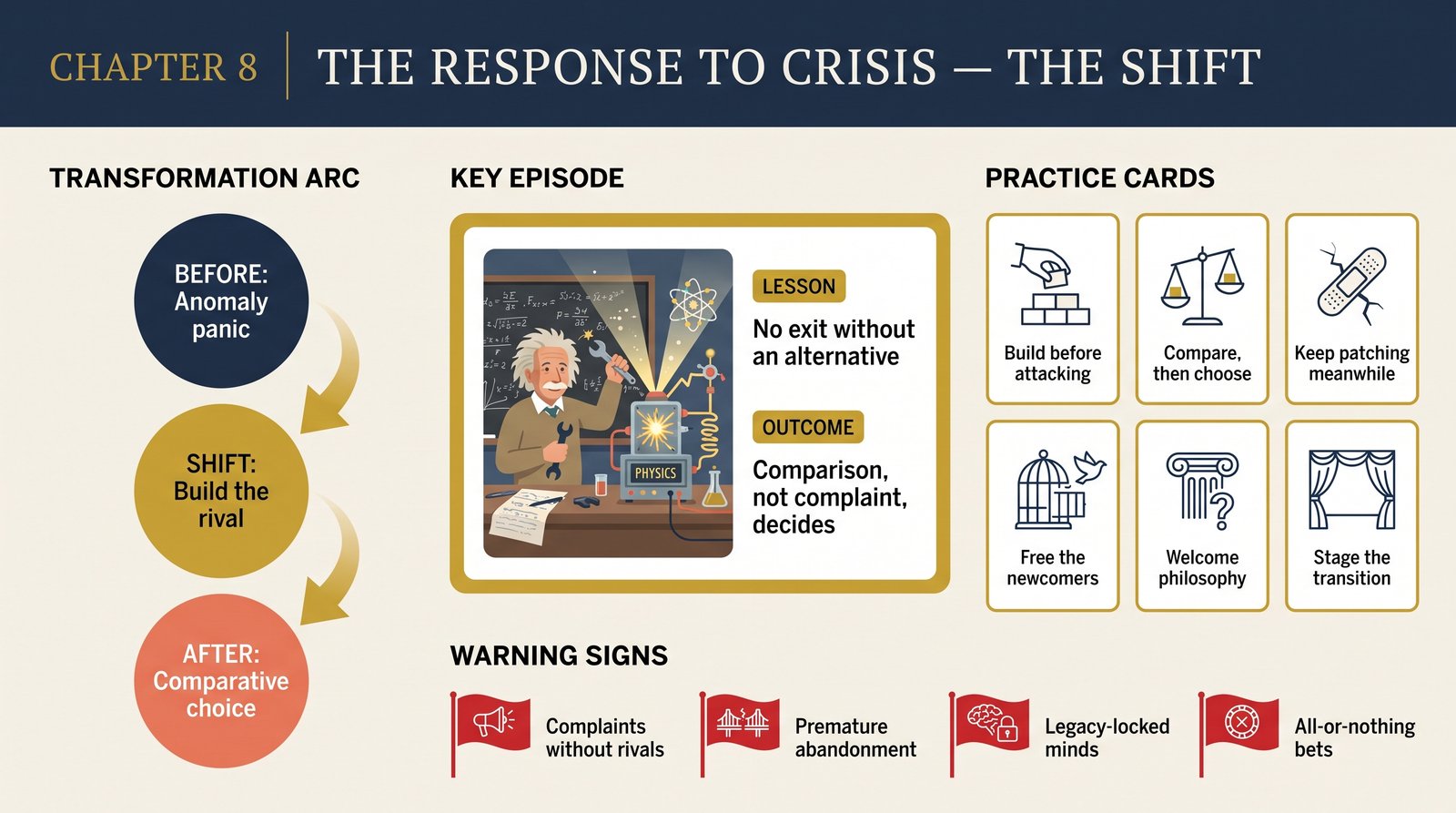
From refutation-logic to comparative judgment: the unit of scientific choice is never "theory vs. evidence" but "theory vs. theory vs. evidence." Crisis behavior also gets a typology: some scientists redouble normal efforts, some quietly leave the field, some — usually young or newcomers — chase the wild options that the loosened rules now permit.
Critiques & Rivals
Popper conceded scientists behave this way but insisted they shouldn't — dogmatism as vice. Lakatos reframed the point as method: never abandon a programme merely for anomalies; abandon it for a better programme. Feyerabend pushed further: even proliferation before crisis is good. The empirical claim — no rejection without replacement — has held up remarkably well.
Modern Application
Never kill a system, strategy, or process on failure alone; kill it on comparison. "This is broken" is a complaint; "this alternative solves what breaks here" is a decision. Conversely, if you want an old approach retired, don't catalogue its failures — build the working alternative that makes the failures fatal. And expect the boldest option-generation from people least invested in the old commitments.
Key Terms
- Paradigm comparison — choice is triadic: two paradigms and nature
- Rule-loosening — crisis licenses speculation normal science forbids
- Extraordinary science — the transitional research mode inside crisis
Key Quotes
"To reject one paradigm without simultaneously substituting another is to reject science itself."
"Once it has achieved the status of paradigm, a scientific theory is declared invalid only if an alternate candidate is available to take its place."
Reflection Questions
- What failing approach are you attacking without offering a replacement?
- In your last big pivot, was the trigger the failure — or the appearance of a viable alternative?
- Who in your organization is free enough of legacy commitments to generate wild options?
Connections
- What makes the ensuing change revolutionary: next chapter
- The debate with Popper is the seed of the Lakatos companion book