Law 16: The Law of Aggression
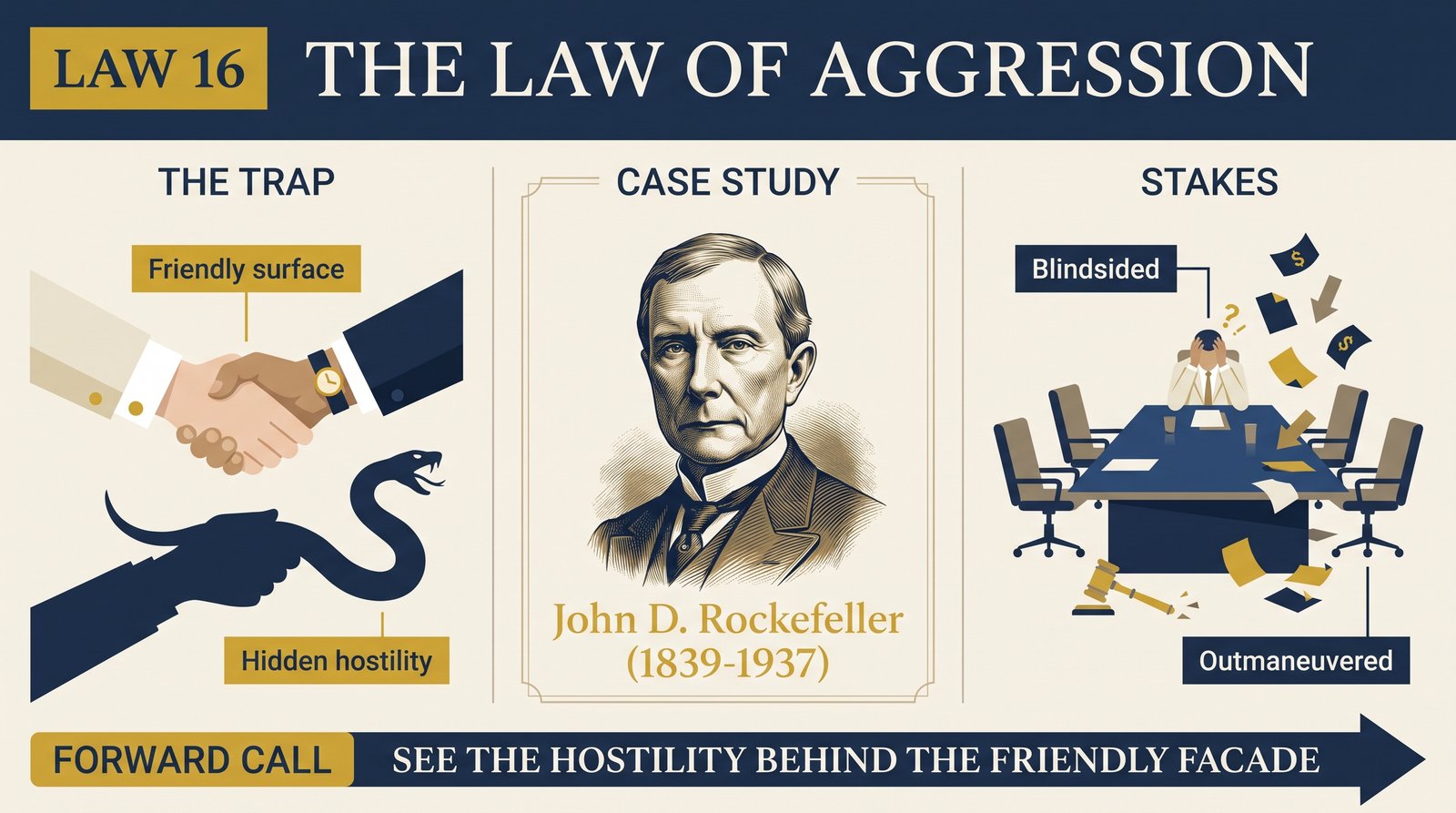
Directive: "See the Hostility Behind the Friendly Facade"
Core Concept
Overt hostility is socially punished in virtually every modern context. You cannot openly threaten your colleagues, demand submission from your competitors, or pursue dominance through direct physical intimidation without facing severe consequences. But the aggressive drive — the desire to prevail, to dominate, to eliminate rivals and obstacles, to expand one's power and resources — does not disappear because direct expression is prohibited. It goes underground. It becomes invisible. And in doing so, it becomes more dangerous, because it operates on people who are not looking for it.
Greene argues that aggression is one of the most fundamental human drives, rooted in our evolutionary heritage as competitive social primates. In ancestral environments, the willingness to fight for resources, mates, and status was a survival advantage of the first order. That drive is still present in every human being, expressed with varying intensity and routed through vastly different channels depending on personality, culture, and circumstance. The person who appears most gentle, most cooperative, most focused on others' wellbeing may be channeling aggressive drive just as powerfully as the obvious bully — they are simply doing it more skillfully and with better camouflage.
Covert aggression takes forms that are not always immediately recognizable as aggression at all. It appears as strategic helpfulness that creates dependency: the colleague who always offers assistance in ways that consistently put you in their debt. It appears as criticism delivered as concern: "I'm just worried about you" as the vehicle for destabilizing your confidence. It appears as passive-aggression — the agreement that is never followed through, the support that fails at the critical moment, the delay that sabotages without leaving fingerprints. It appears as political maneuvering: coalition-building, information control, strategic alliance-forming designed to progressively shift power away from the target. In each case, the surface behavior can be explained innocuously; the pattern of behavior, tracked over time, reveals something quite different.
The people most vulnerable to covert aggression are those trained most thoroughly in niceness. If you were raised to interpret social interactions primarily through a lens of good faith — to take people at their word, to explain away troubling patterns, to prefer charitable interpretations — you will systematically miss what is actually happening in competitive environments. You will be confused by your repeated losses, because the moves that produced them looked cooperative, not hostile. This is not paranoia Greene is prescribing; it is pattern recognition, the ability to read the whole picture rather than just the moment's surface.
The Human Weakness
The core weakness that Law 16 exploits is what Greene calls the "niceness bias" — the cultural training, especially strong in people raised in certain class backgrounds and professional environments, to interpret ambiguous social signals charitably. We are taught that hostility is something we should be able to see clearly — that it announces itself through raised voices, explicit threats, or obvious competitive behavior. Covert aggression exploits this expectation systematically: by maintaining a surface of warmth, cooperation, and concern, the covert aggressor makes their behavior categorically invisible to people whose aggression-detection is calibrated only for the overt kind.
A second weakness is confirmation bias applied to social judgments: once we have formed an impression of someone as fundamentally decent and well-intentioned, we tend to interpret subsequent ambiguous behavior through that lens. The troubling incident gets explained away; the pattern that would be obvious to a fresh observer is invisible to someone who has already committed to a positive assessment. Covert aggressors understand this mechanism intuitively and exploit it by ensuring their initial impression is strongly positive — through excessive friendliness, helpfulness, and expressed admiration — before revealing their actual agenda through behavior.
A third weakness is the internal discomfort many people feel about their own aggressive impulses. If you believe aggression is fundamentally bad — if you have suppressed and denied your own competitive and hostile drives — you will project that denial onto others. You will want to believe that the people around you are not aggressive because you need to believe that you are not aggressive. This makes you not just unable to see others' covert aggression, but actively resistant to evidence of it — because acknowledging their hostility would force you to confront your own. The work of Law 16 thus requires internal work as well as external perception: you need to make peace with your own aggressive drive before you can accurately perceive it in others.
Historical Figure: John D. Rockefeller (Gilded Age America)
John D. Rockefeller is Greene's archetype for controlled, strategic aggression carried to its most sophisticated and devastating conclusion. Rockefeller built Standard Oil into the most powerful monopoly in American history by the time he was in his forties, controlling at its peak approximately 90 percent of American oil refining. He did this while maintaining, with remarkable consistency, a public persona of Christian piety, modest personal habits, and business rectitude. He genuinely believed — or convinced himself that he believed — that he was a steward of God's gifts, that his efficiency and consolidation served the public good, that his competitors were not being destroyed but "absorbed" into a more rational enterprise. His aggression was so thoroughly wrapped in the language of religion and business rationality that he may not have fully experienced it as aggression.
Greene traces Rockefeller's specific covert techniques with care. He used his railroad relationships to secure secret rebates — advantages that gave Standard Oil a price advantage competitors could not understand or respond to, because the mechanism was hidden. He created "front companies" that appeared to be independent competitors but were secretly Standard Oil subsidiaries, allowing him to monitor competitors, undercut them strategically, and eventually acquire them at distress prices without revealing his hand until the acquisition was complete. He cultivated legislators, judges, and political figures through a combination of financial support and personal charm — not through explicit bribery, which left evidence, but through the more sophisticated currency of favors, connections, and long-term relationship investment.
Most revealing for Greene's purposes is how Rockefeller managed interpersonal encounters with rivals and critics. He was legendarily warm, personally generous to employees and family, active in his church community, and genuinely beloved by people in his immediate social circle. He did not present as someone who was systematically dismantling every competitor in the oil industry. When confronted with evidence of Standard Oil's aggressive practices, he expressed genuine puzzlement — how could people characterize as hostile what was simply a more efficient way of organizing an industry? This compartmentalization, whether conscious or not, was itself a form of power: it made him genuinely difficult to read, genuinely confusing to opponents who expected overt hostility to look different from what they were experiencing.
The lesson Greene draws is not that Rockefeller was uniquely evil but that his methods were representative of how effective covert aggression actually works in practice: it is invisible not because it is perfectly hidden but because it looks, from the surface, exactly like normal business activity, normal friendliness, normal ambition. The same pattern, at different scales, is visible in every competitive human environment. The person using it is not necessarily a monster; they may be, like Rockefeller, someone who has constructed an entirely self-consistent internal narrative in which their aggressive behavior is actually selfless, rational, or God's will.
The Transformation
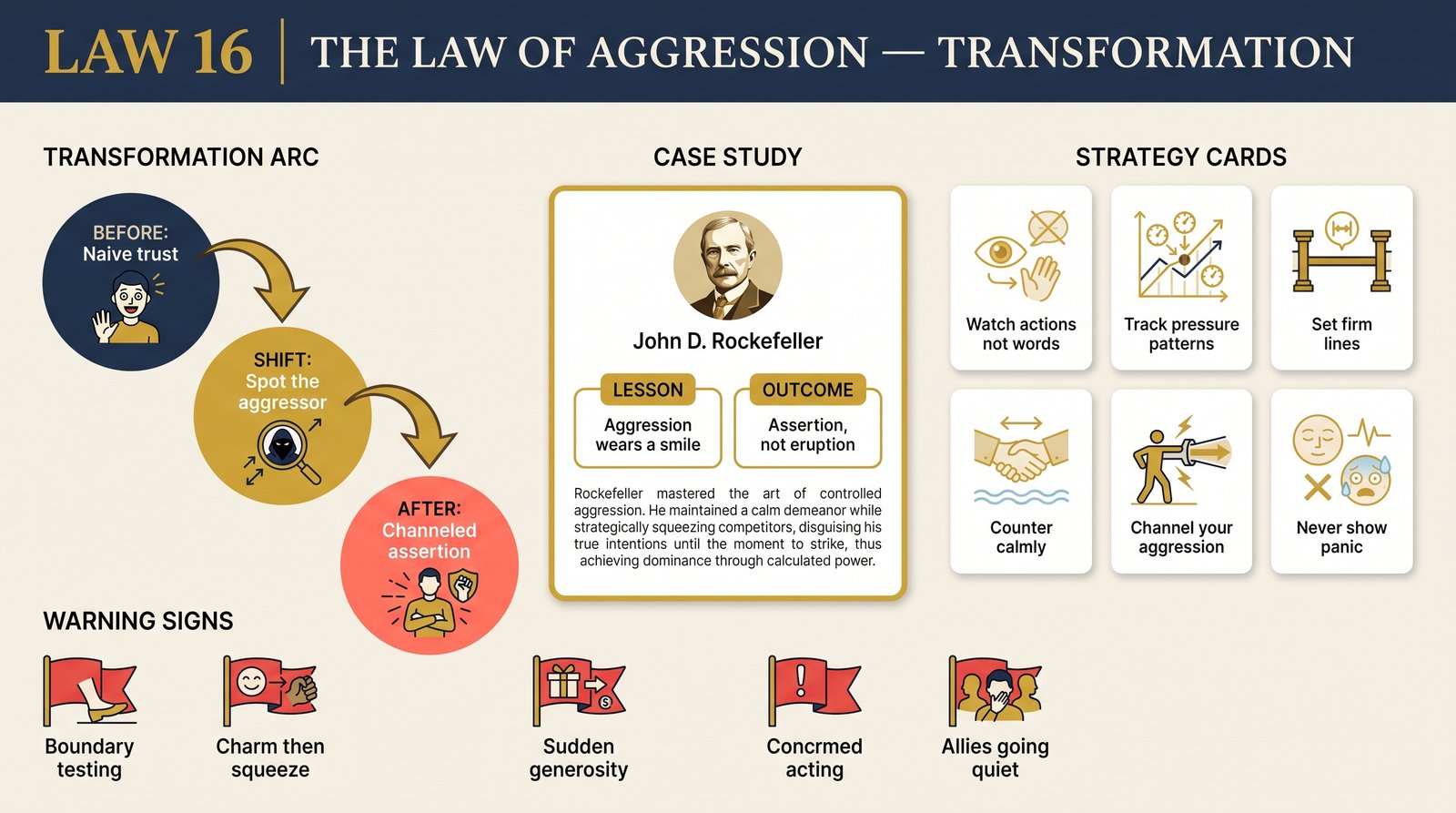
The first transformation Greene prescribes is perceptual: training yourself to read behavior rather than presentation. This means tracking what people actually do — the cumulative pattern of their actions and their outcomes — rather than taking their self-description or surface presentation at face value. The question is not "what does this person say they want and why they're doing this" but "what is consistently happening in situations involving this person, and who consistently benefits?" This sounds cynical; in practice, it is simply the habit of reading the full picture rather than the edited version that most people present.
The second transformation is internal: developing a realistic relationship with your own aggressive drive. Greene argues, drawing on psychoanalytic tradition, that the aggressive impulse is universal — the question is not whether you have it but what you do with it. Suppressed and denied, it tends to emerge in distorted forms: passive-aggression, excessive compliance that secretly seethes, or outbursts of disproportionate anger when the accumulated pressure finally exceeds the containment. Acknowledged and channeled, it becomes one of your most important resources: the competitive drive that keeps you pushing, the assertiveness that gets you taken seriously, the willingness to fight for what you actually care about. The person who has made honest peace with their own aggression is far more effective at managing it and far less susceptible to the guilt-manipulation that covert aggressors typically deploy.
Third is the development of what Greene calls "strategic assertiveness" — the capacity to advance your interests directly, openly, and without excessive apology, while remaining aware of how your assertiveness lands on others and calibrating accordingly. This is the positive channel for aggressive energy: not hostility toward others, but vigorous advocacy for your own interests and values. People who express their aggressive drive through strategic assertiveness are less susceptible to covert aggression because they are not relying on good faith and cooperation to advance themselves — they have their own mechanisms for getting what they need, which means they can choose when to cooperate and when to compete rather than being dependent on others' cooperation.
Practical Guide
- Track patterns, not incidents. A single confusing interaction can be explained away; a pattern of interactions with the same outcome cannot. When you find yourself repeatedly losing resources, credit, opportunity, or relationships in encounters with a specific person, investigate the pattern rather than rationalizing individual events.
- Watch for the "helping that hurts" dynamic. Notice when someone's assistance consistently creates dependency, put you in debt, or gives them information and access they use advantageously. Not all help is benign; distinguish genuine generosity from strategic investment.
- Listen for the "concern" formula. Criticism delivered as concern — "I'm just worried about you," "I say this as a friend," "I'm only telling you this because I care about your success" — is among the most common covert aggression vehicles. The criticism is real; the concern framing is protective camouflage for the critic and disarming for the target.
- Distinguish competitive from hostile. Not all aggressive energy directed at you is malicious. Healthy competition — where someone is simply pursuing their own interests vigorously, not specifically trying to harm you — is normal and not a problem. The distinction matters: reserve your defensive responses for genuine hostility, not for normal competition.
- Channel your own aggression productively. Identify the areas where you have been pulling punches — not advocating for yourself, not competing for what you want, not fighting for the things you care about. The suppression of healthy assertiveness creates both personal dissatisfaction and the kind of passivity that makes you a more attractive target for covert aggression.
- Use silence and patience as tools. Many covert aggressors rely on reactive targets — people who can be destabilized by provocations, who respond to pressure by becoming agitated or confused. The person who responds to provocation with calm patience, who does not immediately react, who thinks carefully before acting, is a much more difficult target. Developing this capacity is one of the most powerful defenses against covert aggression.
- Create transparency where covert aggressors rely on opacity. Covert aggression depends on its invisibility. When you name a dynamic clearly and calmly — "I notice that the projects I've worked on with you have consistently had delays that affected my timelines; I want to talk about what's happening" — you remove the cover that the behavior requires. This does not always solve the problem, but it changes the terms.
Modern Application
The professional environment: A product manager consistently finds that a peer — friendly in meetings, complimentary in public — has a habit of sharing information about her projects selectively: mentioning concerns to leadership in contexts she is not part of, framing her work's challenges in ways that raise questions about her judgment. None of these individual behaviors is incontrovertible; each can be explained as misunderstanding, context difference, or genuine concern. The pattern, however, tells a different story. Law 16's prescription: track the pattern explicitly, stop sharing sensitive project information in shared contexts, and consider a direct conversation that names the pattern without accusation — "I've noticed some things I'd like to understand better."
The romantic relationship: Passive-aggression in intimate relationships is one of the most common and destructive manifestations of covert aggression. A partner who agrees to things and then fails to follow through, who "forgets" commitments that are clearly important to you, who expresses unhappiness through withdrawal and silence rather than direct communication — this person is expressing aggressive impulses through the covert channel. Law 16's prescription includes both recognition (this is aggressive behavior, not merely annoying inattention) and the same channel-opening response: naming the pattern calmly and specifically, making the covert behavior visible rather than continuing to respond to the surface.
The organizational politics context: A senior manager who is consistently warm and supportive in individual conversations but whose organizational decisions consistently undermine the careers of people who challenge her — people who raise critical questions in meetings find their projects defunded, their responsibilities reduced, their allies transferred — is exercising covert organizational aggression at a sophisticated level. The response requires a combination of pattern recognition, political intelligence (understanding who this person can mobilize and how), and the development of coalitions that provide some insulation from her ability to act unilaterally.
The internal dimension: Someone who has spent years suppressing his own competitive drive — raised in an environment where ambition was morally suspect, where "wanting too much" was considered a character flaw — finds himself repeatedly passed over for opportunities he could have claimed, undervalued in negotiations he could have won, and vaguely resentful of people who seem to advance effortlessly. Law 16's prescription here is the internal work: acknowledging the competitive drive, examining where it has been suppressed, and beginning to practice strategic assertiveness in contexts where the cost of failure is low. The goal is not to become aggressive but to stop being the person who makes it easy for others to be aggressive at your expense.
Warning Signs
- Someone consistently benefits at your expense from interactions that, viewed individually, seem explainable but form a troubling pattern over time.
- You feel oddly drained, confused, or destabilized after interactions with a specific person, but cannot point to anything they specifically said or did that was hostile.
- Critical feedback about your work or character consistently arrives through "concerned" intermediaries rather than directly — suggesting someone is managing the narrative about you without leaving fingerprints.
- You find that your "helpful" relationships systematically create dependency or put you in positions of obligation, even when you entered them expecting mutuality.
- You have been repeatedly surprised to discover, after the fact, that someone you trusted as an ally was behaving very differently behind your back — suggesting a pattern in your trust calibration, not just a single bad actor.
- You suppress your own assertiveness out of fear of being perceived as aggressive, while consistently finding yourself on the losing side of interactions with people who have no such inhibition.
Key Quotes
"Overt aggression is what we can see and therefore manage. It is covert aggression — wearing the mask of helpfulness, concern, or cooperation — that does the real damage, because it operates in the space our defenses don't cover."
"Rockefeller was not a hypocrite in any simple sense. He had constructed a complete and internally consistent moral universe in which his aggressive behavior was actually righteousness. This is the most dangerous form of aggression: the kind the aggressor believes is virtuous."
"You cannot accurately perceive aggression in others if you cannot acknowledge it in yourself. The suppression of your own competitive impulse creates a blind spot that makes you consistently vulnerable to the very drive you have refused to see."
Reflection Questions
- Think of a professional or personal relationship where you have repeatedly come out worse than you expected or deserved. Tracking the pattern rather than the individual incidents: is there a consistent mechanism? What would it look like if you dropped the charitable interpretation?
- Where in your life are you currently suppressing legitimate assertiveness — not advocating for yourself, not competing for things you want, not fighting for what you believe in? What are you afraid of, and is that fear well-calibrated to the actual risk?
- Recall the last time you delivered criticism wrapped as concern — "I'm just worried about you," or similar. Was the concern genuine, or was it camouflage for a competitive or hostile impulse? What would it have looked like to deliver the same message more directly?
- What is your honest relationship with your own competitive and aggressive drives? Do you acknowledge them, or have you built a self-image that requires denying them? What does the denial cost you in terms of accurate self-knowledge?
- In the environments where you compete — professionally, socially, creatively — who are the most effective players, and how do they actually advance their interests? Are the mechanisms they use visible on the surface, or are you reading a redacted version of what's happening?
Connected Laws
- Law 14: The Law of Conformity — Group dynamics are one of the primary channels through which covert aggression operates at scale. The deindividuation and diffusion of responsibility described in Law 14 allow aggressive impulses to be expressed collectively in ways that no individual would own — mob behavior, organizational persecution, collective scapegoating. Understanding both laws is essential for recognizing when group dynamics are being weaponized by specific aggressive actors.
- Law 2: The Law of Narcissism — Deep narcissistic injury is one of the most reliable drivers of covert aggression. The person who experiences criticism, perceived disrespect, or competitive loss as a profound wound to their self-image often responds with exactly the covert hostility described in Law 16 — because overt aggression would confirm the humiliation they are trying to conceal. Understanding the narcissistic wound at the root of much covert aggression helps in both predicting it and defusing it.
- Law 15: The Law of Fickleness — The aggression of followers toward leaders, described in Law 15 as the resentment of dependency, is a specific and important application of Law 16's general framework. When followers become hostile to leaders they previously idealized, the hostility often has the covert quality described here — it is expressed through gossip, coalition-building, selective compliance, and subversion rather than direct confrontation. Leaders who understand Law 16 are better equipped to recognize and navigate this specific dynamic.