Chapter 11 — The Invisibility of Revolutions
Core Thesis
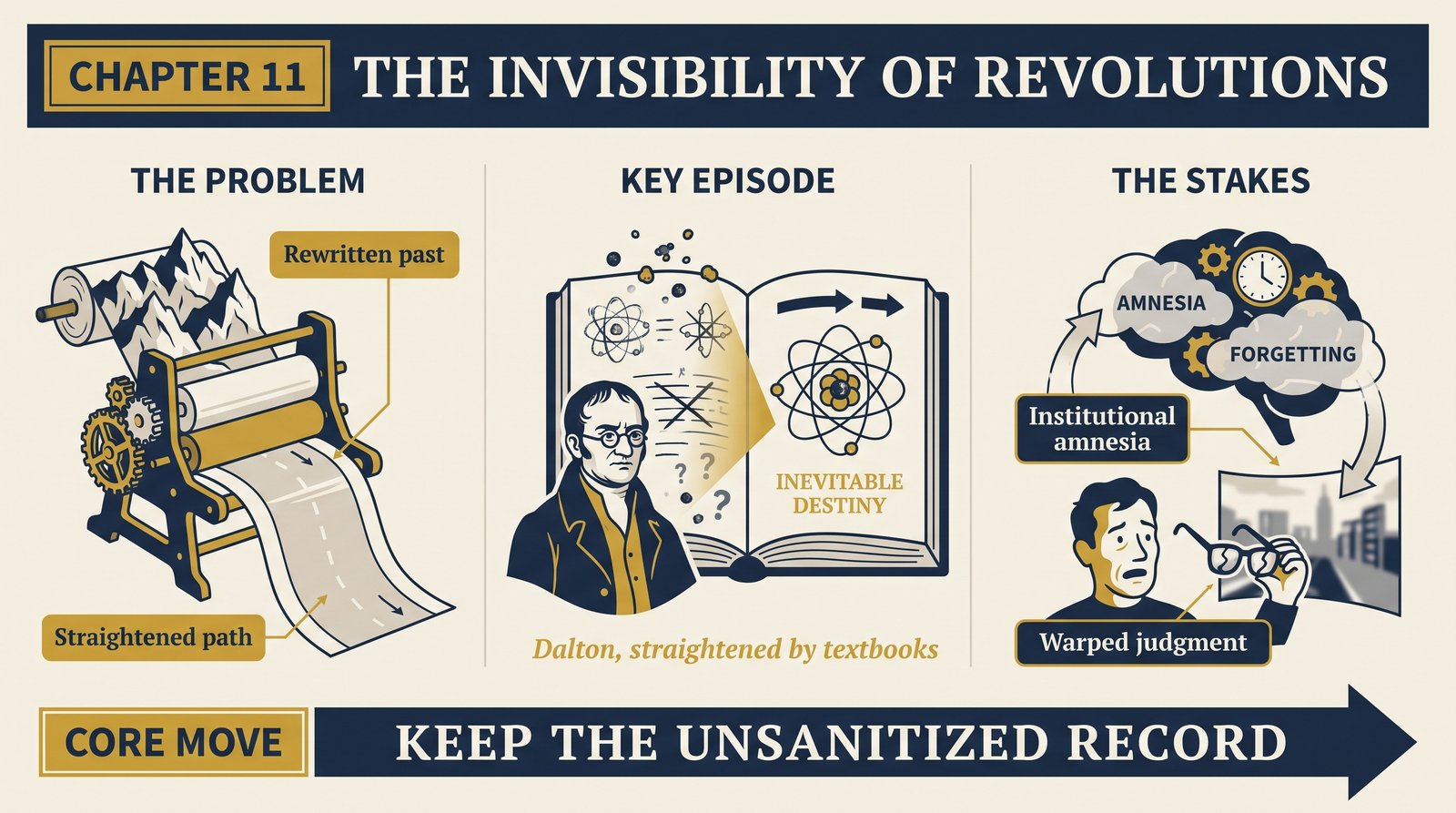
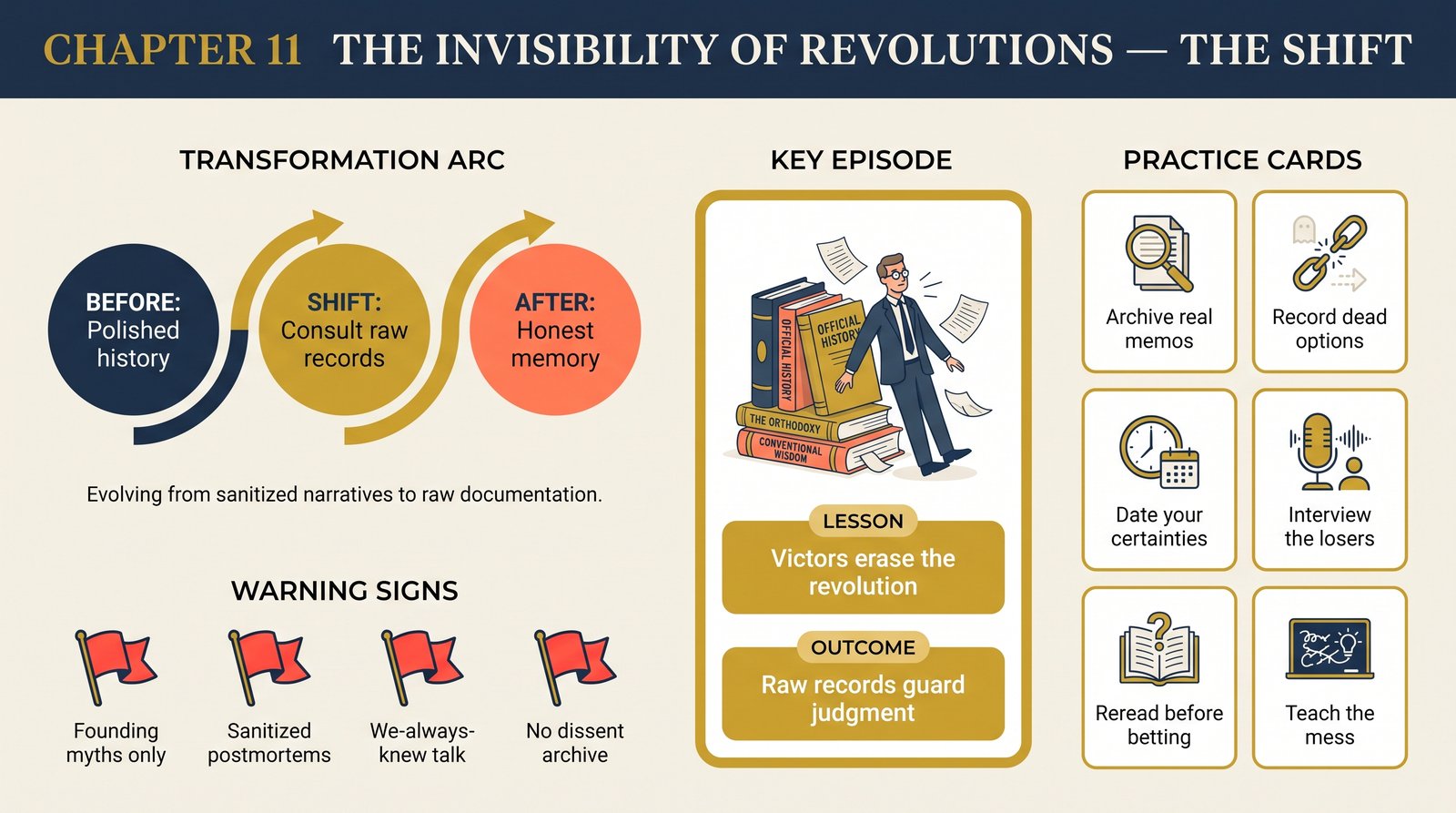
Revolutions become invisible almost as soon as they succeed. Textbooks — the medium through which each generation learns its science — are rewritten after every revolution, and they rewrite history backwards: past scientists appear to have been working on today's problems with today's standards, and science appears cumulative. The revolution's victors erase the war.
The Problem It Solves
Why does the cumulative image of science survive when historians keep disproving it? Because the image is manufactured, systematically, by science pedagogy itself. Unlike art or history students, science students read almost no primary sources — only textbooks that recast the past as a linear march to the present. The distortion isn't a conspiracy; it's functional. Normal science works better when practitioners believe their tradition is continuous.
Key Episode
Dalton's law of fixed proportions, presented in textbooks as an experimental finding chemists had "always" been approaching. Historically, chemists for decades had excellent evidence against fixed proportions (solutions, alloys, glasses all seemed counterexamples); Dalton's atomism forced the redefinition of "compound" that made the law true by category. The textbook version inverts cause and effect — and thereby hides that a revolution happened at all.
The Shift
From reading textbook history as history to reading it as ideology-of-the-tradition. Kuhn's comparison is pointed: the rewriting makes science's past resemble what Orwell's 1984 does to political history — and, like it or not, the member of a mature scientific community is thereby "a victim of a history rewritten by the powers that be."
Critiques & Rivals
Some argue the distortion is pedagogically necessary and epistemically harmless — engineers don't need true history to build bridges. Historians reply that the false image warps philosophy of science, policy, and scientists' own self-understanding in crisis (believing "facts decide quickly," they mismanage actual paradigm debates). Both can be right: useful for training, costly for judgment.
Modern Application
Every organization writes textbook history: the founding myth, the "inevitable" pivot, the postmortem sanitized into a straight line. Fine for onboarding morale; dangerous for decision-making. Keep raw records — original memos, dead options, the argument as it actually ran — and consult them before the next big bet. If your only history is the polished deck, you've institutionalized amnesia.
Key Terms
- Textbook science — pedagogy's linear reconstruction of the past
- Invisibility — revolutions hidden by post-hoc rewriting
- Functional distortion — the rewrite serves normal science's efficiency
Key Quotes
"Textbooks... have to be rewritten in whole or in part whenever the language, problem-structure, or standards of normal science change... and, once rewritten, they inevitably disguise not only the role but the very existence of the revolutions that produced them."
"The member of a mature scientific community is, like the typical character of Orwell's 1984, the victim of a history rewritten by the powers that be."
Reflection Questions
- What does your organization's official history smooth over — and who remembers the real version?
- Which "we always knew" belief in your field was actually a hard-won, contested revolution?
- Where do you keep the unsanitized record of your last major decision?