Chapter 2 — The Route to Normal Science
Core Thesis
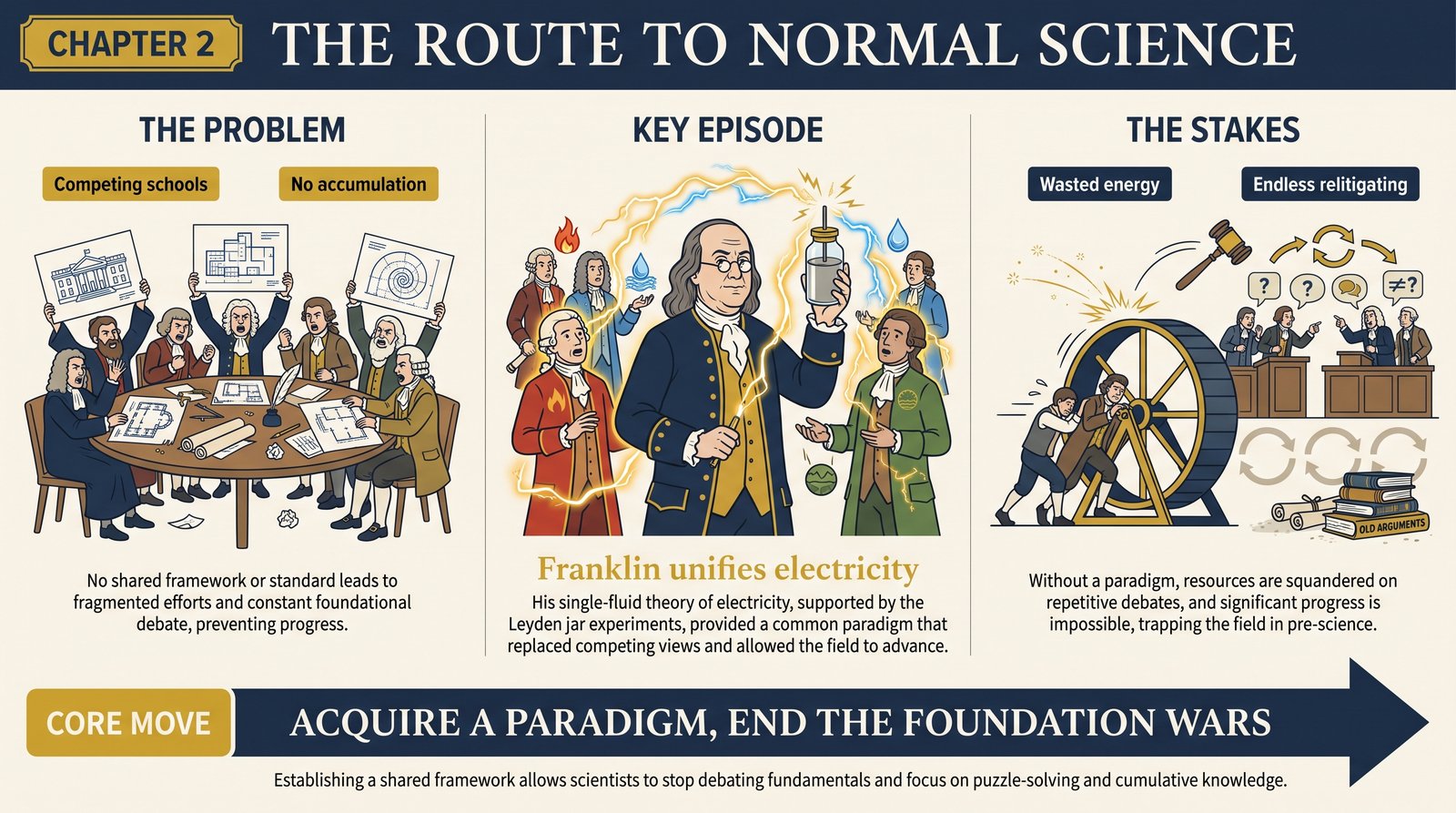
A field becomes a science when it acquires its first paradigm — an achievement so compelling that it draws practitioners away from competing schools and so open-ended that it leaves plenty of problems to solve. Before the paradigm: chaos of competing schools, each rebuilding foundations. After: a community that agrees on fundamentals and gets to work on details.
The Problem It Solves
Why do some fields (physics, chemistry) show rapid consolidated progress while others endlessly re-argue their foundations? Kuhn's answer isn't intelligence or method — it's paradigm acquisition. Pre-paradigm fields waste their energy on foundational debates; every author starts from scratch, addressing the general educated public rather than fellow specialists.
Key Episode
Optics before Newton. Epicureans, Aristotelians, and Platonists each had theories of light — light as particles, as modification of the medium, as interaction between medium and eye. All were scientific in method; none commanded the field. Newton's Opticks provided the first near-universal paradigm for physical optics. Similarly, electricity before Franklin was a babel of competing effluvium theories; Franklin's account of the Leyden jar unified the field.
The Shift
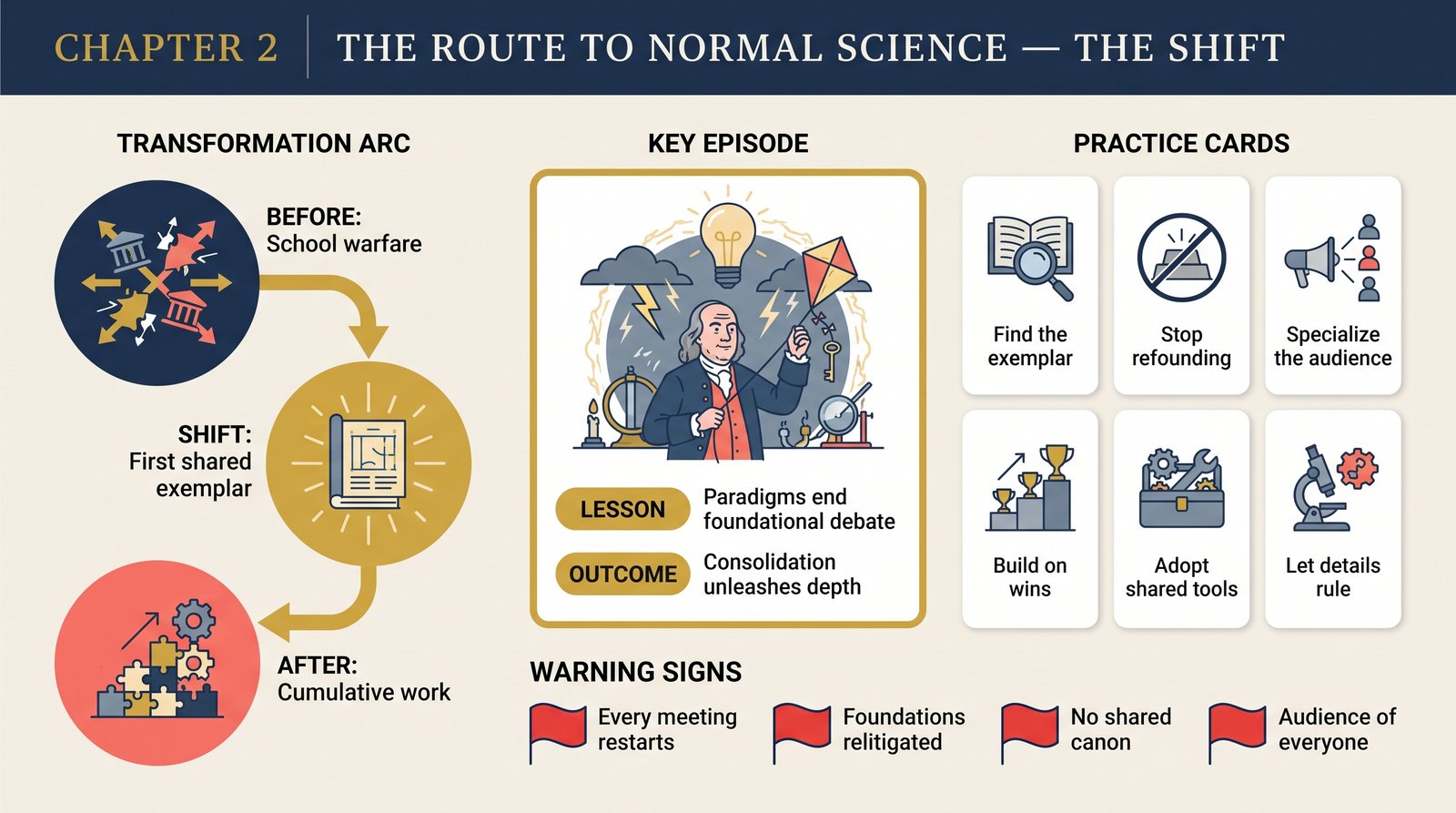
From school-versus-school debate to a shared foundation nobody has to re-defend. The signs of arrival: specialized journals, professional societies, textbooks replacing original works, and research reports that no layperson can read. Losing the general audience is, perversely, a sign of maturity.
Critiques & Rivals
Social scientists have argued their fields are multi-paradigm sciences rather than pre-paradigm ones. Kuhn's own criteria for "having a paradigm" were attacked as vague — Margaret Masterman famously counted 21 senses of the word in the book. The Postscript concedes and refines this.
Modern Application
Diagnose any field or organization: is it pre-paradigm (every meeting relitigates foundations) or paradigmatic (shared assumptions, cumulative work)? Startups often die in pre-paradigm mode — endless strategy debates, no accumulation. The first "good-enough exemplar" — a working product, a repeatable playbook — plays the role of paradigm: it ends foundational war and lets normal work begin.
Key Terms
- Paradigm — a concrete scientific achievement that supplies a community's models of problems and solutions
- Pre-paradigm period — competing schools, foundational debate, random fact-gathering
- Normal science — research firmly based upon a shared paradigm
Key Quotes
"To be accepted as a paradigm, a theory must seem better than its competitors, but it need not, and in fact never does, explain all the facts with which it can be confronted."
"In the absence of a paradigm... all of the facts that could possibly pertain to the development of a given science are likely to seem equally relevant."
Reflection Questions
- Which parts of your work are pre-paradigm — where does every discussion restart from foundations?
- What was the founding exemplar of your discipline or team, and what problems did it declare solvable?
- What did your field stop debating when it professionalized — and was anything valuable lost?
Connections
- The paradigm concept is deepened in The Priority of Paradigms
- What normal science does with the paradigm: next chapter