Chapter 14 — Why Are Flowers Beautiful?
Core Thesis
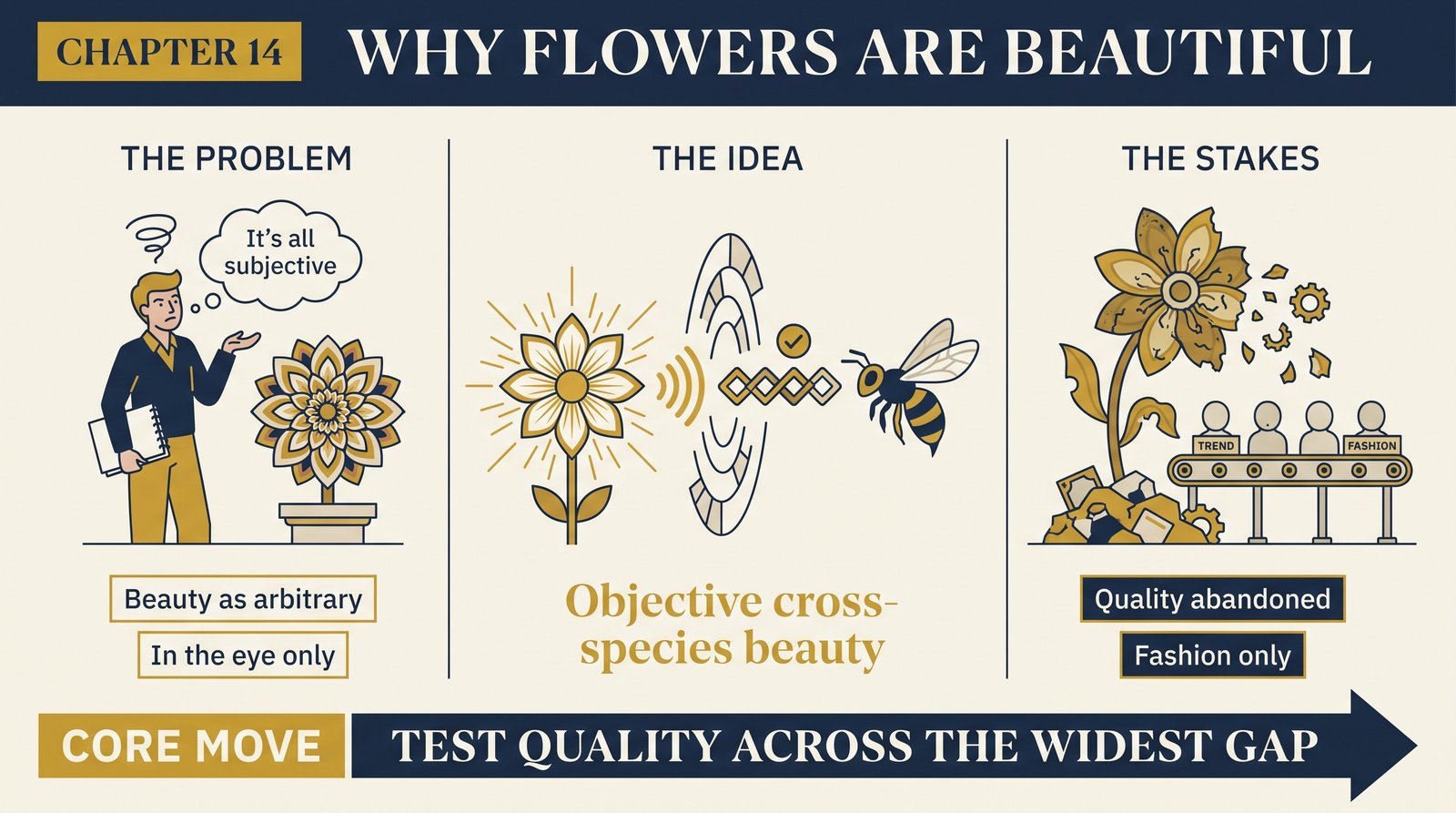
Some beauty is objective — not culturally arbitrary, not merely in the eye of the beholder. Deutsch's argument runs through flowers and their pollinators: a flower must signal reliably to insects across a species gap where no shared genes, and thus no shared code, can be assumed. To be recognized by a different species, the signal must embody criteria that neither party can cheaply fake — objective standards of attractiveness. Human attraction to flowers taps the same objective beauty, which is why it crosses cultures.
The Problem It Solves
The relativist default that all aesthetic value is convention or evolutionary happenstance ("we find flowers pretty because of arbitrary neural wiring"). Deutsch grants much beauty is parochial but denies the universal negative. The flower-pollinator channel is his existence-proof: here is a case where beauty had to be objective to function, demonstrating the category is real and leaving open how far it extends into art and human affairs.
Key Episode
The flower and the insect as two species solving a hard communication problem across an unbridgeable genetic gap. Camouflage and mimicry can exploit within-species channels cheaply; but a flower advertising to bees must hit criteria robust enough that a different kind of mind converges on "attractive" — hard-to-fake, hard-to-vary signaling. Deutsch links it to Chapter 10's theme: like meaning across minds, beauty across species must rest on objective, non-arbitrary standards to be reliably transmitted.
The Shift
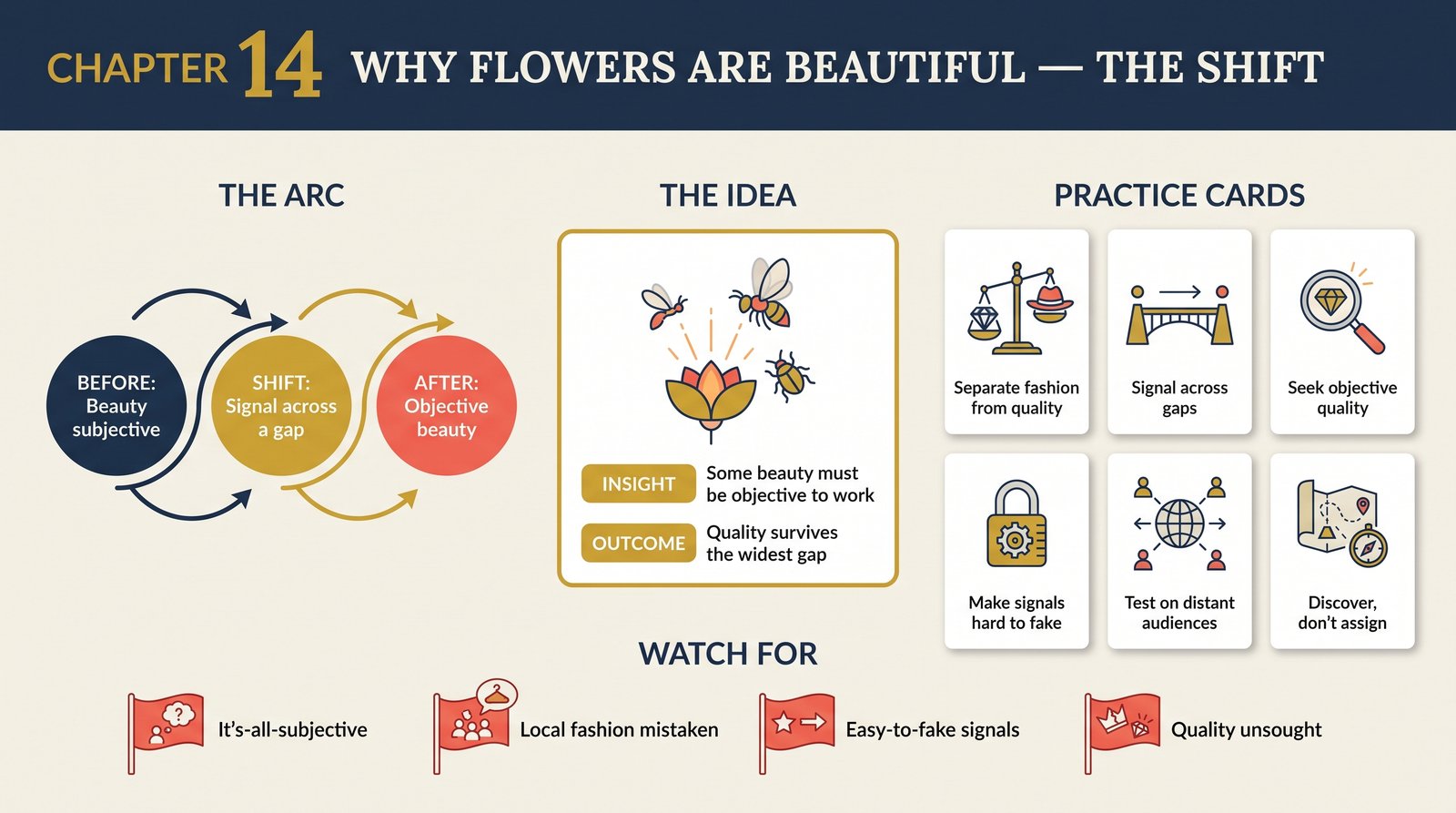
From beauty-as-subjective/parochial to beauty-as-(sometimes)-objective-knowledge: aesthetic criteria can be discovered, not just conventionally assigned, when they must bridge a gap that arbitrariness can't cross. This plants aesthetics in the same soil as the rest of the book — objective, improvable knowledge with reach — and suggests artistic progress (not just change) is possible.
Critiques & Rivals
Evolutionary aestheticians offer a deflationary rival: flower-love is a sensory-bias spandrel (we like the signals bees were tuned to), objective-looking but not objective value. Cultural relativists hold the line on art. Philosophers of aesthetics question the leap from "objective signaling criteria" to "objective beauty" — reliability isn't obviously value. Deutsch concedes the extent is open; the existence claim is the wedge.
Modern Application
Distinguish parochial appeal from objective quality in design and communication. When a signal must land across a gap — different culture, discipline, or species of user — the elements that survive that crossing are candidates for objective quality, not just taste. Practical heuristic: to find what's genuinely good (not merely locally fashionable) in a design, test it across the widest audience gap you can; what still works is closer to objective, hard-to-vary beauty.
Key Terms
- Objective beauty — non-arbitrary aesthetic standards, discoverable
- Cross-species signaling — beauty that must bridge a genetic gap
- Parochial vs universal appeal — local taste vs objective quality
Key Quotes
"Flowers have to create objective beauty, and to recognize objective beauty, in order to bridge the gap between species."
"There is such a thing as objective beauty, and... it is a form of knowledge."
Reflection Questions
- In your work, which appeal is parochial fashion and which survives crossing an audience gap?
- Where do you assume "it's all subjective" and thereby stop seeking objective quality?
- What signal do you send across a genuine gap — and is it hard to fake?
Connections
- Communication across minds: Chapter 10
- Objective knowledge with reach, extended to aesthetics: Chapter 1