Chapter 4 — Creation
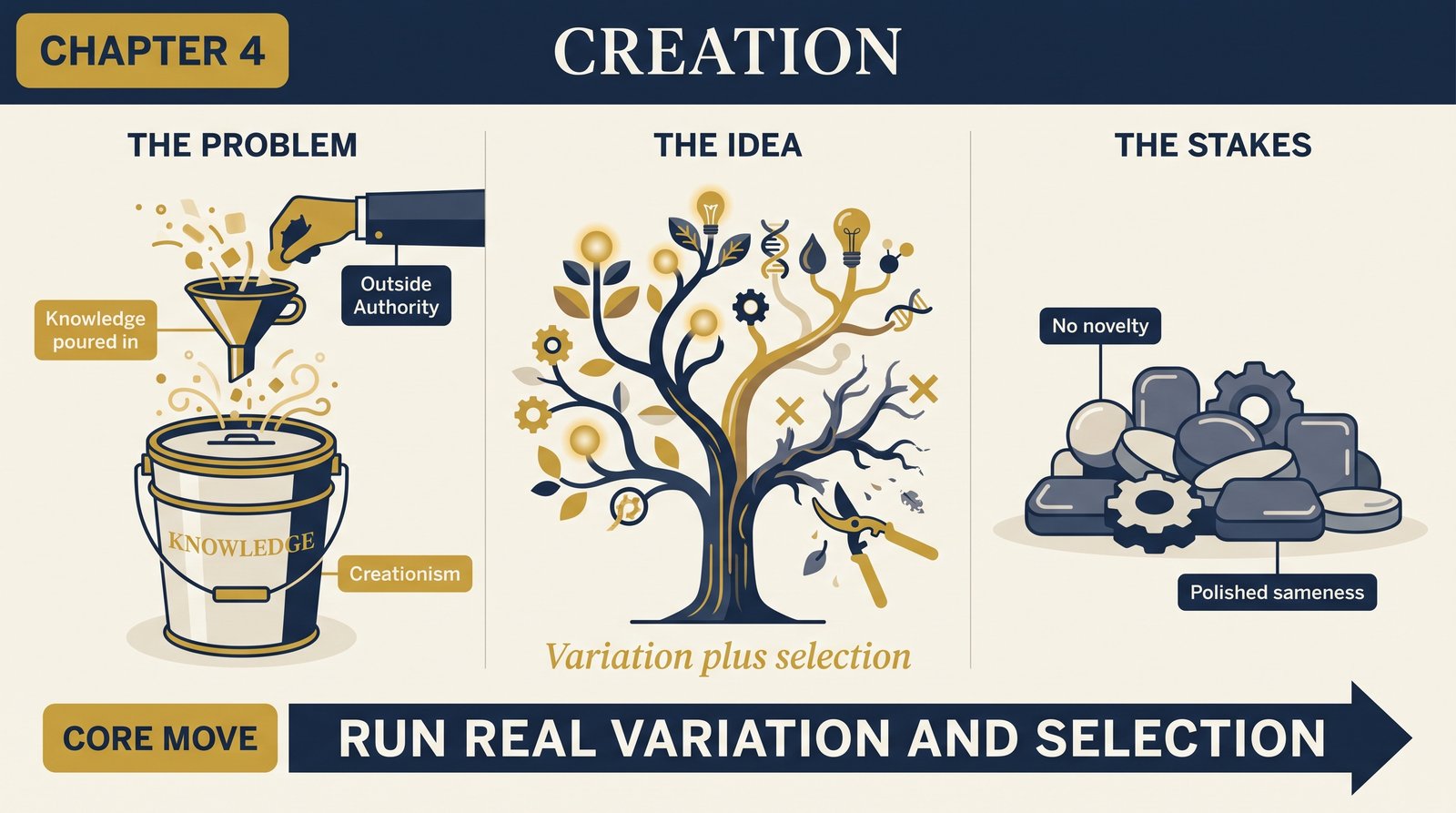
Core Thesis
Knowledge is created by one process only: variation and selection — conjecture and criticism. Biological evolution and human thought are the two known instances. Neither copies knowledge from anywhere: evolution doesn't learn from the environment, and minds don't derive ideas from the senses; both create knowledge that wasn't there, by generating variants and killing the failures. Creationism — knowledge poured in from an authority — is false everywhere it's proposed, including its secular forms.
The Problem It Solves
Where does the apparent design in organisms — and the genuine novelty in ideas — come from? Paley's watch argument had real force: complex adaptation demands explanation. Deutsch's telling makes Darwin's answer epistemological: evolution explains the origin of knowledge (in genes) without a knowing designer, just as Popper's epistemology explains discovery without infallible sources. Lamarckism, inductivism, and divine creation are the same error in three costumes: knowledge acquired by instruction from outside, rather than created by variation-selection within.
Key Episode
Paley's watch on the heath, given its full due — the finest wrong explanation of its century, hard to vary in every respect except the one that matters. Its overthrow: Darwin's population of replicators, varying blindly, filtered by survival. Deutsch sharpens with the modern gene-centric view (Dawkins): what evolves is knowledge in genes for causing their own replication — adaptations are the genes' survival strategies, not the species' welfare programs.
The Shift
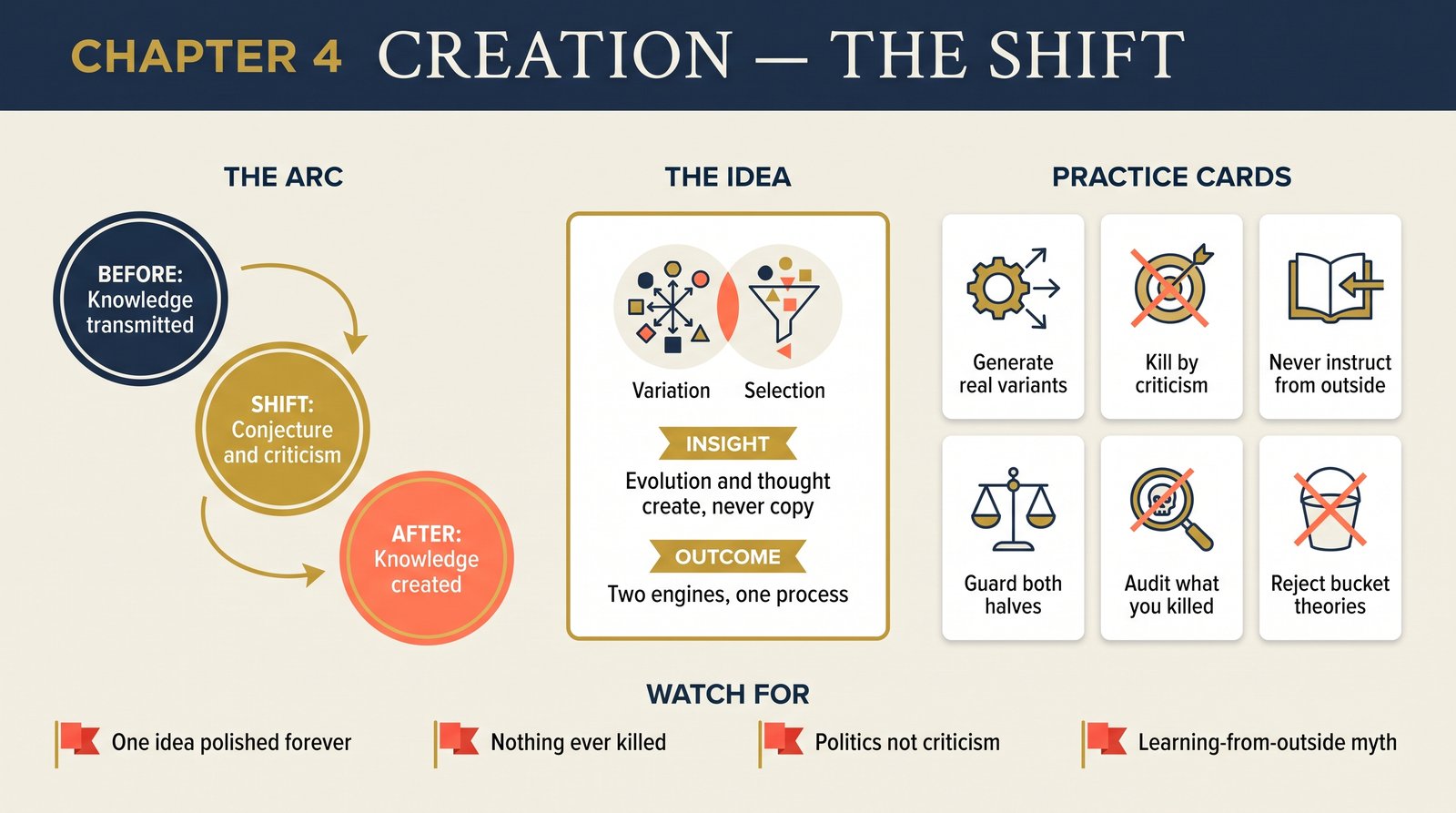
From knowledge-as-transferred to knowledge-as-created. The unification is the point: Neo-Darwinism and Popperian epistemology are the same theory at different substrates — replicators/variation/selection ≙ ideas/conjecture/criticism. Both refute every "bucket theory" of knowledge; both make creation ongoing, ordinary, and explicable.
Critiques & Rivals
Fine-tuning arguments relocate design one level up (constants of physics); Deutsch defers that to anthropic reasoning and multiverse cosmology. Lamarckian echoes recur in modern clothes (epigenetics hype); the core objection stands — acquired characteristics carry no tested knowledge. Critics of the evolution–epistemology analogy note thought is guided, not blind; Popperians reply: conjecture is indeed directed by problems, but its validity is still established only by selection.
Modern Application
Run creation processes honestly: brainstorms, product bets, research agendas are variation-selection engines, and starving either half kills them. No variation (one sanctioned idea, refined forever) = Lamarckism: polishing without novelty. No selection (every idea shipped, none killed) = no knowledge created. The practical audit: what did we generate this quarter, and what did we kill? Institutions that can't kill variants don't create knowledge; they accrete opinions.
Key Terms
- Neo-Darwinism — replicators + blind variation + selection
- Creationism (generalized) — knowledge from authority, in any costume
- Replicator — that which gets copied because of what it is
Key Quotes
"Like biological adaptations, human ideas are created by variation and selection... neither is derived from the environment."
"The knowledge in genes is knowledge of how to cause their own replication."
Reflection Questions
- Where is your organization Lamarckian — refining one anointed idea without generating rivals?
- What was actually killed in your last selection round — and by criticism or by politics?
- Which "learning from the market" narrative is really conjecture-and-selection wearing empiricist dress?
Connections
- The epistemology being unified: Chapter 1
- Culture as the same process on memes: Chapter 15